Religion as Social Force, 1989–2001
Subscribe
https://meridian-archive.com/feed.xmlOpen in your app, or paste the link above into any other:
The Emergency Line
In Borough Park, Williamsburg, and Crown Heights, a call to the city’s own 911 system could bring two ambulance corps instead of one: the Fire Department’s paramedics, and Hatzolah, an Orthodox Jewish volunteer ambulance service with its own radio dispatchers, its own uniformed crews, and its own chain of command, run alongside city emergency response as a matter of routine coordination rather than exception. City Hall’s political ledger in these neighborhoods — kept through a decade of reliable bloc voting in Borough Park and in Williamsburg’s 48th Assembly District — filed the arrangement next to yeshiva school-bus service funded in part through Title I and negotiated eruv boundaries strung along utility poles: ordinary line items of municipal accommodation, not scandals, not exceptions requiring a memo. The arrangement’s very ordinariness was the story. On the evening of August 19, 1991, when the lead car of the Lubavitcher Rebbe’s motorcade ran a red light at Utica Avenue and President Street and a following station wagon jumped the curb and struck two seven-year-old Guyanese-American cousins, killing Gavin Cato and seriously injuring Angela Cato, a Hatzolah ambulance already on the scene treated the Hasidic driver and passengers; the New York Police Department, by later account, had directed the Hatzolah crew to leave the children for the city’s own EMS, which arrived after. Whether the sequence was necessity or preference became, within three nights, a citywide riot’s founding grievance — but the sequence itself, a private religious ambulance corps working a fatal accident scene under police direction, had been routine for years before anyone outside Crown Heights had reason to notice it.
On the morning of Sunday, December 10, 1989, roughly four and a half thousand demonstrators from ACT UP and the Women’s Health Action and Mobilization filled Fifth Avenue outside St. Patrick’s Cathedral, and a few dozen more went inside to stop the 10:15 Mass. The protest — planned and named in advance as Stop the Church — was aimed at Cardinal John O’Connor’s public campaigns against condom distribution in the public schools, against needle exchange, and against abortion. Outside, the placards read “Curb your dogma” and “Papal Bull.” Inside, affinity-group members blew whistles, chained themselves to pews, threw condoms, and staged a die-in in the aisles; a demonstrator named Tom Keane took a consecrated host from a priest’s hand, crumbled it, and dropped the pieces to the floor. Police made 111 arrests, 53 of them inside the cathedral, carrying out on orange stretchers the protesters who refused to walk.1 The action led the network news in the United States and Western Europe and ran on the front pages of the Times, the Post, and the Daily News the next morning.
As spectacle, the action succeeded absolutely: no courthouse rally had ever forced the collision between the AIDS epidemic and the Catholic hierarchy onto the front page. As persuasion, it failed, and some of its own organizers — the filmmaker Maria Maggenti on later record among them — said so afterward — the desecration of the host split public sympathy, consolidated O’Connor’s constituency, and handed the Archdiocese a tone of measured grievance it drew on for years. ACT UP’s internal debate over whether the church action had been a tactical gift to its target ran long and never fully closed.2 The epidemic and the movement that fought it are chronicled elsewhere in this archive; what December 10 exposed was something narrower and stranger. The largest city in the country had spent the decade being described, by its own most prestigious print institutions, as a secular capital. One Sunday morning made the description look like a category error. Four and a half thousand people had just organized their rage around a cathedral, because the cathedral mattered.
The Catholic City
The Archdiocese of New York — Manhattan, the Bronx, Staten Island, and seven counties north — counted roughly 2.4 million Catholics in this period, making it the largest single religious institution in the city by headcount and by political weight. Its head from 1984 was John Joseph O’Connor: born 1920, a former Navy chaplain who had retired a rear admiral, created cardinal in 1985, and present on the local evening news at a frequency no other unelected New Yorker matched. His institutional positions were unyielding — against condoms in schools, against needle exchange, against safe-sex education that did not center abstinence — and those positions made him, to ACT UP and to most of the city’s editorial class, the epidemic’s most prominent institutional villain.
The personal practice ran in another direction, and the two facts have to be held at once. In November 1985, St. Clare’s Hospital on West 51st Street, an archdiocesan institution, opened a dedicated AIDS unit — among the first in the country, and the principal Catholic AIDS ward in Manhattan through the worst years of the epidemic. O’Connor visited regularly and set himself a private quota of direct care: by his own accounting he personally tended more than a thousand AIDS patients across St. Clare’s and St. Vincent’s in the West Village, emptying bedpans and washing sores.3 The man whose policies the activists on Fifth Avenue believed were killing them spent his Tuesday afternoons washing the bodies of dying men. The contradiction made him intolerable to both wings of the argument — too compassionate to caricature, too institutional to forgive — and the city’s magazines, which needed him to be one thing or the other, mostly wrote him as the other.
Mass-Catholic New York surfaced into visibility at intervals. On October 7, 1995, Pope John Paul II said Mass at Aqueduct Race Track in Queens before tens of thousands — a horse track filled with parish busloads, children in school uniforms, a Polish contingent from Greenpoint in red and white. The Manhattan press covered it as a politics-and-religion story; for the women of the parishes it was the most important day of the year, and the gap between those two readings was the decade’s religion coverage in miniature. O’Connor died of a brain tumor on May 3, 2000. His funeral at St. Patrick’s drew the President, the Vice President, both senators, the mayor, and a First Lady in mid-Senate-campaign. Edward Egan was installed that June; he was an administrator, and the office narrowed. No one after O’Connor could claim to speak for Catholic New York in a single voice.
Eastern Parkway
At 770 Eastern Parkway in Crown Heights, a neo-Gothic brick building acquired in 1940, sat the world headquarters of Chabad-Lubavitch and the study hall of Menachem Mendel Schneerson — “the Rebbe” — who had formally accepted leadership of the movement there in 1951 and never traveled outside New York after 1950. From that building he built a global apparatus of emissaries — shluchim — numbering in the thousands, with schools and outreach centers on every inhabited continent; he received senators and Israeli prime ministers; and every Sunday in his later years he stood for hours handing a dollar bill to each visitor in a line that stretched down Eastern Parkway, the dollar to be given onward to charity.4 The neighborhood core ran from Eastern Parkway south to Empire Boulevard, with Kingston Avenue as its commercial spine: kosher bakeries, Judaica shops, the mikvah, the small prayer rooms. The August 1991 riot that made Crown Heights a national word — the deaths, the trials, the political wreckage — is chronicled elsewhere in this archive; what the news frame never held was the religious drama running inside the community at the same time.
The drama was messianic. From the late 1980s a growing faction of Schneerson’s followers held that the Rebbe himself was the Messiah. He rebuked them repeatedly — in 1991 he suppressed a movement-journal article presenting him as the presumptive Messiah, reportedly protesting that its authors were “taking a knife to my heart,” and asked directly by an Israeli reporter whether he was the Messiah, he answered, “I am not.”5 A stroke in March 1992 took his speech; a second stroke followed in March 1994; he died at Beth Israel Medical Center on June 12, 1994, and was buried at the Ohel in Cambria Heights, Queens, a gravesite that drew tens of thousands of pilgrims a year for the rest of the decade. His death did not settle the question. It split the movement — between those who held that his messiahship continued and those who held it had never been — and at 770 the messianist chant of “Yechi Adoneinu” could be heard nightly, the words painted inside some of the building’s windows. In 1996 the Rabbinical Council of America resolved that Judaism held no place for belief in a Messiah who dies before completing his mission.5 The largest Jewish religious controversy of the American decade unfolded eight subway stops from every Manhattan masthead, and no general-interest magazine sent anyone.
116th Street and Lenox
The Nation of Islam’s historic base in New York stood at 102 West 116th Street at Lenox Avenue — the corner where Malcolm X had led Mosque No. 7 from 1954 to 1964, its successor building a converted department store under a green dome, formally the Sunni Masjid Malcolm Shabazz since the movement’s 1976 split, with Nation-affiliated activity running alongside through the whole period. In 1991 a young minister named Conrad Muhammad took over the Mosque No. 7 organization, rebuilt its congregation and school, was spoken of in the press as a possible heir to Louis Farrakhan, and cultivated the hip-hop world so assiduously that he came to be called the Hip-Hop Minister; he was stripped of the ministry in February 1997. The Nation’s street presence was the most visible religious commerce in Harlem: bow-tied young men outside the subway exits with the Final Call in one hand and foil-wrapped bean pies in the other, Fruit of Islam patrols walking the lobbies and stairwells of housing complexes that had hired them for security, storefront drug-rehabilitation programs that were often the only treatment available to men with no insurance.
On October 16, 1995, the Million Man March filled the Mall in Washington; buses left 125th Street and Frederick Douglass Boulevard at two in the morning. The Park Police estimated 400,000; the organizers claimed over a million; a Boston University remote-sensing analysis put the crowd near 837,000.6 Whatever the count, it was the largest Black religious-civic mobilization of the decade, and the city’s white-edited magazines could not properly cover it, because their writers did not personally know anyone going. The New Yorker solved the problem by sending Henry Louis Gates Jr., whose long, ambivalent profile of Farrakhan ran the following spring.7 Most outlets at that tier reported from the wires. On mastheads with large Jewish and Black contingents, the march was not an assignment but a litmus — a staffer who defended attendance against Farrakhan’s record of antisemitic statements was quietly read as taking a side, and a staffer who wrote the standard denunciation-with-qualifications was read as taking the other — and the safest editorial response to a litmus was distance.
The corner’s loudest neighbors were not the Nation’s men but the Black Hebrew Israelites — street preachers of the One West school, named for One West 125th Street, who held 125th and Lenox on Saturdays and Times Square on weekend evenings in robes and metallic breastplates styled on the Twelve Tribes, preaching from a King James Bible a doctrine that Black Americans were the literal Israelites and that white Jews were imposters. Their style grew more confrontational across the decade. In 1998 the Giuliani administration tried to ban their Times Square preaching under the quality-of-life agenda; the ACLU intervened, the city paid a $59,000 settlement, and the preaching resumed.8 They were everywhere visible and almost never written about, because every available angle — street religion, antisemitism, free speech, Black expression — was itself a political statement, and so no angle was taken.
The Black Church
What the phrase “the Black church” flattened was an ecology. Baptist congregations — Abyssinian on West 138th Street, Concord and Bethany in Bedford-Stuyvesant, Mt. Olivet on Lenox — formed the largest tradition; the African Methodist Episcopal churches, anchored by Mother AME Zion on West 137th, founded 1796 and the oldest Black congregation in the state, carried the older free-Black history and much of the civil-rights infrastructure; the Pentecostal and Church of God in Christ wing, with Greater Allen Cathedral in Jamaica, Queens at its head, grew fastest; and beneath the named institutions ran hundreds of single-pastor storefront Holiness churches across Harlem, Bedford-Stuyvesant, East New York, and the South Bronx. The most visible pulpit belonged to Abyssinian, where Calvin O. Butts III became senior pastor in 1989 and founded, that same year, the Abyssinian Development Corporation, which grew into one of the largest Black-led housing developers in the country; his 1990 campaign against malt-liquor and tobacco advertising in Harlem was conducted with paint rollers, whitewashing the billboards himself.9
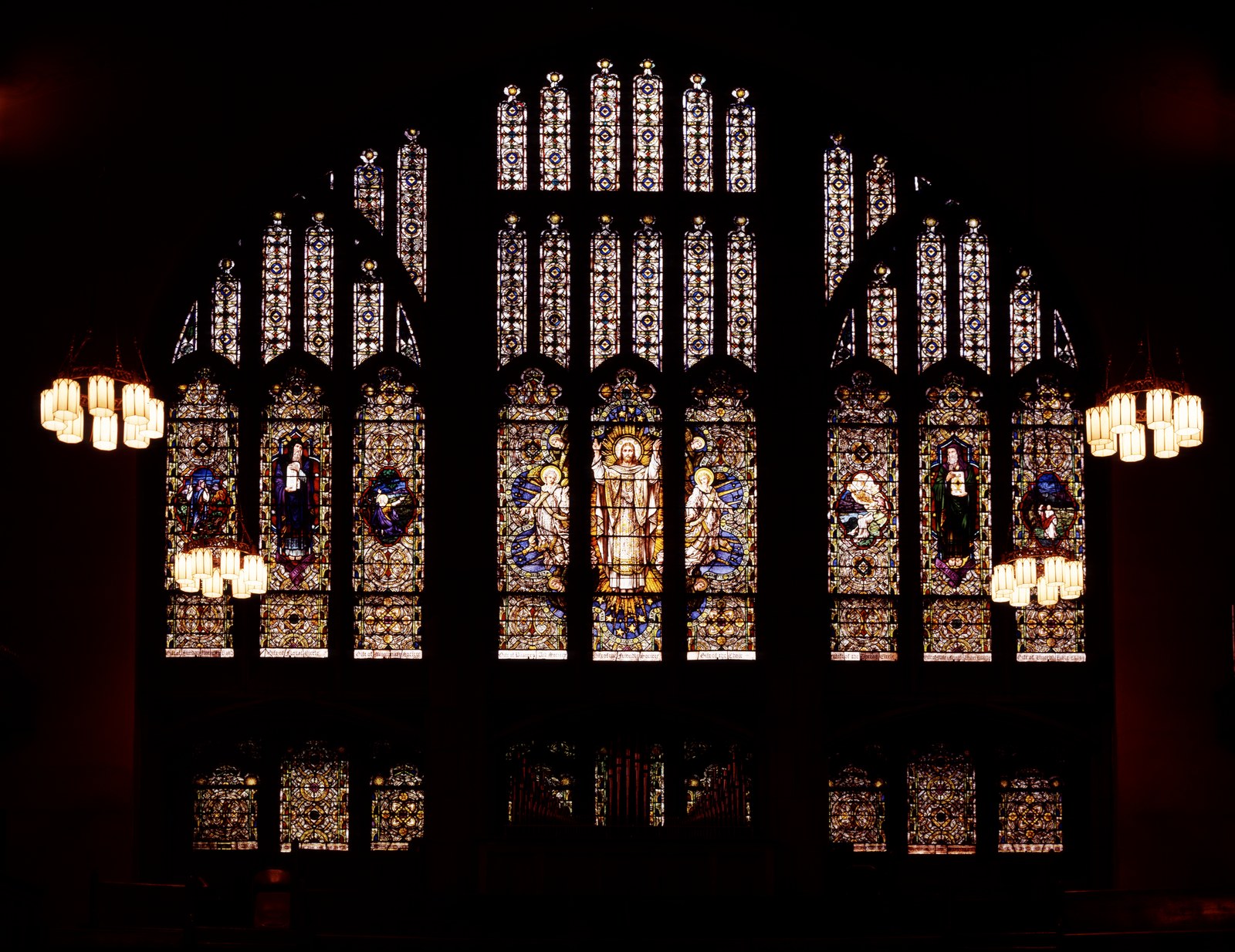
A Sunday morning in a Bronx Baptist church in 1992 ran from 10:45 to well past one: Hammond B-3 organ on stage right, drum kit center back, a robed choir of thirty to sixty voices in wine-red with gold collars, processional and devotion and two choir selections built to repeat and climb, hand-claps on the two and the four, the front pews held by ushers in white uniforms and white gloves, fanning themselves with cardboard fans printed with the name of a local funeral home. The service was the week’s social infrastructure as much as its liturgy — food pantry, eldercare, the reading of the sick list — in congregations that functioned as the neighborhood institutions of record.
The epidemic tested that infrastructure and found it slow. Through the 1980s the Black church was widely criticized, from inside Black Protestantism as much as outside, for silence on AIDS — the disease’s association with homosexuality collided with pulpit teaching, even from pulpits occupied by gay men, which was not rare. The pivot began in Harlem in 1989, when an immunologist named Pernessa Seele convened the first Harlem Week of Prayer for the Healing of AIDS out of Harlem Hospital; by mid-decade her organization, The Balm in Gilead, was coordinating weeks of prayer in hundreds of Black congregations nationally, and pastors of Butts’s stature had moved to open advocacy.10 The change was audible at pew level in the smallest unit of language: households where the disease had been the sickness for a decade began, around the middle 1990s, to hear the word said plainly from the pulpit.
The Growth Front
The fastest-growing religious institutions in 1990s New York were the ones no Manhattan editor had ever entered. In Flushing, whose residential succession is treated elsewhere in this archive, the Korean immigrant community had built by the late 1990s roughly 140 churches and ministries within one community district — Presbyterian-dominant, with Methodist, Baptist, and Pentecostal congregations alongside — serving a population in which an estimated seven or eight of every ten Korean Americans attended a Korean church, among the highest attendance rates of any immigrant group in the country.11 The churches ran double liturgies — a Korean-language service for the first generation, an English Ministry for the second — and their weekly rhythm started before the city’s: saebyeok gido, dawn prayer, six mornings a week.
The Spanish-speaking Pentecostal world was older than its 1990s visibility — its institutional roots ran to Puerto Rican evangelists organizing in Manhattan in the late 1930s — but its growth front in this decade was the South Bronx, East Harlem, and Bushwick: congregations of sixty to a hundred and twenty in folding chairs behind plate-glass storefronts painted Iglesia Pentecostal in white block letters, on Fordham Road, Southern Boulevard, Westchester Avenue, Knickerbocker Avenue. Services ran Sunday night from seven until ten or eleven, in Spanish, with drums and bass and a tambourine line, with speaking in tongues and anointing with oil; the pastor was typically bivocational, driving a livery cab or working construction through the week. By the mid-1990s these congregations plausibly held on the order of a hundred thousand active worshippers. No major Manhattan magazine covered them in the decade — not badly; not at all.
A third front arrived from the collapsed Soviet Union. The refugee wave of the 1990s brought roughly 200,000 Russian-speaking Jews to the city and its edges, concentrating along Brighton Beach Avenue under the elevated line — a community observant in Soviet terms, Friday candles and Yom Kippur, largely unfamiliar with normative American synagogue Judaism, its religion folded inside its cultural life. Among the non-Jewish Russians and Ukrainians settling in Rego Park, Bensonhurst, and Sheepshead Bay, Russian Orthodox parish life revived — four-hour vigils in Old Church Slavonic, incense, an iconography the editorial class knew only from Tarkovsky — in congregations split between the old émigré Church Outside Russia and the Moscow Patriarchate, a schism of the 1920s suddenly renegotiating itself in Brooklyn because the state that caused it had ceased to exist.
The Court and the Storefront
The decade’s most consequential religion case in American law was argued about chickens. The Church of the Lukumi Babalu Aye, a Santería congregation in Hialeah, Florida, had announced public worship — including the animal sacrifice integral to the rite — in 1987; the city council answered with emergency ordinances criminalizing “ritualistic” animal killing. On June 11, 1993, the Supreme Court struck the ordinances down 9–0: they were neither neutral nor generally applicable, pursued the city’s stated interests only against religiously motivated conduct, and therefore failed the Free Exercise Clause.12 After Employment Division v. Smith had narrowed free-exercise protection three years earlier, Lukumi fixed the surviving rule — a law targeting a specific religion must survive strict scrutiny.13 For New York, which had its own slaughter ordinances and boroughs full of practitioners, the ruling settled in advance a case that would otherwise have arrived in Brooklyn or the Bronx.
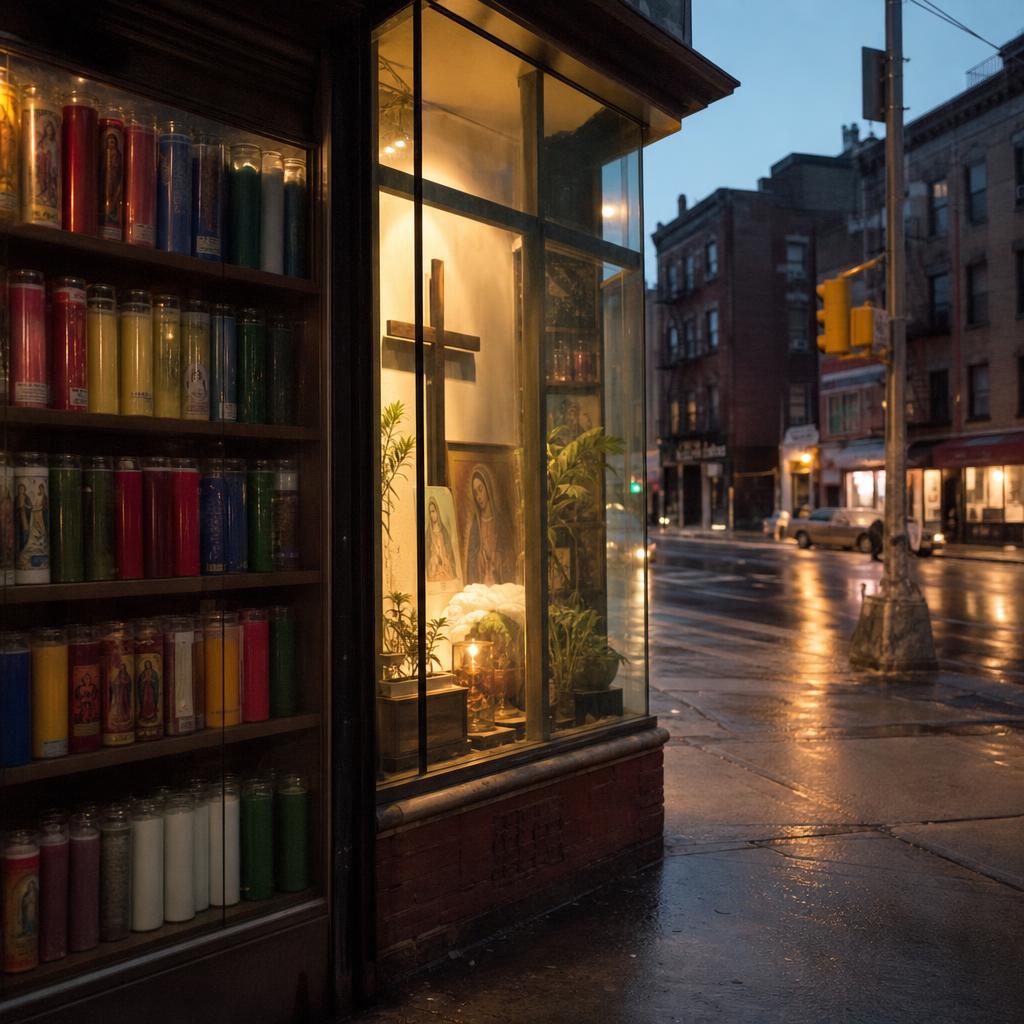
Santería — Lukumí, Regla de Ocha — had come to the city with Cuban migration after 1959 and spread through Puerto Rican and Dominican practice; by the early 1990s the city likely held tens of thousands of practitioners, though the religion was initiation-based and no census counted it. Its visible commerce was the botánica: the storefront religious-supply shop of Spanish Harlem, Washington Heights, the Bronx, and the Knickerbocker Avenue corridor, serving Santería and the overlapping traditions of Espiritismo, Palo, and Vodou. The largest, Original Products on Webster Avenue in the Bronx, family-run since 1959, had grown to superstore scale with a mail-order catalog.14 For most Manhattan editors, the June 1993 decision was the first notice that the shop between the subway and the office was the retail front of a religion with First Amendment standing, and not a folkloric curiosity awaiting Sunday-magazine treatment.
The Page and the Pew
The intellectual event of the decade in American religion took place in New York, at magazine length. In March 1990 Richard John Neuhaus — a Lutheran pastor with a Brooklyn parish history, whose 1984 book The Naked Public Square had argued that American democracy could not sustain itself on a public square scrubbed of religious argument — launched the monthly journal First Things from an office on lower Fifth Avenue.15 That September he was received into the Catholic Church; a year later he was ordained a priest.16 The journal engaged Rawls and Dworkin at full seriousness, opposed Roe, and assembled the most intellectually formidable religious conservatism in the country — until November 1996, when its symposium “The End of Democracy?” asked whether the federal judiciary had rendered the American regime illegitimate, and split the conservative intellectual world itself, costing the journal several of its most distinguished allies.17 Around it stood the older institutions of the city’s religious-intellectual right: Commentary at the American Jewish Committee, National Review on Lexington Avenue — the magazines the secular mastheads mocked and read. The Christian Coalition, founded in 1989 out of Pat Robertson’s presidential run and claiming 1.7 million members at its mid-decade peak, had almost no New York organization; its local force was cultural pressure, felt in the city mainly as a subject to be explained to readers who would never meet a member.
The dismissal of this world as “the religious right” was a category error a writer could commit in copy and discover only at the edit — if the editor knew enough to catch it. Neuhaus was not a televangelist; he was a public theologian conducting, in a Manhattan monthly, the most sustained argument of the decade about the terms on which religious citizens could enter public life. The mastheads that took First Things seriously argued with it well. The ones that did not covered a caricature, and their readers learned nothing.
The Secular Floor
The theory underneath the mastheads’ inattention had a name: secularization. The sociological consensus of the postwar decades held that modernity eroded religion as a matter of course — that the more modern a society became, the less it would believe. By decade’s end the theory’s own architects had abandoned it. Peter Berger, who had done as much as any sociologist to build the secularization thesis in the 1960s, published its recantation in 1999: the world, he wrote, was as furiously religious as it ever was, and the assumption that it was secularizing had been falsified nearly everywhere — everywhere, he noted, except in one thin stratum, an internationalized intelligentsia of Western-educated academics and journalists, who had mistaken their own subculture for the direction of history.18 The exception described a Manhattan editorial floor with precision. A general-interest masthead of the early 1990s was overwhelmingly non-attending — secular Jewish, lapsed mainline Protestant, lapsed Catholic, with practicing believers of any tradition in the single digits — and from that demography flowed the coverage rules, never written down: religion was a story when it intersected power; a sidebar at the holidays; a curiosity in travel writing; and otherwise off-stage.
What the frame could not see was the city it sat in. Roughly 140 Korean congregations in one Queens district; the fastest-growing churches in the Bronx meeting behind painted glass; the messianic split in the city’s most globally consequential Jewish movement; the botánica economy; the actual content of First Things; the women in headscarves on the elevated lines who outnumbered the editors. The best-documented failure was comparative: The New Yorker of the 1990s, the closest analog to the city’s other prestige monthlies, produced religion coverage that was thin and, when it appeared, excellent — Gates on Farrakhan, occasional Hasidim reportage — while patient long-form religion as a standing beat existed at no major general-interest magazine in the city. The secularization thesis was collapsing in the seminar rooms while its assumptions still ran the story lists. Theory had already conceded what the assignment desks had not.
The city’s religious life in these years was not a survival or a remnant; it was infrastructure, growing fastest exactly where the prestige press looked least. The cathedral could put four and a half thousand protesters on Fifth Avenue because it still governed real questions of life and death; the storefront church could fill folding chairs on a Sunday night because it was the only institution on the block that had not left; the dawn prayer in Flushing and the chant at 770 and the candle counter on Webster Avenue were each the working center of a world with its own press, its own economy, its own law now confirmed at the Supreme Court. The one theory the editorial class held about all of this — that modernity was dissolving it — was surrendered by its own authors before the decade ended. The believing city had never been a leftover from the past. It was one of the largest facts of the present, waiting on every corner for the people paid to describe the city to notice what the city was made of.
Meridian would have taken First Things’s launch as far as a call to Neuhaus’s office and no further. The journal would have surfaced from lower Fifth Avenue in March 1990, and an editor would have found it serious enough to raise at the table — and would have watched it die there, on the oldest doubt the room kept: whether the front of the book could be trusted to want an argument pitched at this register. Reader-flattery doubt, not merit, would have closed the file.
The Supreme Court’s ruling in the Hialeah case would have reached the room as law before ever reaching it as religion, and would have gone into The Essay that September as an argument about the Free Exercise Clause’s recovery after Smith. Santería itself, and the botánica economy the ruling implicated, would have been folded into a single illustrative paragraph. The wider subject, the room would have judged, could not have been written in the house’s own voice; the register would have been the trouble, not the story.
The Rebbe’s death at Beth Israel that June, and the messianic split it opened at 770, would have circulated the room as talk and nothing further — would have been repeated at the coffee machine and dropped there, because no peg would have presented itself to a monthly already built to run behind such a story by its own calendar. Nothing about the schism would have offered a date the magazine could print against; that absence would have been the whole of the objection.
October’s march on Washington would have been claimed for The Essay, an editor arguing Farrakhan and the politics of Black nationalism at a critical remove. The doubt over whether such a piece served the readership it argued for — the same doubt that had closed Neuhaus’s file in March — would have decided the shape of it: no correspondent would have been assigned to the buses leaving 125th Street at two in the morning, nor to the crowd gathered on the Mall itself.
Footnotes
-
Jason DeParle, “111 Held in St. Patrick’s AIDS Protest,” New York Times, December 11, 1989. ↩
-
ACT UP Oral History Project (actuporalhistory.org), interviews concerning the December 10, 1989 St. Patrick’s action; several participants record the post-action debate over the desecration’s tactical cost. ↩
-
“Eulogy: John Cardinal O’Connor,” Time, May 2000. ↩
-
Sue Fishkoff, The Rebbe’s Army: Inside the World of Chabad-Lubavitch (Schocken, 2003). ↩
-
David Berger, The Rebbe, the Messiah, and the Scandal of Orthodox Indifference (Littman Library of Jewish Civilization, 2001). ↩ ↩2
-
Boston University Center for Remote Sensing, crowd-size analysis of the Million Man March, released October 1995 (estimate of roughly 837,000, with a stated margin of error near 20 percent). ↩
-
Henry Louis Gates Jr., “The Charmer,” The New Yorker, April 29, 1996. ↩
-
“Black Hebrew Israelites: New York’s Most Obnoxious Prophets,” Village Voice, March 30, 2011. ↩
-
Abyssinian Baptist Church, “History” (abyssinian.org); the 1989 pastorate, the founding of the Abyssinian Development Corporation, and the 1990 billboard campaign are matters of institutional record. ↩
-
This Far by Faith (PBS/Blackside, 2003), companion material on the Black church and HIV/AIDS, including the 1989 Harlem Week of Prayer and The Balm in Gilead. ↩
-
Tony Carnes and Anna Karpathakis, eds., New York Glory: Religions in the City (New York University Press, 2001). ↩
-
Church of the Lukumi Babalu Aye v. City of Hialeah, 508 U.S. 520 (1993). ↩
-
Employment Division v. Smith, 494 U.S. 872 (1990). ↩
-
Original Products Botanica, company history (originalbotanica.com); founded 1959, Webster Avenue, Bronx. ↩
-
Richard John Neuhaus, The Naked Public Square: Religion and Democracy in America (Eerdmans, 1984). ↩
-
Randy Boyagoda, Richard John Neuhaus: A Life in the Public Square (Image, 2015). ↩
-
“The End of Democracy? The Judicial Usurpation of Politics,” First Things, November 1996. ↩
-
Peter L. Berger, ed., The Desecularization of the World: Resurgent Religion and World Politics (Ethics and Public Policy Center / Eerdmans, 1999). ↩