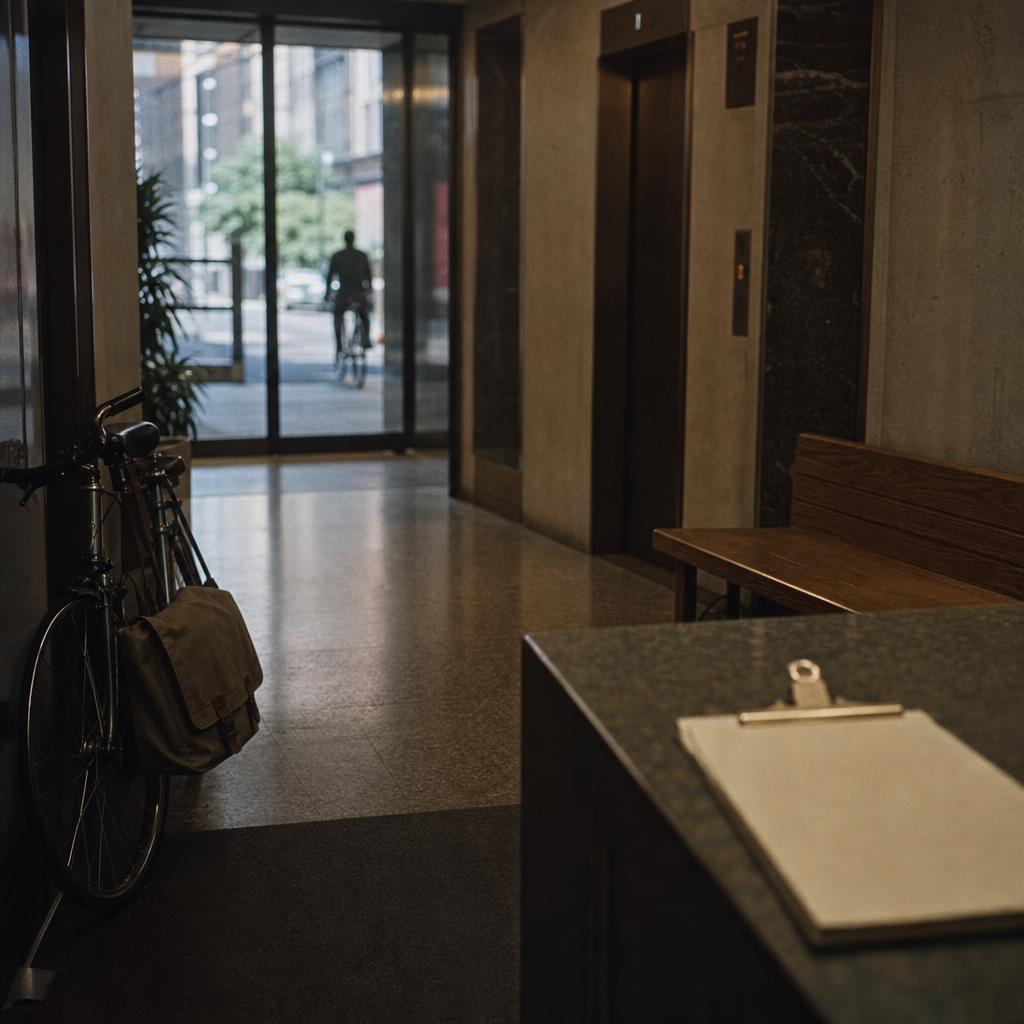
The Bike Messenger
Subscribe
https://meridian-archive.com/feed.xmlOpen in your app, or paste the link above into any other:
The Trade
At every prestige magazine in Midtown, the only sanctioned point of contact between the messenger and the institution he served was a manifest clipboard, and the clipboard was built to guarantee the two parties never learned each other’s names. The messenger presented it across the reception counter; the receptionist initialed or stamped the line; the messenger waited, forty seconds, sixty, while the time-in was recorded on a carbonless tear-off sheet, then left. The managing editor did not know the messenger’s name. The messenger did not know the editor’s. The envelopes moved between them like water moving between vessels, and the routine — clipboard, stamp, time-in, exit — was administered identically at reception desks across the district, a standard procedure rather than an oversight, for as long as either party held the job.
What passed through that routine was not interchangeable with what a fax line could carry. Through the 1980s and into the middle of the following decade, the objects that mattered most to magazine production — corrected transparencies, Cibachrome prints, paste-up boards, signed contracts, color proofs marked by hand — were either too large for the wire, too fragile for the overnight courier’s standard tier, or too time-sensitive for either. A 4×5 chrome at production resolution was tens of megabytes; a 28.8K modem in 1994 would have needed the better part of a day per file. A fax rendered a photograph into something that resembled a photograph only in the way that a pencil rubbing resembles a coin. The body was faster than any wire available — the messenger described as “the thread that connected people and facilitated commerce.” It would remain faster until the wire caught up.
The economic logic of this was piecework. A single drop paid somewhere between two and six dollars through the late 1980s; rates moved modestly upward as the decade turned. A working messenger grinding the four-hour close-of-business window — when every galley, every chrome, every executed contract needed to be somewhere it was not — could clear a low five-figure annual gross without benefits, without sick pay, and without the kind of fixed schedule that would have cost a firm a salaried employee’s overhead. Hiring was constant and turnover was high. The trade absorbed recent arrivals from other countries, art-school students who had stopped attending, ex-couriers from Chicago and Boston, and a persistent category of young man for whom movement through the city was itself the point. What the work rewarded was the grid: the building numbers on the avenues, the alternating one-way directions, the locations of the freight elevators, the names of the receptionists who moved fastest at the stamp. New York had more geography to hold in one’s head than any other city in the trade, and the men and women who held it well could earn the difference between a moderate living and a poor one.
The Peak
In the years between roughly 1989 and 1995, the trade operated at something close to its fullest extent. Trade-press estimates in the early 1990s put New York’s working messenger population in the low thousands; those numbers were never counted precisely, and they were already moving by the time anyone reported them. In 1992 Bill Goodman of the Association of Messenger Services told a reporter that more than 20 percent of New York City’s 305 messenger companies had closed during the prior two years.1 The contraction was visible in the trade’s own associations before the general public registered it.
What kept the trade alive through the apparent contraction was the fact of the irreducible object. Until the second half of the decade, a corrected chrome from a photographer’s studio could not reach a magazine’s art department in any other form. The file did not yet travel. The dispatcher held the city in his head — a wall of pager numbers, a clipboard map of the avenues, a CB-style radio handset, a phone ringing every ninety seconds in the afternoon window — and routed the bodies through it the way an air traffic controller routes aircraft: by holding the positions in simultaneous awareness and adjusting continuously. The dispatcher’s knowledge was not written down anywhere. It ended when he left. The same held for the rider: the intimate knowledge of the grid on which a messenger’s earnings depended lived nowhere but in the body that carried it, and the piecework rate that rewarded that knowledge also enforced the perennially hurried state the trade was known for — every minute between drops was a minute unpaid.
The subculture the trade generated was, by various accounts, distinctive and largely self-contained. Alleycat races on weekends routed through Manhattan and Brooklyn; the residential geography was the East Village and the stretches of lower Williamsburg that the art-school population had begun to colonize. The pay was piecework and the hours were irregular, which meant the social life concentrated in the evenings, and the evenings ended at bars. The risk was structural. By various accounts, the trade’s injury rate ran among the highest of any common urban occupation in the period — the conflict surface was everything the city offered: cab doors opening without signal, pedestrians stepping off the curb against the light, delivery trucks reversing into the lane the messenger had already committed to. The work was faster than the traffic, and faster than the traffic meant closer to the moment the traffic stopped being predictable.
At most midtown prestige buildings, a wooden or steel bench sat by the elevators for messengers waiting on signatures, or waiting while the photo department sent someone down. By the mid-1990s the bench at a busy building was full from two in the afternoon until six.
The Cliff
The first category to disappear was the internal memo. By 1997, corporate email through Outlook 97 and the maturing AOL business accounts had made the envelope of internal correspondence — memos, small attachments, documents under a megabyte — redundant. The hand-delivered internal envelope evaporated so quickly that most production departments could not have said exactly when they had stopped sending them out.
The image took longer. By 1995, Iomega had brought the Zip drive to market at a hundred megabytes per cartridge, and the Jaz drive at a gigabyte; production departments began to standardize on the cartridges almost immediately for the category of delivery where physical media was more practical than a messenger and faster than overnight courier. A photographer’s studio could ship a Zip cartridge by FedEx for a fraction of the cost of a same-day messenger run, and the cartridge arrived the next morning at the art department’s door with the file intact and uninterpreted. The chrome messenger run did not die in a single month; it thinned, drop by drop, as studios converted.
Private FTP servers arrived for the high-end relationships between 1997 and 1999. A magazine production department that maintained a standing relationship with a major photographer’s studio could, by 1998, route color proofs and corrected chromes through a dedicated server at 128 kilobits per second on an ISDN circuit. The file moved overnight; the body did not move at all. The production department’s budget reflected this with a specificity the production manager could not ignore: the line for messenger services fell sharply in 1998 and fell harder in 1999, while the line for dedicated digital connectivity rose to replace it. The math was clear before the cause was.
The federal labor bureau counted roughly a hundred and twenty thousand couriers and messengers in the national workforce at the end of the decade. By two decades later, the figure had fallen by roughly a third. What remained on the manifest after 1999 was a narrower set of objects: signed contracts where a wet signature was still legally required, the actual chrome where a photographer or a particular art director insisted on the original, the rare delivery to a small firm that had not yet invested in the infrastructure to receive a file. The busy afternoon became four drops, then two, then the occasional single envelope that arrived on a Tuesday and felt like a footnote to a practice that had already ended.
John Harris’s photographic project Still Passing By, completed in 1999, documented forty cyclists killed in New York City traffic that year — a record figure that coincided exactly with the economic collapse of the trade.2 The coincidence does not establish causation, only adjacency. The numbers sat next to each other without explanation.
For roughly a decade, every issue of every prestige monthly depended on legs and pedals as much as it depended on pencils and proofs. The body in the city was not a workaround or a stopgap; it was the infrastructure, the final physical layer of an editorial economy that could not yet send a corrected image across a wire at any useful speed. The messenger trade at its peak was not particularly legible from the editorial floor — the envelopes arrived at the reception desk, were stamped and signed for, and moved on; the body that brought them was already gone. When the wire became fast enough to carry the image, the budget line for messenger services fell by half within eighteen months, and then kept falling. What vanished was not noticed in proportion to what it had been. The editorial floor had treated its own connective tissue as weather — reliable, seasonal, not requiring thought. When the weather changed, the building was quieter. No one above the sixth floor read the quiet as loss.
The harder version of the messenger story — who these people were, where they lived, what a trade running injury rates by various accounts above most common urban occupations owed them in exchange for carrying nothing — would have died at the water cooler in 1994 before it reached an editor’s desk in any form a memo could capture. No beat at Meridian would have touched courier labor; no association, no filing, no agency would have kept the injury numbers a piece of that weight would have needed to stand on. There would have been no door for a reporter to knock on and no record for the checking desk to call, only a hundred dispatchers’ logbooks in a hundred basement offices, none of them obliged to open to anyone.
What would have run instead, in The City that August, was the piece the trade could actually supply: a profile built around one working rider, the manifest, the bag, the lock, the particular knowledge of the grid that made one messenger worth more to a dispatcher than another. Meridian would have had the appetite for craft treated as subject — the bicycle as the last purely analog tool left in a production economy already converting to the digital, the rider’s expertise geographic and physical rather than credentialed. The photographs would have carried the piece as much as the reporting would have.
The collapse would have reached The Front by early 1999, once the invoices would have made the argument the reporting would never have needed to make: the messenger-service line falling by half between October 1998 and June 1999, the corresponding ISDN-circuit line rising to take its place. A trade note, not a eulogy — Zip drives, email attachments, a wire finally fast enough to carry what the body used to carry.
The Back would have carried John Harris’s Still Passing By in November 1999, forty cyclists dead in the year’s traffic set against a photographer’s own account of watching the trade empty out around him. The review would have named the coincidence — the year of the highest recorded deaths meeting the year of the trade’s steepest collapse — and would have stopped there, without claiming the one had caused the other.