The Sensory Office: HVAC, Light, Sound, Smell
Subscribe
https://meridian-archive.com/feed.xmlOpen in your app, or paste the link above into any other:
The Room’s Two Whooshes
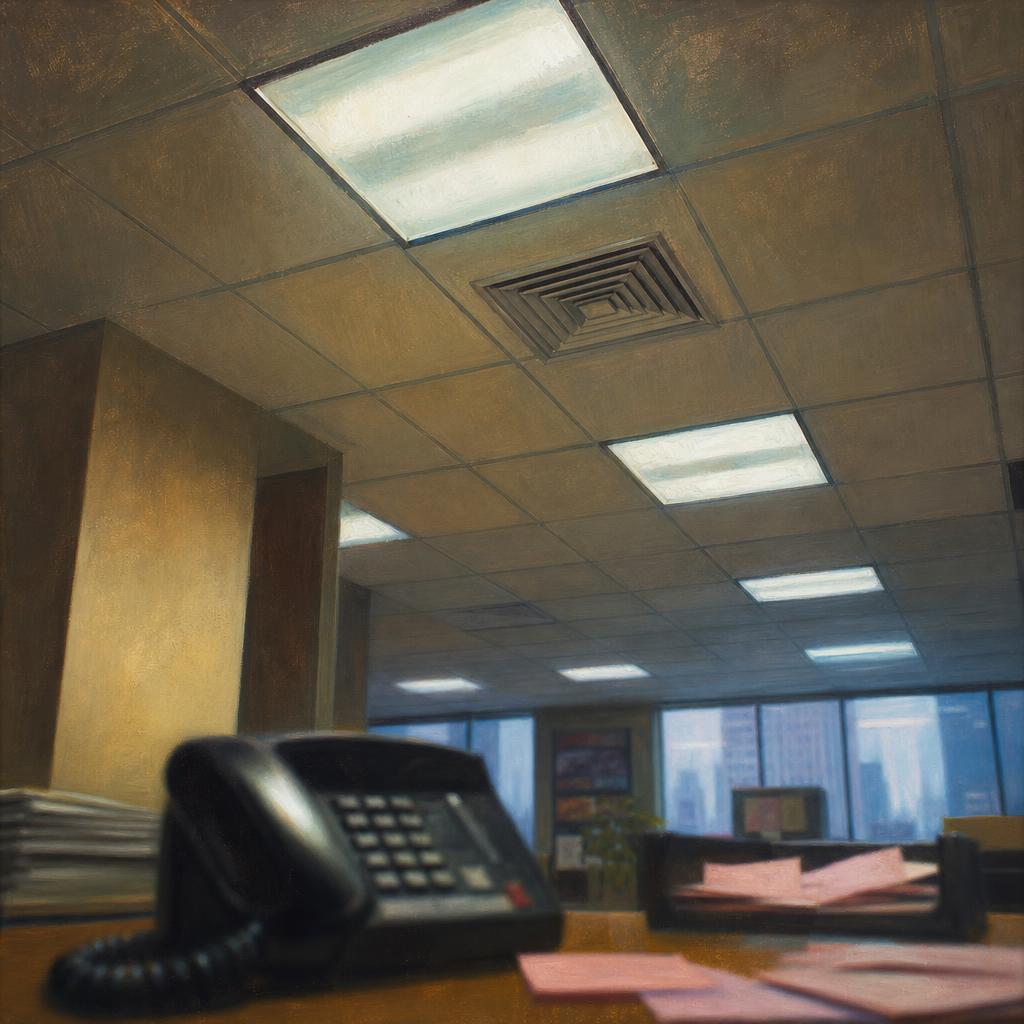
A magazine’s editorial floor in November 1989 sat inside a background noise level that a national engineering standard had set for a specific, stated purpose: covering the sound of one colleague talking to another. The American Society of Heating, Refrigerating and Air-Conditioning Engineers set its era’s target for open-office background noise at NC 35 to 40, roughly 40 to 45 decibels, and its own handbook gave the reason in plain terms — loud enough to mask a private conversation two desks away, quiet enough that no one filed a complaint about it.1 No memo on the floor announced the figure and no editor had asked for it; the standard arrived pre-installed in the ceiling, generated by two machines running without pause through the working day that almost no one on the floor had ever learned to separate from each other. One came from the ceiling itself: a magnetic ballast inside every fluorescent fixture, its iron core physically flexing 120 times a second as 60-cycle line current reversed polarity twice each cycle, producing an audible hum at 120 hertz with harmonics climbing to 240 and 360. The other came from behind the ceiling: a Variable Air Volume damper somewhere above the tile, opening and narrowing to hold its zone at a programmed setpoint, throwing off a broadband wash — a low rumble in the 125–250 hertz band from the damper itself, a higher hiss in the 500–2,000 hertz range where the diffusers pushed air into the room. In a building whose systems had aged past their original commissioning, the real figure often ran higher, NC 40 to 45, and pneumatic thermostats prone to “hunting” gave the whoosh a slow, almost tidal pulse as dampers overcorrected and settled back.
The visible hardware was unremarkable by design. Square ceiling diffusers, twenty-four inches on a side, sat flush in the grid over the interior desks; narrow linear slots ran along the window wall, laying a curtain of conditioned air against the glass to offset the cold radiating through it in January and the heat radiating through it in July. A small satin-chrome box on the corridor wall, no larger than a deck of cards, held the pneumatic thermostat that told the system what the zone believed it wanted. None of it was loud enough to notice on its own. Together, ballast hum and duct whoosh blended into a single sound bed that a new hire stopped hearing within the first week on the floor — present at every desk, in every corridor, under every phone call, and reported by no one because there was nothing to report. The building did not go quiet until the day the power failed.
The Light That Flattened Everyone
The lamp behind that hum was the F40T12 — a forty-watt, inch-and-a-half-diameter, four-foot Cool White tube running on the same magnetic ballast that produced the hum, and in November 1989 it was still the standard fixture in nearly every American office ceiling. Its Color Rendering Index was 62, a number that meant nothing to the editors working under it and explained a great deal about how they looked to each other. Cool White halophosphate is rich in yellow and yellow-orange wavelengths and starved of red and green; under it, skin read pale, faintly sallow, with a greenish undertone that no one on the floor called sickness, because everyone’s face did it at once. A “Deluxe” Cool White tube existed at a considerably better CRI of 89, but it produced roughly 30 percent less light for the same wattage, and a cost-conscious facilities budget rarely specified it outside a design department where color judgment mattered enough to pay for.
The fixtures themselves were two-by-four-foot troffers recessed into the grid, most still fitted with the prismatic acrylic lenses standard to a 1970s installation — a rippled, ice-cube-tray texture that scattered the light broadly rather than aiming it — though a newer parabolic-louver fixture had begun appearing near the handful of desks where a Macintosh screen needed protection from glare. Three or four tubes to a fixture, spaced roughly eight feet apart across the ceiling grid, delivered something in the range of 50 to 70 foot-candles at desk height: bright, flat, shadowless, and considerably more light than the era’s own task-lighting standard called for, which was closer to 40. The color temperature was 4,100 Kelvin everywhere, a specific bluish-white distinct from any other light source in the building. It was not designed to flatter anyone. It was designed to be cheap, uniform, and bright enough that no facilities manager could be blamed for it.
Two Kinds of Light at Once
None of this held true near a window, which is where the room’s second and entirely different light source took over. The window glass in a building of this vintage was single-pane and body-tinted — bronze or gray throughout the mass of the glass rather than film-applied — cutting visible light transmission to somewhere between 44 and 53 percent and warming everything that passed through it by two to five hundred Kelvin. At 8:30 on a late-November morning, the sun sat barely thirteen degrees above the horizon; in that same month it never climbed higher than about 28 degrees at its midday peak, and it set by 4:32 in the afternoon. Sunlight at that low an angle traveled through more than four times the atmosphere that same sunlight crossed at noon, arriving warm and amber before the glass touched it at all; the bronze tint pushed it warmer still, so that the first hour of a November workday could deliver light to a desk near the glass at something close to 3,500 Kelvin, a color no fluorescent tube in the building was built to produce.
The two light sources did not blend so much as compete. Within the first ten feet of a window wall, daylight dominated: warm, directional, casting real shadows and rendering skin the color it actually was. Beyond twenty feet, the fluorescent grid took over completely, flat and cool and CRI 62. In between sat a ten-foot band where the two fought for the same desk, an editor’s face lit half in amber from one side and half in institutional blue-white from the other. An editor working near the glass looked, by the accident of square footage, healthier than a colleague seated well back from it — a distinction that had nothing to do with either editor’s actual health and everything to do with where the floor plan had put their desk.
The month itself worked against the daylight side of that boundary. Manhattan’s late November averaged sunshine on barely half its possible daylight hours, and an eight-foot window head, at the standard rule of one and a half to two and a half times its own height, threw useful daylight only twelve to twenty feet into the room — well short of the low-angle beam’s full thirty-five-foot reach at 13 degrees, and shorter still on one of the month’s frequent overcast mornings, when the window wall contributed nothing and the fluorescent grid lit the room alone, from the glass inward.
The Ride Up
The floor’s sound began before a visitor reached it. An Otis elevator — the manufacturer’s cars ran in the Empire State Building, the Chrysler Building, and the World Trade Center, and by 1989 dominated the Midtown stock built in the decades between — announced itself through the shaft wall in a fixed sequence: a rapid chatter of electromagnetic relay clicks when the car was called, a low motor hum from the DC traction motor climbing and falling in pitch as the car sped up and slowed, a mechanical whir from the door operator driving the center-opening stainless doors along their track, and a single metallic ding from an electromagnetic striker — one ding for up, two for down — followed by a faint thunk as the car leveled with the floor. On a quiet afternoon, the relay chatter and the rising motor hum reached the corridor through the shaft wall several seconds before the doors opened.
Nothing about the arrival asked to be noticed. A lobby attendant sat at a modest desk, and sign-in was inconsistent enough that Tina Brown, visiting Condé Nast’s editors at 350 Madison Avenue, walked straight from the newsstand to the elevator without being stopped.2 The cartoonist Michael Maslin, delivering his week’s drawings to The New Yorker’s offices at 25 West 43rd Street, came in through the revolving doors and rode directly to the twentieth floor, where a receptionist behind a glass partition took his envelope and handed back the previous week’s rejects.3 Neither building ran a turnstile, a card-swipe barrier, or a bag check between the lobby and the desk. The directory just inside the doors did the only screening the building performed: a black felt letter-board — Tablet & Ticket Co. made most of them — in a bronze-toned frame behind a locking glass door, its plastic letters slotted in by hand, one name to a line.
The corridor past that directory carried its own quiet evidence of the building’s age. Brass lever handles on the corridor’s birch and oak doors had spent two and a half decades absorbing the same hands; under a Cool White tube in the hallway ceiling, that same patina read not as warm gold but as olive-toned, faintly greenish — the identical distortion the fluorescent tubes worked on every face on the floor, applied here to a doorknob instead.
The floor’s own reception area staged its quiet the same way the lobby had. Framed covers from past issues hung in a salon-style grid on the wall behind the desk, next to the magazine’s name in brushed-stainless or brass dimensional letters. A visitor waited in a low-slung Knoll or Herman Miller club chair, a glass-and-chrome table in front of it holding the current issue fanned out next to the ones from the two months before, and a ficus tree in the corner that someone on the cleaning contract, not the magazine, kept alive. None of it made a sound. It was there to be looked at while the receptionist buzzed back to say a visitor had arrived.
What the Desk Sounded Like
The desk itself ran on a different register of sound, one built from machines rather than building systems. The AT&T Merlin system on most desks was the BIS-10 — glossy black ABS plastic, ten programmable line buttons with steady red for an assigned line, flashing green for one ringing, ten buttons because ten was as many as most desks needed and the receptionist’s console needed more. Its ring was an electronic two-tone warble, generated by a sine-wave oscillator inside the phone rather than a bell, one of eight selectable patterns the system offered so that an outside call and an intercom buzz did not sound alike — “some of the finest phone ring sounds ever devised,” in one telephony historian’s judgment.4 The mechanical choreography around it was constant: an assistant watching a line light blink, answering, placing the caller on hold, buzzing the intercom, waiting for the extension to pick up — repeated dozens of times a shift, at every desk that fielded calls for someone more senior. Beside the phone sat a black metal Rolodex, worn smooth at the flip point from years of the same two fingers, and a stack of salmon-pink “While You Were Out” slips, pre-printed with boxes for Telephoned and Please Call and URGENT, filling faster on some desks than others depending entirely on whose door the desk sat next to.
A second layer of sound came from the writing itself, underneath the phone’s warble, and in November 1989 that layer was not yet uniform. An Apple Extended Keyboard, plugged into a Mac SE or the newer IIci in the art department, produced a light, hollow click-clock from its Alps mechanical switches — a smaller, drier sound than the IBM Selectric it was steadily displacing. The Selectric itself, where it survived, made an entirely different noise: a low internal hum at rest, a snapping percussion when the golf-ball typing element struck the platen at up to 14.8 characters a second, and a distinctive rolling thunder each time the carriage returned. IBM had already retired the Selectric line from production in 1986, ahead of spinning its typewriter business off whole into the newly formed Lexmark in 1991, but a machine already on a desk did not disappear on a corporate timetable, and a floor in late 1989 held both sounds at once — the assistant’s Mac clatter from one office, the holdout writer’s Selectric snap from the next, the two never quite overlapping because they belonged to different generations of the same job.
Down the hall, the conference room carried its own instruments: a Kodak Carousel 35-millimeter slide projector, loaded with a photo editor’s contact-sheet selects or a proposed cover, advancing tray to tray with a single mechanical ka-chunk that had no digital equivalent yet in existence — PowerPoint had shipped only two years earlier and remained rare outside a handful of early corporate adopters, and an LCD projector cost more than most departments’ annual supply budget — and, for acetate transparencies, an overhead projector from 3M, Bell & Howell, or Dukane, its bright lamp throwing off enough heat to warm the front row and a steady fan hum underneath whatever was being presented. The whiteboard mounted beside the pull-down screen contributed a smell rather than a sound, a sharp solvent note off an Expo marker’s felt tip that dissipated within a minute of the cap going back on — one of the only synthetic scents in the building anyone could identify by name without thinking about it. The chairs around the same table stayed almost entirely silent: a Knoll Pollock executive chair’s tufted leather creaked once, briefly, when a body shifted its weight, then went quiet for the rest of the meeting; the plainer Steelcase Sensor filling out a less design-conscious floor’s conference room did the same in charcoal or navy fabric, and said even less. And in the pantry, the sounds of refreshment ran their own short cycle: a Bunn Pour-O-Matic brewer, gravity-fed rather than pump-driven, took an initial splash of poured water and turned it into a rhythmic low gurgle every one to two seconds as it forced pre-heated water through the grounds, finishing a twelve-cup pot in three to four minutes; a few feet away, an inverted five-gallon Poland Spring jug on a floor cooler answered with its own noise when the spigot opened — a smooth first flow, then a periodic gloop as air bubbles rose through the water to replace what had drained, audible every two to four seconds and just loud enough to be heard from the next cubicle over.
The Night the Trinitron Stayed On
A magazine office was not a wire-service newsroom, and its television — a nineteen- or twenty-inch Sony Trinitron, dark charcoal casing, perched on a filing cabinet in a common area — stayed off more often than on, switched on for a launch, a verdict, a disaster, or a story already assigned. On the afternoon of November 9, 1989, it stayed on. CNN had moved to continuous coverage by early evening, after a spokesman for East Berlin’s ruling party read out, at a hastily called and imperfectly rehearsed press conference, a new travel regulation that a reporter’s follow-up question turned into an immediate opening; the Bornholmer Strasse checkpoint, the northernmost crossing on the inner-Berlin border, gave way to crowd pressure and let people through that night, hours into the New York workday’s own evening by the time the footage reached a Midtown filing cabinet.5 Richard Blystone, CNN’s senior correspondent in Europe through that year, was already on the ground. “On the West side, there was all this graffiti and dirty words and names of rock groups,” he said of the checkpoint itself; “on the Eastern side, it was clean and white, just so sterile” — the two histories meeting at a single seam of concrete.6
The signal reaching the Trinitron carried none of the digital compression artifacts of the medium’s later, satellite-fed decades — no macroblocking, no digital stutter, because digital compression did not yet exist. What came through instead were the analog imperfections of an FM satellite feed under load: an occasional sparkle of noise, a faint smearing at the edge of a saturated color, the herringbone shimmer NTSC produced on fine detail, and a half-second to a second and a half of conversational lag between an anchor in Atlanta and a correspondent on the ground, the stacked delay of more than one satellite hop. Bernard Shaw, CNN’s principal anchor since the network’s 1980 launch and for another decade after, anchored long stretches of the network’s coverage across the period.7 The lower-third graphics identifying speakers and locations were generated on Chyron hardware, which by the decade’s end held the large majority of the American character-generator market; the type rendered with faint jagged edges on any curve, because a character generator’s anti-aliasing in 1989 was still a rough approximation rather than a smooth one. None of it mattered to the small knot of staffers standing in front of the filing cabinet. A magazine’s newsroom does not usually gather around a television. That afternoon, this one did.
What the Room Smelled Like, 1989 to 2001
The smell of the floor changed more slowly than any of its sounds, and it changed on a schedule that tracked the decade’s larger machinery rather than any single office’s preference. In 1989 it was smoke. Many of the large open editorial floors at the bigger publishing houses had already gone informally non-smoking in the common areas, but a senior editor’s private office, door closed, was still an ashtray kept full — Marlboro Lights the editorial standard, a Nat Sherman cigarello the occasional affectation. Under that sat the Selectric’s specific note, an oily petroleum smell from the ribbon ink, present in any room running three or more of the machines at once; the Bunn’s pot, forgotten on its warming plate and scorched by eleven in the morning; Aqua Net or Final Net hairspray, a holdover scent on the art department’s women over thirty-five; wet wool coats drying in the winter; and the flat chemical note of Xerox toner from the copier down the hall. Mayor David Dinkins signed the New York City Smoke-Free Air Act on January 10, 1995, restricting smoking across most workplaces and taking effect that April.8 Within the following year, the ashtrays disappeared from every common area they had survived in; a private holdout might keep one behind a closed door at a handful of the more traditional mastheads, but the office as a whole stopped smelling like a bar.
The same years took the coffee smell with them, though by a different route. Starbucks opened its first Manhattan location on April 23, 1994, at Broadway and 87th Street — at three thousand square feet, the largest store the chain had yet built.9 It took roughly two years for a green-and-white cup to become the standard prop of an editorial assistant’s nine-forty-five arrival at a Midtown floor, but by 1996 a location stood within an easy walk of nearly every prestige masthead in the neighborhood, and the office Bunn pot — never beloved, always a little burnt by midmorning — gave up its monopoly on the floor’s caffeine. The Selectric went the same decade, more completely: its production line had ended in 1986, its parent business spun off whole into the newly formed Lexmark in 1991, and by the back half of the 1990s the few machines still on a floor were kept for envelopes and the rare contract that wanted a wet signature rather than a printed name, not for drafts. By 2001, the floor’s ambient smell was carpet, dry-cleaned wool, printer toner, and, on the better-funded floors, a bottle of Pellegrino sitting open on someone’s desk. What was gone by then was not one smell but the whole register the floor had once run on — the smoke, the scorched pot, the ribbon ink — replaced by something quieter that no single object or habit accounted for.
None of this was engineered to mean anything. The ballast hum, the bronze glass, the Merlin’s eight rings, the Bunn’s gurgle, the smoke that thinned into Pellegrino across a decade — none of it appeared on any budget line as atmosphere, and no one on the floor described their own office in these terms, because a person working inside a sensory environment rarely notices it as one. It becomes noticeable only from outside it, or after it has already gone. What changed between 1989 and 2001 changed for reasons that had nothing to do with a magazine’s editorial ambitions — a 1995 municipal ordinance, an out-of-town coffee chain’s real-estate strategy, a corporate parent’s decision to exit a typewriter business — and every piece the floor produced across those years was written inside a room being reshaped by forces no editor at a desk had ever been assigned to cover.
Meridian’s own floor would have run the identical hum: the same F40T12 tubes overhead, the same VAV whoosh behind the ceiling tile, the same Merlin ring pattern distinguishing an outside call from an intercom buzz. A senior editor’s afternoon light would have shifted the same way through the same bronze glass, warm at the window and flat and greenish by the time it would have reached the desks farther back — a difference the floor plan would have priced in long before anyone would have proposed it as a piece.
The route driver for the office coffee service would have come through on a fixed weekly schedule — the portion packs, the filters, the case of Styrofoam cups, the powdered creamer, restocked before the Bunn would have run dry — a man the receptionist would have signed for without exchanging much beyond a name and a delivery count. He would have known the building’s freight elevator schedule better than any editor upstairs would have known his own masthead’s typography rules, would have known which floors would have kept the door locked after five and which wouldn’t have, would have carried the same case up the same service elevator every week for years. By the time the green-and-white cup would have begun arriving on desks, the office coffee order would have started shrinking a case at a time, and no one on the editorial floor would have noticed the coffee route thinning before it would have vanished entirely. The driver would not have been told which magazine would have dropped the account, or why. He would have crossed the name off a route sheet already thinner than the year before, and he would have driven the same truck to the next building on the list, and the case he would no longer have carried up to the higher floors each week would not have been missed by anyone who would never have known his name to begin with.
Footnotes
-
ASHRAE Handbook — HVAC Applications, 1987 edition (American Society of Heating, Refrigerating and Air-Conditioning Engineers), the standard reference for office background-noise criteria current to the period (NC 35–40 for open-plan offices). ↩
-
Tina Brown, The Vanity Fair Diaries: 1983–1992 (Henry Holt, 2017). ↩
-
Michael Maslin, “Tuesday Spill: Personal History…5 EZ Steps to The New Yorker,” Inkspill (michaelmaslin.com), May 31, 2022. ↩
-
J. B. Crawford, “Analog Phones,” computer.rip, June 10, 2022. ↩
-
Mary Elise Sarotte, The Collapse: The Accidental Opening of the Berlin Wall (Basic Books, 2014). ↩
-
Richard Blystone, quoted in “Remembering the Night the Berlin Wall Fell,” CNN.com, November 9, 2009. ↩
-
Paul Farhi, “Bernard Shaw, Unflappable Founding Anchor at CNN, Dies at 82,” The Washington Post, September 8, 2022. ↩
-
New York City Smoke-Free Air Act (Local Law 5 of 1995), signed by Mayor David Dinkins, January 10, 1995. ↩
-
Florence Fabricant, “Food Notes,” The New York Times, April 27, 1994. ↩