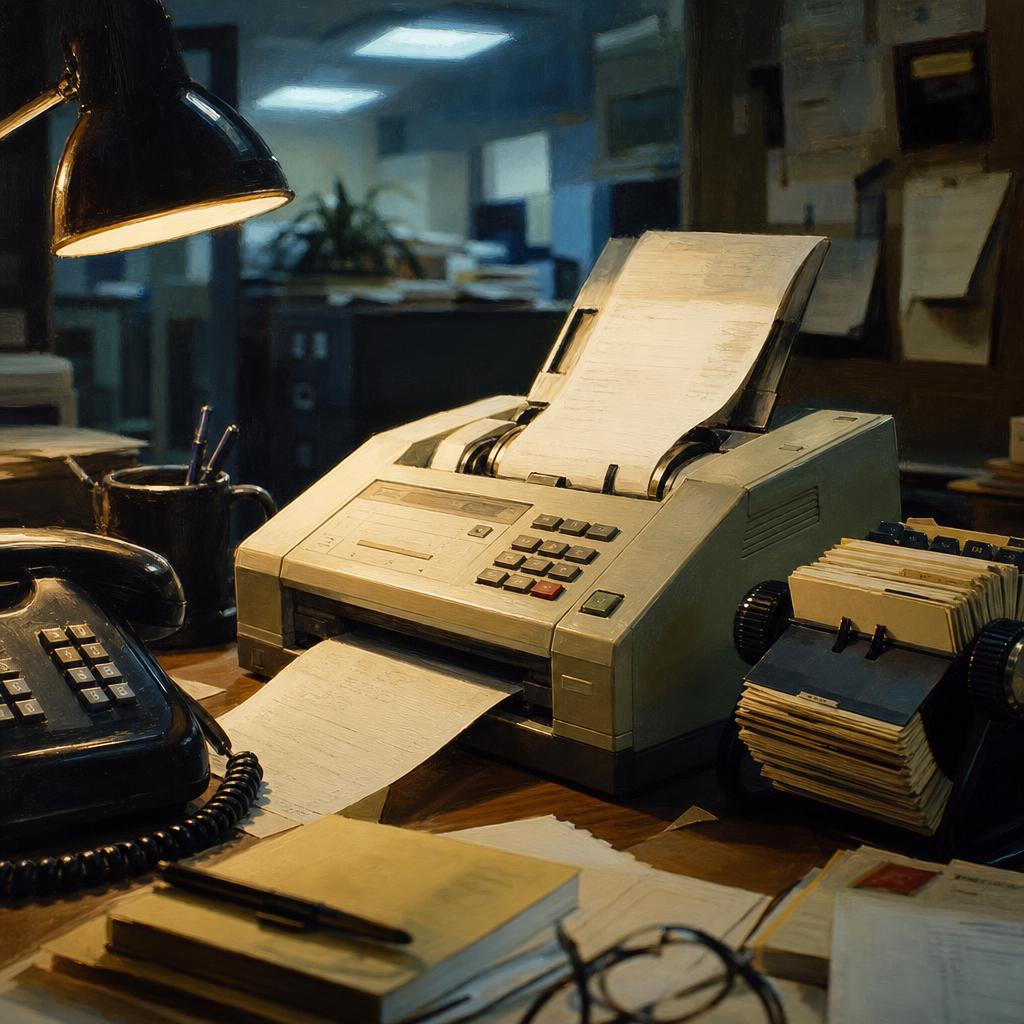
Office Communication: The Phone, the Fax, and the Message Slip
Subscribe
https://meridian-archive.com/feed.xmlOpen in your app, or paste the link above into any other:
The Signature That Did Not Exist
An American magazine could close a contract with a writer or a photographer for the entire length of the period this chapter covers without either party’s original signature ever occupying the same room, city, or continent as the document it belonged to, and no one in the business treated this as remarkable. A page was signed by hand, fed through a fax machine, and read on the other end as a closed deal the moment it printed — work began, checks were cut, assignments were made — though a signature transmitted that way carried no legal standing anywhere in the country for the whole of the practice’s working life. The industry ran on its own shorthand for the fiction, repeated identically by magazine counsel, publishers, and freelancers with no formal training in law: “fax it, the original to follow.” The paper original did follow, mailed the same afternoon, but it mattered only for the file — it arrived after the agreement it was nominally required to create had already been acted on for the better part of a week. Federal law did not recognize an electronic signature as the equivalent of a wet one until the Electronic Signatures in Global and National Commerce Act took effect on October 1, 2000, a full decade after the convention had already become universal practice in every magazine office in the country.1
The instrument that carried the call setting such a contract in motion, and every other transaction that moved through a magazine floor before it reached a fax tray, sat on a different desk from the one it served. A telephone on a magazine editor’s desk in November 1989 almost never rang for the editor. It rang for the assistant sitting outside the door, whose job was to intercept it. The instrument itself was a glossy black AT&T Merlin set — the color options had narrowed to black alone once the BIS series of handsets replaced the earlier membrane-button models, so the beige and midnight-blue phones of the 1970s survived only as holdouts on a few older desks. The system underneath it, the Merlin Classic or Merlin Plus, was built for exactly the scale of a mid-size editorial floor: up to thirty lines and seventy handsets from a single key service unit, no PBX required. A publisher large enough to occupy an entire tower ran a full System 75 or 85 switchboard as backbone and used Merlin-compatible sets only as the desk hardware; a magazine on one or two floors ran directly off the key system itself.
The ring was electronic, not mechanical — a two-tone warble generated by a sine-wave oscillator inside the phone, with eight selectable patterns so that an outside call and an intercom buzz announced themselves differently to an ear that had learned to tell them apart without looking up. The line buttons beneath the handset carried the day’s real information: a steady red light meant the line was assigned to that desk; a flashing green meant it was ringing; a steady green meant someone, somewhere on the floor, was already on it. An editor’s own set typically carried three to five lines — a direct number, a private line, an intercom — because incoming calls were not supposed to reach the editor directly. The assistant’s set carried more buttons, not fewer, because the assistant’s job was to watch every one of the boss’s lines at once, see the light change, answer in the boss’s name, put the caller on hold, and buzz the intercom. This was a rehearsed sequence performed dozens of times a day, and it was the actual mechanism by which access to a senior editor’s attention was granted or withheld.
The desk that held the phone held a fixed cluster of other objects around it. To one side sat a Rolodex — a rotating barrel of alphabetized cards that a reporter or editor built over years and that functioned, in practice, as a portable record of a career’s worth of sources; the device had been patented in 1956 by an engineer at the office-supply firm Zephyr American, and by 1989 the word had become common enough as a noun that journalists used it to mean the network of contacts itself, not merely the object that held the cards.2 Next to it sat a pad of pink “While You Were Out” slips — 4-by-5¼-inch salmon bond manufactured by firms like Adams or TOPS, pre-printed with checkboxes for “Telephoned,” “Please Call,” and “URGENT” — on which an assistant recorded, in her own handwriting, who had called and when. Small strips of paper taped beside the programmable buttons carried speed-dial labels in the same handwriting. The coiled handset cord, after enough months of use, no longer hung straight.
The Machine in the Bullpen
If the phone was where a call started, the fax machine was where the day’s actual documents moved. The technology ran on a single international standard — ITU Group 3, specified in recommendations T.30, T.4, and T.6 — transmitting a page at 200 dots per inch in standard mode, encoded with a compression scheme called Modified Huffman, over an ordinary telephone line at a modem speed of 9,600 baud in 1989, rising to 14,400 baud by roughly 1992.3 A standard page took thirty to forty-five seconds to cross; a page set to “fine” resolution, useful for a marked-up proof or a dense photograph proxy, took twice that. None of this was exotic technology by 1989 — the fax machine had been commercially viable in the United States for most of a decade — but a magazine office ran through a specific, dated sequence of hardware as the decade went on: thermal-paper workhorses through about 1991 (Panasonic’s Panafax line, Canon’s early FAX-220, Sharp’s UX-170), plain-paper machines entering the mix through 1993, and plain paper standard by the middle of the decade, driven by laser-printer-style engines that replaced the thermal roll with cut-sheet stock.
The difference between the two paper technologies was not a footnote. Thermal paper came off the machine warm and faintly waxy, curled back toward its roll shape within minutes of printing, smudged under a thumb, and faded visibly within a matter of months under ordinary desk light — an archival hazard serious enough that anything important arriving on thermal paper in 1990 was routinely photocopied before it had a chance to disappear. Plain paper, once the newer laser and inkjet-style machines took hold, behaved like an ordinary photocopy and simply lasted. A single floor typically ran more than one machine: a general-purpose unit near the mailroom or reception handling inbound press releases and wire copy, a workhorse in the editorial bullpen carrying story drafts and fact-checking pages back and forth to a typesetter, a dedicated machine near the photo department for caption corrections, and a thermal holdout on the copy desk well into the 1990s for late-night galley corrections, since the copy desk’s business was speed rather than permanence.
The Cover Sheet and the Unwritten Rule
Every transmission that mattered left the building behind a cover sheet, and the cover sheet was a small bureaucratic form with a fixed anatomy: a masthead line at the top, fields for TO, COMPANY, FAX, PHONE, FROM, DATE, PAGES, and RE, a row of checkboxes — URGENT, FOR REVIEW, PLEASE COMMENT, PLEASE REPLY — and, by the early 1990s, a standardized paragraph of confidentiality boilerplate warning that the transmission “may be confidential and legally privileged.” Junior staff filled the sheet out by hand; senior staff scrawled a line or skipped the form outright. The only field anyone reliably checked was “PAGES: ___ (including this cover sheet),” because it was the sole means of confirming that a transmission had arrived whole.
The confidentiality warning did nothing. There was no technical means of restricting who read a page coming off a shared machine, and the industry’s own practice acknowledged as much: when a document actually needed to be kept from casual eyes, the sender telephoned first — “I’m sending a fax now, are you at the machine?” — and the recipient stood at the tray until the transmission finished. A communal fax in a bullpen or near reception was public space by construction; anyone passing could read a cover sheet, and sometimes the page beneath it, before the addressee arrived to claim it. Only the machines in a senior editor’s or a publisher’s outer office functioned as anything like private territory, because an assistant controlled who reached them. The etiquette that governed a misdirected page was entirely unwritten and inconsistently enforced: a fax for someone who had stepped out got carried to an inbox; a fax for someone senior to the finder went unread on principle; a fax for someone junior got a glance at the cover sheet, and further reading depended on how interesting that glance had been.
The machine itself announced its business acoustically before a page ever printed — a handshake of two tones specified in the same ITU standard that governed the transmission itself.3 Anyone who picked up a voice extension on a line mid-handshake got the full screech in the ear and hung up fast, a routine enough mishap that it barely registered as an event. By the early 1990s the volume of unsolicited “junk” faxes — real-estate pitches, mortgage-rate flyers, notices addressed to “ATTENTION OFFICE MANAGER” — had grown enough that Congress banned unsolicited fax advertising under the Telephone Consumer Protection Act, signed into law that December, though enforcement stayed modest for years afterward.4 Pulling the junk off the morning roll and discarding it before reading what lay beneath it was itself a small daily ritual.
What the Wire Could Not Carry
The fax earned its place in an office’s daily workflow by doing things a phone call or the mail could not. A phone call carried words but not the marked-up page itself — a copy editor correcting a typesetter’s galley, or an editor annotating a writer’s draft in the margins, needed the recipient to see the actual marks, not hear them described. The mail carried the physical page but took a day or more; a deadline measured in hours could not wait for it. Between those two limits sat a specific list of jobs the fax did reliably: galley proofs from a typesetter to the copy desk, a fact-checker’s marked list of quotes sent to a source for same-day confirmation, an editor’s redlined draft sent back to its writer, photo caption corrections routed between the photo desk and copy, a signed contract sent for a same-day countersignature with the original to follow by mail, and a formal letter from a subject’s attorney, where the fax created a dated record faster than the postal service could.
What the fax could not do, at any point in its working life, was carry a photograph. Standard fax resolution rendered an image in pure black and white at 200 dots per inch with no gray scale, so a photograph sent by fax arrived as a blotchy, high-contrast approximation — useful only to identify which frame a caller meant, never to reproduce. The actual transmission of publishable photographs from the field ran on a separate and considerably more specialized technology. Drum-based transmitters inherited from the wire services took eight or nine minutes to send a single black-and-white print in the early going. Nikon’s NT-1000, developed with Kyodo News and introduced in 1983, cut that considerably using an early CCD sensor. The Associated Press’s Leafax 35, introduced in 1988, scanned a negative directly and transmitted a color image over an ordinary phone line in about thirty minutes — a briefcase-sized unit with a built-in five-inch monitor that let a photographer view and caption the image before sending it, primitive by any later standard but revolutionary against what had come before.5 The AP’s Photostream system, introduced the following year, moved the same job onto a digital satellite link and cut transmission time from roughly ten minutes to under one.5 The Kodak DCS 100, released in May 1991 at a price near twenty thousand dollars, mounted a 1.3-megapixel digital sensor to a Nikon F3 body and represented the first commercially available digital camera built for a wire photographer’s use — fewer than a thousand units were ever sold, and a magazine’s own photo department did not own one, though a wire-service photographer working the same story might already have carried one by the middle of the decade.6
Filing From the Wars
For a correspondent working outside a city with reliable infrastructure, filing a story ran through a ranked set of options, worst case to best. Dictating copy over the phone was fastest when a line worked at all, but error-prone — names and figures garbled by a bad connection were a routine hazard. A hotel fax was the default method through roughly 1995 wherever a hotel had a working line. A press center or aid organization’s machine served when hotels had been damaged or evacuated. Telex, an older teleprinter technology, survived in some bureaus into obsolescence. A satellite telephone was more reliable than any of the above but cost five to ten dollars a minute, required a terminal the size of a briefcase, and remained rare at any magazine before the middle of the decade. Sending a hard copy by international courier took days and was reserved for material that was not urgent enough to justify the wire. The story itself was typically drafted on a battery-powered portable — the Tandy Model 100, light enough to carry and rated at twenty hours on four AA batteries, was common enough among traveling reporters in the era to be treated as a default rather than a novelty.7
The two cities that defined this hierarchy for the era’s correspondents were Sarajevo and Mogadishu, and the two press hotels that housed them are independently documented. The Holiday Inn in Sarajevo, built for the 1984 Winter Olympics, stood roughly two hundred meters from active front-line positions along the boulevard press corps nicknamed Sniper Alley; it was shelled repeatedly through the siege that began in April 1992, evacuated briefly, and reopened that June specifically to serve as the press hotel for the war’s duration, its press-hotel status documented on the record by CNN, Reuters, AP, and Magnum’s Paul Lowe, among correspondents who included Reuters’ Kurt Schork, the New York Times’s John Burns, and CNN’s Christiane Amanpour into 1996.8 In Mogadishu during the 1993 UN intervention, the equivalent institution was the Sahafi Hotel — its name is Arabic for “journalist” — on the K4 roundabout, the base from which the American and international press corps covered the operation that culminated in the October 1993 battle later chronicled in book form by Mark Bowden.9 Both hotels functioned less as lodging than as infrastructure: a fax line that worked, a generator when the city’s power did not, and enough of a community that a correspondent arriving from the field could find someone who knew whether the machine down the hall was taking calls. The math of filing from Sarajevo ran six hours ahead of New York: a story sent at nine in the evening reached an editor’s desk mid-afternoon, workable before a close, while one sent at two in the morning sat on the machine until an assistant found it after nine.
Rwanda in 1994 broke the pattern. The Hôtel des Mille Collines in Kigali sheltered roughly 1,268 people fleeing the killing that spring10 — a refuge, not a press base, its Belgian managers evacuated once the violence began; the radio station that shared a nearly identical name, Radio Télévision Libre des Mille Collines, was the broadcaster that helped incite the massacre, an entirely different institution easily and dangerously confused with the hotel that sheltered its victims. The foreign press base for the genocide was Nairobi, not Kigali. The journalist Catherine Bond, reporting from the region at the time, later described chartering a small aircraft to Mbarara in Uganda and catching a United Nations aid flight into Kigali to reach the story at all; coverage out of Nairobi in the first weeks was thin, and much of it mischaracterized the killing as a resumption of civil war rather than the organized destruction it was.11 A correspondent shooting film in Kigali that spring depended on the same UN flights to move undeveloped rolls out to a Nairobi lab, then faxed a contact sheet back for selection — a chain that could stretch the distance between a photograph taken and a photograph published to a week or more, a lag the technology of the moment offered no way to close.
Reaching any of these lines from a hotel required routing through AT&T’s USADirect service, dialing a country access code, then the domestic number, with charges billed to a calling card the traveling correspondent carried for exactly this purpose. A transmission that failed partway printed a partial page and stopped; the correspondent redialed and resent from wherever it had broken off, then telephoned the newsroom afterward to confirm which pages had actually arrived, because a machine could as easily have run out of paper or jammed as failed to connect at all.
The Quiet Machine
The fax’s dominance did not end abruptly; it eroded across roughly a decade, unevenly, by function and by geography.
The Shift from Fax to Electronic Mail, 1989–1997
| Year | The magazine’s internal traffic | A correspondent filing from a difficult city |
|---|---|---|
| 1989 | No electronic mail; internal notes traveled by phone, paper memo, or a walk down the hall. | Telex lingered in a few bureaus; the fax was already dominant. |
| 1992 | An internal system reached senior staff only and did not cross to the outside world. | A hotel with a working phone line and a compatible modem could sometimes reach a commercial online service, on the rare line that took a modem at all. |
| 1993 | Drafts circulated inside the building electronically; anything leaving the building still went by fax. | A handful of correspondents in major capitals held accounts with a commercial mail service; conflict-zone bureaus had none. |
| 1995 | Internal mail was ordinary; formal external correspondence and signed documents still went by fax. | Correspondents in functioning cities usually found a data port; those in active conflict zones still depended on the fax. |
| 1997 | Fax was reserved for legal and signed documents; nearly everything else moved electronically. | Satellite telephones with data capacity grew more reliable, and documents began moving as attachments rather than transmissions. |
What the newer technology displaced was not only a machine but a set of physical confirmations built around it: the cover sheet, the transmission report that printed as an afterthought once a fax completed, the pile of curling thermal paper on a bullpen floor some mornings, and the audible handshake itself — the screech that had told everyone within earshot that a document existed at both ends of a line. Electronic mail offered none of this. It arrived in silence, and for years many of the people who received it distrusted the silence more than they had ever distrusted a fax.
The business card tracked the same shift in miniature. A card printed before 1990 typically listed one number, the telephone. Through the middle of the decade a second line, “Fax,” sat beside it with equal visual weight, sometimes joined by “Tlx” for a foreign correspondent still routing through a telex bureau. By 1996 email had claimed the third line on the card; by the century’s end it had frequently claimed the second, with the fax number demoted or dropped from the card altogether.
A writer who could not afford a fax of his own — and a fax was a real expense for a freelancer working from an apartment — had one dependable public alternative: a Kinko’s copy shop, open around the clock. The chain had begun in 1970 when Paul Orfalea, working from a roughly hundred-square-foot former hamburger stand near the University of California, Santa Barbara, opened a self-service copy shop with a five-thousand-dollar loan and pricing set at four cents a page; the name came from his own nickname, earned by his curly red hair.12 By 1980 the chain had grown to roughly eighty locations; by March 1996 it had passed eight hundred, run not as a franchise but through Orfalea’s partnerships with local owner-operators. A Kinko’s counter by the mid-1990s rented Macintosh computers by the hour, sold color copies at a premium, and sent a fax domestically for one to two dollars a page or internationally for five to ten — a real, if unglamorous, price for a freelancer’s only way to get a signed contract or a finished manuscript out of the building on a Friday night.
Every working day at the office itself still opened the same way regardless of what the calendar year said about the pace of change elsewhere: an assistant arrived shortly before nine, tore the overnight thermal roll along its perforations or gathered the loose plain-paper sheets that had piled in the tray, and sorted them into three piles — trash, routine distribution, and whatever looked urgent or bore a name worth walking to a desk immediately. Nothing about that sorting judgment was written down anywhere. It happened the same way, at the same hour, on a morning when the pile held nothing but real-estate flyers and on a morning when it held the legal letter that occupied the rest of the day.
An office in 1989 ran on a layered system of human intermediaries standing between every voice and its destination — an assistant screening a call before it reached a desk, a machine’s cover sheet promising a confidentiality it could not enforce, a morning sort deciding by feel which page mattered enough to carry across the room. None of it was efficient by a later standard, and all of it left a physical trace: a pink slip in a stack, a transmission report nobody read until they needed it, a thermal roll curling on the floor. What replaced it over the following decade did the same jobs faster and left no trace at all, which is why so many of the people using it for the first time kept reaching, for a while, for the confirmation the old machines had always given them without being asked.
A trade piece proposing the office’s own hidden relay system — the assistants who would have screened every call before it reached a desk, the operators at commercial answering services who would have held a floor’s private business every night from midnight to eight — would have surfaced once, at a Tuesday lunch, and would have gone no further; there would have been no subject in it a masthead could have put a name to, no scandal, no announcement, nothing a City-section editor could have pointed to as the news. The idea would have been called a good one and would have been let go.
An operator at an answering service in an exchange somewhere in Queens would have taken a senior editor’s calls between midnight and eight for years without ever meeting him, logging each caller’s name on a printed form and reading it back once before ringing off. The pattern of who called and when would have told her more than anyone asked her to know: a marriage fraying, a habit of drinking before the calls that came in past midnight, a man who rang every night at two and a man who never rang after nine. She would have owed it all silence, and the silence would have cost her nothing — no masthead would ever have asked what she carried. She would have clocked out at eight, handed the board to the day operator, and gone home to sleep through the very hours when the office she would have guarded all night would, at last, have come alive without her.
Footnotes
-
Electronic Signatures in Global and National Commerce Act, Pub. L. No. 106-229, 114 Stat. 464 (2000). ↩
-
Merrill Perlman, “‘Rolodex,’ on Rotation,” Columbia Journalism Review, April 16, 2020. ↩
-
Jonathan Coopersmith, Faxed: The Rise and Fall of the Fax Machine (Johns Hopkins University Press, 2015). ↩ ↩2
-
Telephone Consumer Protection Act of 1991, Pub. L. No. 102-243, 105 Stat. 2394. ↩
-
“This Is How AP Journalists Sent Photos From the Field in the 1980s,” PetaPixel, October 13, 2021. ↩ ↩2
-
“Kodak DCS: Why the Revolutionary Digital Camera System Failed to Catch On,” PetaPixel, April 23, 2025. ↩
-
Stephen Cass, “Upcycling a 40-Year-Old Tandy Model 100 Portable Computer,” IEEE Spectrum, October 2022. ↩
-
Kenneth Morrison, Sarajevo’s Holiday Inn on the Frontline of Politics and War (Palgrave Macmillan, 2016). ↩
-
Mark Bowden, Black Hawk Down: A Story of Modern War (Atlantic Monthly Press, 1999). ↩
-
Paul Rusesabagina with Tom Zoellner, An Ordinary Man: An Autobiography (Viking, 2006). ↩
-
Catherine Bond, “Covering the Rwanda Genocide,” Centre for International Governance Innovation, April 18, 2019. ↩
-
Paul Orfalea and Ann Marsh, Copy This! Lessons from a Hyperactive Dyslexic Who Turned a Bright Idea into One of America’s Best Companies (Workman Publishing, 2005). ↩