The Photograph: Contact Sheets, Lightboxes, Selects, 1989–2001
Subscribe
https://meridian-archive.com/feed.xmlOpen in your app, or paste the link above into any other:
The Fabrication Line
By the early 1990s a magazine photographer who altered what a published photograph showed — moving an element, compositing two exposures into one, adding or removing what the lens had actually recorded — risked a career-ending finding under a rule with no statute behind it, enforced case by case by the trade’s own professional associations. The American Society of Magazine Photographers, renamed the American Society of Media Photographers in 1992, and the National Press Photographers Association spent the early 1990s drawing a line the trade had not needed before Photoshop existed: adjusting a photograph’s tone and color was retouching, the same correction a skilled darkroom printer had always made by hand; changing its content was fabrication, and fabrication ended careers. Nothing about the underlying question was new — National Geographic’s February 1982 cover had already moved two Egyptian pyramids closer together to fit the magazine’s vertical format, using Scitex electronic retouching equipment nearly a decade before Photoshop existed, over photographer Gordon Gahan’s objection, with the magazine defending the change as establishing a new point of view1 — but the distinction assumed something prior to any correction: that a photograph was, at minimum, a record of light that had actually reached a piece of film. The sheet that carried that record, before any editor’s hand touched it, arrived on a photo editor’s desk the size of a postage stamp.
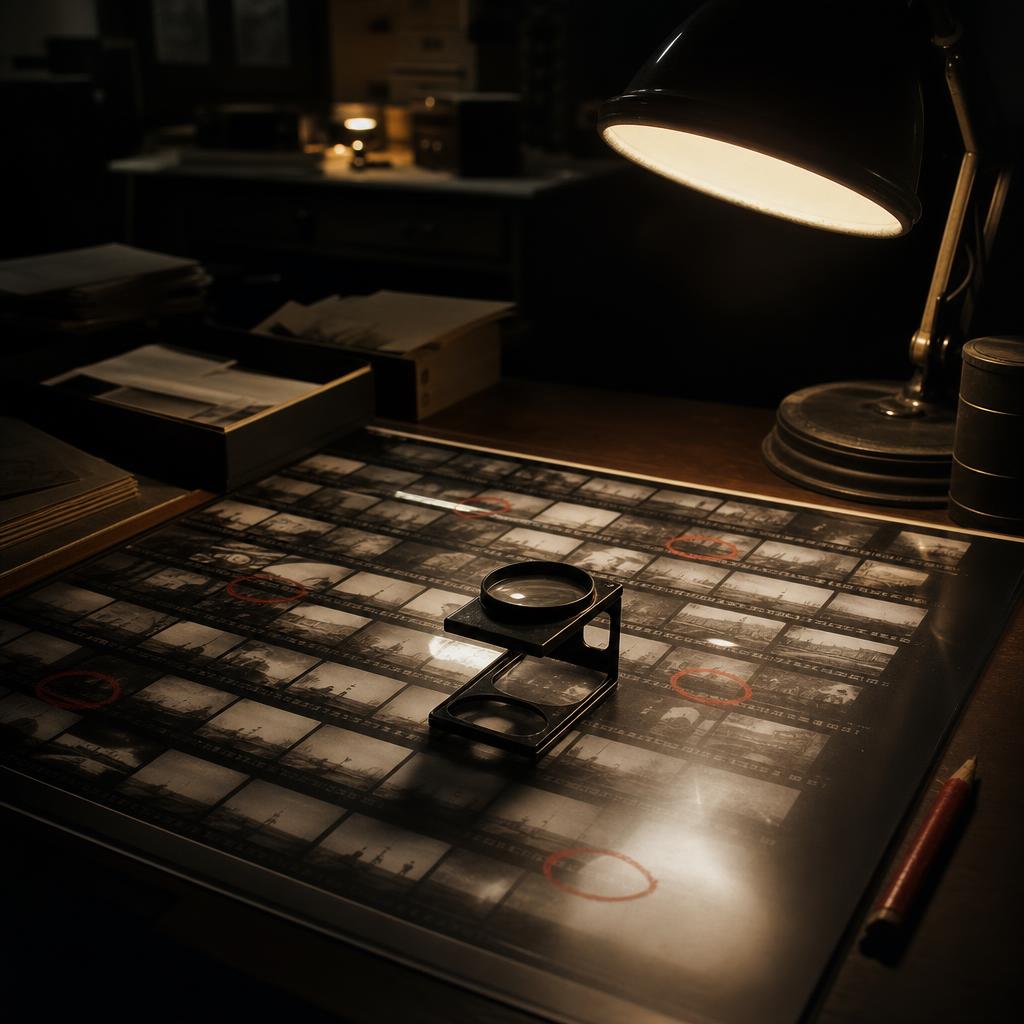
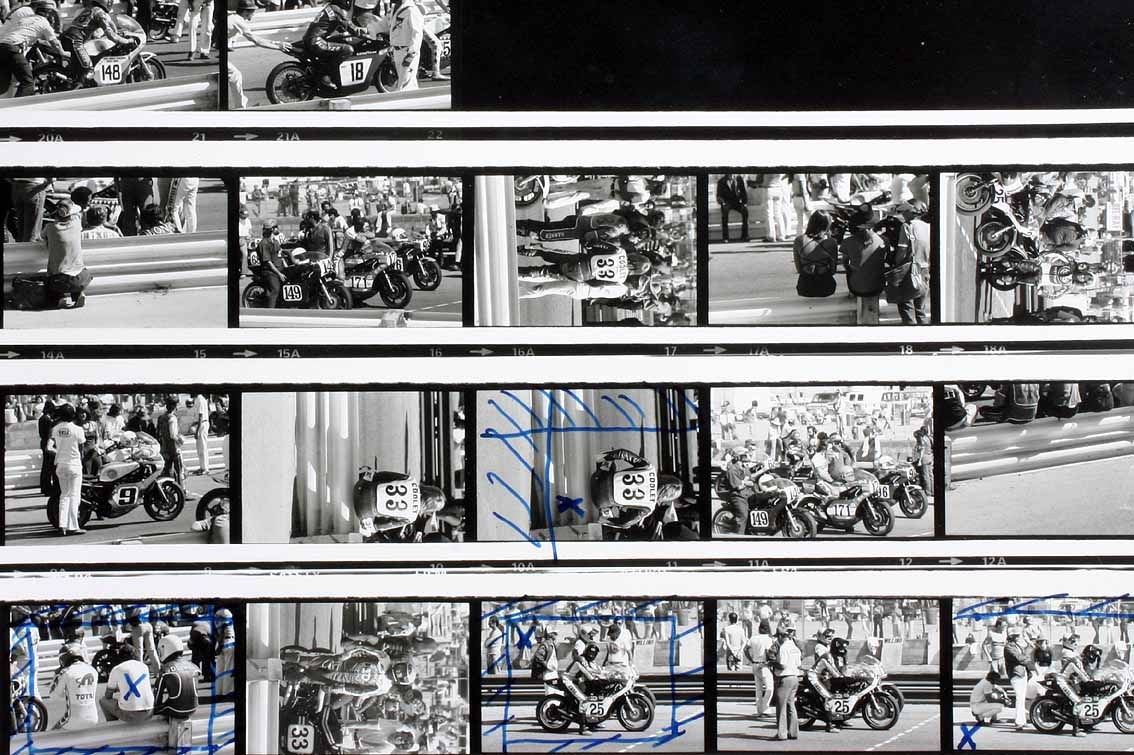
A roll of thirty-six exposures came back from the lab as a single 8×10-inch sheet of glossy resin-coated paper, printed at contact scale — six strips of six frames, each frame reproduced at exactly the dimensions of the negative that made it, roughly twenty-four by thirty-six millimeters, sprocket holes and rebate edges intact. The sheet was called a contact sheet because nothing came between the negative and the paper but direct contact under an enlarger; no image on it had yet been enlarged to anything resembling a published photograph.
The paper itself did particular work. Kodak Kodabrome II RC or Ilford Multigrade RC were the standard stocks — resin-coated so they processed fast and dried flat, glossy because gloss held the sharpest detail and the highest contrast a magnifying loupe could resolve. The sheet carried a faint plastic feel and a fainter chemical smell, the residue of the fixer bath. It arrived from the lab in a flat stack, interleaved with tissue to keep one sheet’s silver from scratching the next.
The photographic original, though, was not what circulated on a magazine floor day to day. That distinction belonged to the Xerox copy — a reproduction of the contact sheet run off on ordinary white bond, high-contrast and grainy, shadows blocked to solid black and highlights bleached to nothing, the thirty-six frames barely legible as compositions and unreadable as focus or expression. A photo editor, an art director, an articles editor, and an editor-in-chief all needed to look at the same roll in the same week, and photographic prints for four people cost money and days that a magazine on a monthly closing did not have. The Xerox — run on a floor-standing Xerox 5046 or 5028, or the older 1075 that many offices still kept — was disposable, smudgeable, and everywhere. The photographic original stayed in the photo department, precious, waiting for someone to look at it properly.
The Loupe and the Grease Pencil
Looking at it properly meant a loupe — a small magnifying lens on a flat base, four-power or eight-power, made by Schneider or Peak or Rodenstock, pressed directly against the paper so the barrel excluded stray light. A photo editor working a stack of contact sheets sat hunched over a table with the loupe against the sheet, moving frame to frame, reading a face at postage-stamp scale for the difference between a subject mid-blink and a subject caught open. Henri Cartier-Bresson rotated contact sheets in his hands rather than laying them flat, “looking at them from all angles, assessing the formal composition.”2
The instrument of decision, once a frame earned one, was the grease pencil — a wax china marker, red by overwhelming default. A circle around a frame meant select. A check mark meant a definite yes. An X meant reject. Crop marks drawn directly on the tiny image told the platemaker what to keep and what to trim when the frame was enlarged; arrows and connecting lines indicated sequence, one frame’s relationship to its neighbor. The mark had a slightly raised, waxy texture a fingertip could feel, and it lifted clean with a dry cloth — which meant a sheet could be re-edited without damage, a photographer’s first pass overruled or refined by a photo editor’s second without erasing the record of either.
Red was the default but not universal. On a dark black-and-white frame, red grease pencil barely showed, and photo editors reached for yellow or white instead; a set of contact sheets by Diane Arbus held in the Metropolitan Museum of Art’s collection carries frames circled in yellow wax pencil for exactly this reason.3 Where more than one person marked the same sheet — photographer, then photo editor, then art director — a second and third color kept the votes distinct. On the negative sleeves themselves, small adhesive flags, colored Post-it tabs pressed onto the clear plastic pages, marked a promising strip without putting grease pencil anywhere near the negative slated for a full-size enlargement.
From Roll to Page
The sheet’s life followed a fixed sequence. Film shot on assignment went first to a professional lab, which returned contact sheets alongside the negatives themselves, sleeved in clear Print File archival pages with individual channels for each strip. The photographer took the first pass, circling personal favorites in grease pencil before the sheets reached anyone else; at a title working against a tight closing, unedited sheets sometimes skipped that step and went straight to the photo editor. The photo editor’s read was the one that mattered editorially. Kathy Ryan, photography director at The New York Times Magazine from 1987, described working through some fifty rolls the photojournalist Gilles Peress had shot on assignment — roughly eighteen hundred individual frames — and narrowing the take to the ten or fifteen strongest before the harder edit, for the page itself, had even begun.4
Once a photo editor had made selects, Xerox copies of the marked sheet went by interoffice envelope — kraft paper, string-tie closure, names crossed off the routing list as it circulated — to the art director, who considered the images against the shape of the layout rather than in isolation. Selected frames were then ordered up from the lab as work prints, eight-by-ten as the standard first enlargement, eleven-by-fourteen or larger for a photograph that had survived to a final layout. On a cover or a lead feature, the editor-in-chief weighed in on the final choice alongside the photo editor and the art director; Susan White, Vanity Fair’s photography director from 1988, said a cover shoot had a team working the creative side together, the editor-in-chief included alongside the fashion and creative directors — “those more elaborate shoots are very much a group effort.”5
The photo editor and the photo researcher did different jobs under titles that were easy to confuse. The photo editor assigned photographers, oversaw shoots, and made the creative call on what ran; the photo researcher tracked down existing and archival images through agencies — Sygma, Gamma-Liaison, Black Star, and, increasingly through the decade, Corbis — and cleared the rights and permissions that let a magazine print a photograph it had not commissioned. One job produced images; the other found and licensed them. Both were credited on the masthead, and neither was the same work as the other.
The Light Table
Color transparencies did not travel through the same postage-stamp scrutiny as black-and-white contact sheets; they were judged on a light table, a horizontal surface of translucent glass or acrylic lit from below by fluorescent tubes calibrated to 5000 Kelvin — daylight-balanced, the standard against which a transparency’s true color could be judged without the yellow cast of ordinary office fluorescents. A photo editor laid slides directly on the glass, picked one up between thumb and forefinger, held it against the light, set it down beside its neighbors, and picked up the next. The comparison was tactile before it was visual.
It was also unforgiving in a way a Xerox copy was not. A transparency was a single physical object; there was exactly one in existence, and losing it meant losing the photograph outright, with no negative to reprint from. The slide archive that resulted from a decade of assignments lived in binders of archival sleeves, filed in cabinets or dedicated rooms — a physical inventory that a magazine’s photo department maintained the way a library maintained its stacks, because there was no other copy anywhere to fall back on.
The Pixel Arrives
Kodak released the first commercially available digital camera aimed at working photojournalists in May 1991: the DCS 100, a customized digital back built onto a Nikon F3 body, its 1.3-megapixel sensor feeding a separate storage unit worn on a shoulder strap and tethered to the camera by cable. It sold for approximately twenty to twenty-five thousand dollars depending on configuration, and in three years on the market it found 987 buyers.6 Image quality was not the reason to buy one — at magazine enlargement sizes a 1.3-megapixel frame looked visibly softer than film. Speed was the reason: a wire photographer who could transmit a frame from an event floor in minutes, with no film to develop and no courier run to a darkroom, held a real edge on a same-day story that a monthly’s closing schedule had no use for.
For a monthly magazine, that edge changed nothing about how a cover got made. Through the rest of the decade, film remained standard in magazine photography for reasons a wire service did not have to weigh: through 1998, professional film still resolved finer detail than any sensor available at a comparable price, color fidelity and skin tone remained a genuine weakness of early digital sensors, and the equipment cost was steep — a digital body ran fifteen thousand dollars or more and was obsolete within two years, against a film camera’s comparatively modest fixed cost per assignment. A fourth reason was harder to put a number on: a photographer who had built years of judgment around film was being asked to give up not just a material but a whole sequence of pauses — the contact sheet, the loupe, the wait to learn whether an exposure had actually worked — and for a working photojournalist who found meaning in that sequence, trading it for an instant screen preview was not obviously an improvement. Kodak’s line evolved through the DCS 200 in 1993 and the NC2000, built with the Associated Press specifically for wire-service news work, in 1994; by 1998 the DCS 500 series reached six megapixels at fourteen to eighteen thousand dollars.6 None of it changed the economics for a magazine that closed once a month rather than once a news cycle.
The Kodak DCS line, dated
| Model | Year | Resolution | Price |
|---|---|---|---|
| DCS 100 | 1991 | 1.3 MP | ~$20,000–25,000 |
| DCS 200 | 1993 | 1.54 MP | ~$20,000 |
| NC2000 (with AP) | 1994 | 1.3 MP | wire-service issue |
| DCS 500 series | 1998 | 2–6 MP | $14,000–18,000 |
| Nikon D1 (non-Kodak) | 1999 | 2.74 MP | $4,999 |
The reset came in 1999, and it did not come from Kodak. Nikon’s D1 shipped at $4,999 — a third of the price of the six-megapixel Kodak DCS 660 it competed against, in a body built and priced for a working photojournalist rather than a wire-service consortium’s shared equipment pool.7 It did not replace the contact sheet on a magazine floor by the end of the period covered here; a photo editor in 2001 still spent afternoons with a loupe and a red grease pencil over glossy paper, and film still shot most of what ran in a cover well. What the D1 did was put digital photography’s speed advantage within an individual working photographer’s budget for the first time, rather than only a wire service’s. By 2001, a working photo editor still owned a loupe and a red grease pencil, and still needed them most days.
What the Software Could Change
Adobe shipped Photoshop in 1990, and within three years it was standard equipment in a magazine’s production department — not for altering what a photographer had recorded in the field, but for the same tonal and color correction a skilled darkroom printer had always performed by hand: adjusting contrast, correcting for how a specific press laid ink on a specific stock. What Photoshop altered was who could make this kind of change and how easily, sharpening a distinction the trade’s associations had already drawn between retouching and fabrication. Nothing in a photo editor’s training yet asked what that distinction meant for an image that had never touched film at all.
The contact sheet was not a byproduct of photography in this period; it was the mechanism by which a magazine decided what photography meant. Thirty-six frames of the same subject, printed too small to read without a lens, forced a choice — which fraction of a second, out of thirty-six candidates, stood for the whole encounter — and the choice belonged to whoever held the loupe and the grease pencil, not to whoever had stood behind the camera. A photographer’s authorship ended at the moment the roll went to the lab; a photo editor’s began at the moment the sheet came back. What 1989 to 2001 stripped out, in the end, was not the photograph but the interval: the afternoon spent turning a sheet in the light, the pause in which a magazine’s idea of a person or an event was still being decided rather than already fixed. The magazine’s picture of the world had always been made twice — once by a lens, once by a hand with a red pencil — and the second decision, unsigned and unremarked, shaped as much of what a reader took for simply seen as anything a writer ever put in a sentence.
Meridian would have carried the retouching-versus-fabrication question in The Essay in the summer of 1990, worked through the same distinction the trade associations were drawing that year — tone and color correction as the old darkroom craft carried onto a screen, content change as a different act entirely, one that ended careers rather than earned bylines. A year later, Kodak’s DCS 100 would have gone into The Front as a trade note: a Nikon body with a digital back and a shoulder-slung storage unit, a price near twenty thousand dollars, and no reason yet for a monthly’s photo department to give up film.
Somewhere in the same span a photo editor or a picture researcher would have pitched a profile of the editing floor’s own judgment — what a loupe and a red grease pencil actually decided about a photographer’s week of work. It would have died as a story too small for the book: a single desk’s daily calls, not an argument a national reader had a stake in, and every photographer candid enough to describe the process from inside it would have needed that desk’s next assignment, which left the pitch with no one willing to be named.
Nikon’s D1, in 1999, would have rated the same trade note in The Front as the DCS 100 eight years before, at a fifth the length and none of the skepticism: four thousand nine hundred ninety-nine dollars, a third of what Kodak’s equivalent body cost, and still nothing that moved a magazine’s cover shoot off film before the decade closed.
Footnotes
-
Alex Boese, “The Case of the Moving Pyramids,” Hoaxes.org, 2015. ↩
-
Magnum Contact Sheets, ed. Kristen Lubben (Thames & Hudson, 2011). ↩
-
The Metropolitan Museum of Art, Diane Arbus contact sheet collection, gift of Doon Arbus and Amy Arbus, 2019. ↩
-
“Inside the Mind of a Master Photo Editor,” Time, October 2011, on Kathy Ryan, The New York Times Magazine Photographs (Aperture, 2011). ↩
-
Susan White, photography director, Vanity Fair, from 1988; “Staying Power, Natural Glamour: Three Decades at Vanity Fair,” LensCulture, May 2016. ↩
-
“Kodak DCS: Why the Revolutionary Digital Camera System Failed to Catch On,” PetaPixel, April 2025. ↩ ↩2
-
Jon Stapley, “Cameras That Changed Everything: The Nikon D1,” Fixation (Wex Photo Video), January 2017. ↩