The Body's Daily Logistics: Eating, Drinking, and the Long Death of the Lunch, 1989–2001
Subscribe
https://meridian-archive.com/feed.xmlOpen in your app, or paste the link above into any other:
The Deductible Lunch
An expense-account lunch under fifty dollars a head drew no scrutiny at all at a well-run Manhattan magazine; a lunch running fifty to a hundred dollars a head required one typed line of justification on the expense report; past a hundred dollars a head, the accounting department routed the receipt to a memo on the publisher’s own desk as a matter of standing procedure, and a wine bill running to two bottles at a four-person table triggered that same memo automatically, whatever the food itself had come to. The tiers were company policy rather than any one editor’s caution, understood by every rank at the table well enough that nobody needed to do the arithmetic before ordering, and Si Newhouse’s Condé Nast ran an even looser version of the same machinery for years on a proposition never printed in any employee manual — that its editors did not expense a lunch so much as charge one, the receipt the writer’s business to keep rather than the company’s business to interrogate.1 Tina Brown, who ran a more bureaucratic shop after taking Vanity Fair in 1984 and The New Yorker in 1992, never fully displaced the looser culture she inherited.
The instrument that made a memo-triggering lunch possible in the first place was the corporate charge card, and behind the tiers themselves sat an arithmetic that changed twice in seven years by act of Congress. The Tax Reform Act of 1986 cut the business-meal and entertainment deduction from 100 percent to 80 percent, effective for the 1987 tax year; the Omnibus Budget Reconciliation Act of 1993, signed into law on August 10, 1993, cut the same deduction again, from 80 percent to 50 percent, effective the following January.23 Between the two cuts sat the recession of 1990–91, which performed its own arithmetic on the same rooms without touching a line of the tax code. What had been, at the decade’s start, a three-hour, four-course transaction with two cocktails in it — the whole bill recoverable, dollar for dollar, against the company’s own taxes — became, by 1994, a transaction the company only half owned. The other half came out of a magazine’s actual profit, in a business that rarely had much profit to spare, and an editor doing the lunch’s own arithmetic in 1994 found that the martini he had ordered without thinking in 1989 now cost the magazine, in the plainest sense, twice what it once had. What the two tax cuts changed was not the tiers inside any one company’s accounting department. It was the shape of the whole system the tiers sat in — a system built, room by room, around the assumption that the government would eventually cover most of the pleasure, and was now covering barely half of it.
The consequence showed first in the clock rather than the menu. A lunch that ran from one until four in 1989 ran from twelve-thirty until two by 1995 at the same table, ordered by the same rank of editor, the extra ninety minutes no longer worth defending to an accountant who now saw half the check as pure expense. The wine thinned before the food did — a shared bottle of Sancerre gave way to a single glass, then to sparkling water — because a bottle split four ways was the line item an auditor could see from across the room, and a personal glass was the line item that photographed, on the same receipt, as restraint. The order at the table tracked the same decline: two martinis and the lunch was the pattern an editor ordered without a second thought before 1986; a glass of wine and the lunch was the pattern by the middle of the decade; a bottle of mineral water and the lunch was the pattern by 2000, and nobody at the table required an explanation for any of the three.
The Room Survives, the Ritual Does Not
The rooms themselves mostly survived the two tax cuts; what they served at midday did not. Michael’s, on West Fifty-fifth Street, the Four Seasons Grill Room in the Seagram Building, the ‘21’ Club, Le Cirque on the Upper East Side — the geography of where an editor’s standing was read at lunch is treated at length elsewhere in this archive’s account of class at the table.4 None of it moved because the deduction shrank. What moved was the length of the visit and the size of the bill a company would still defend. The grand French rooms that had defined the top of the scale in 1989 — Lutèce, La Côte Basque, La Caravelle, the Russian Tea Room — no longer defined it by 2001; each had thinned to a fraction of its old lunch trade, kept alive more by dinner and by memory than by the four-course expense-account meal that had built the reputation. The institution the rooms had once supplied was fading even in rooms that were not.
The clearest evidence of how far the institution had traveled arrived in 1999, when Condé Nast left its longtime home at 350 Madison Avenue for 4 Times Square and opened, on the fourth floor of the new tower, a staff cafeteria designed by the architect Frank Gehry — titanium-paneled curving walls, blue-tinted glass, entrées priced in the mid-teens and subsidized down to a few dollars for staff, the room itself reported to have cost several million dollars to build.5 Within months it was, by one account of the building’s own press, the lunch every editor in publishing was angling to be seen inside.6 The room did what neither tax act alone had done: it absorbed the pull that Michael’s and the Four Seasons Grill Room had once exerted on their own, so that an editor who ate eight lunches a month at Michael’s in 1994 might eat two by 2000, the other six now walked down a flight of stairs rather than out a revolving door. Graydon Carter’s Vanity Fair and, until 1998, Tina Brown’s New Yorker held out longest at the rooms outside the building; the cafeteria changed the gravity of everyone else’s building regardless.
The industry tried, in between the two tax cuts, one deliberate countermeasure of its own. Restaurant Week began in July 1992, built by the restaurateur Joe Baum and the guide publisher Tim Zagat to feed the journalists and delegates in town for the Democratic National Convention, a hundred of the city’s better dining rooms offering a fixed-price lunch for $19.92 — the number set to match the year rather than any actual cost of the meal.7 The promotion outlived the convention that had prompted it and became an annual fixture, proof that a room built for the three-hour expense-account lunch could still fill its tables at midday if the price were engineered low enough to require no expense account at all.
What a Lunch Cost, 1990–2000
The figures below are period estimates rather than itemized receipts; the institutional lunch’s price moved with the tax deduction that funded it.
| The meal | Where | c. 1990 | c. 2000 |
|---|---|---|---|
| Coffee, bottomless | Greek diner | roughly $1 | roughly $1.50 |
| Eggs, home fries, toast, coffee | Greek diner | roughly $4 | roughly $6 |
| Weighed salad, desk lunch | Korean deli salad bar | not yet the norm | roughly $6–7 |
| Business lunch, two courses | Michael’s and similar rooms | $20s–30s a head | $30s–40s a head, half deductible |
| Formal lunch with wine | the Four Seasons Grill Room, Le Cirque | $30s–40s a head | $40s–50s a head, half deductible |
| Staff cafeteria lunch | the Condé Nast cafeteria | not yet built | subsidized to a few dollars |
The Desk Salad’s Conquest
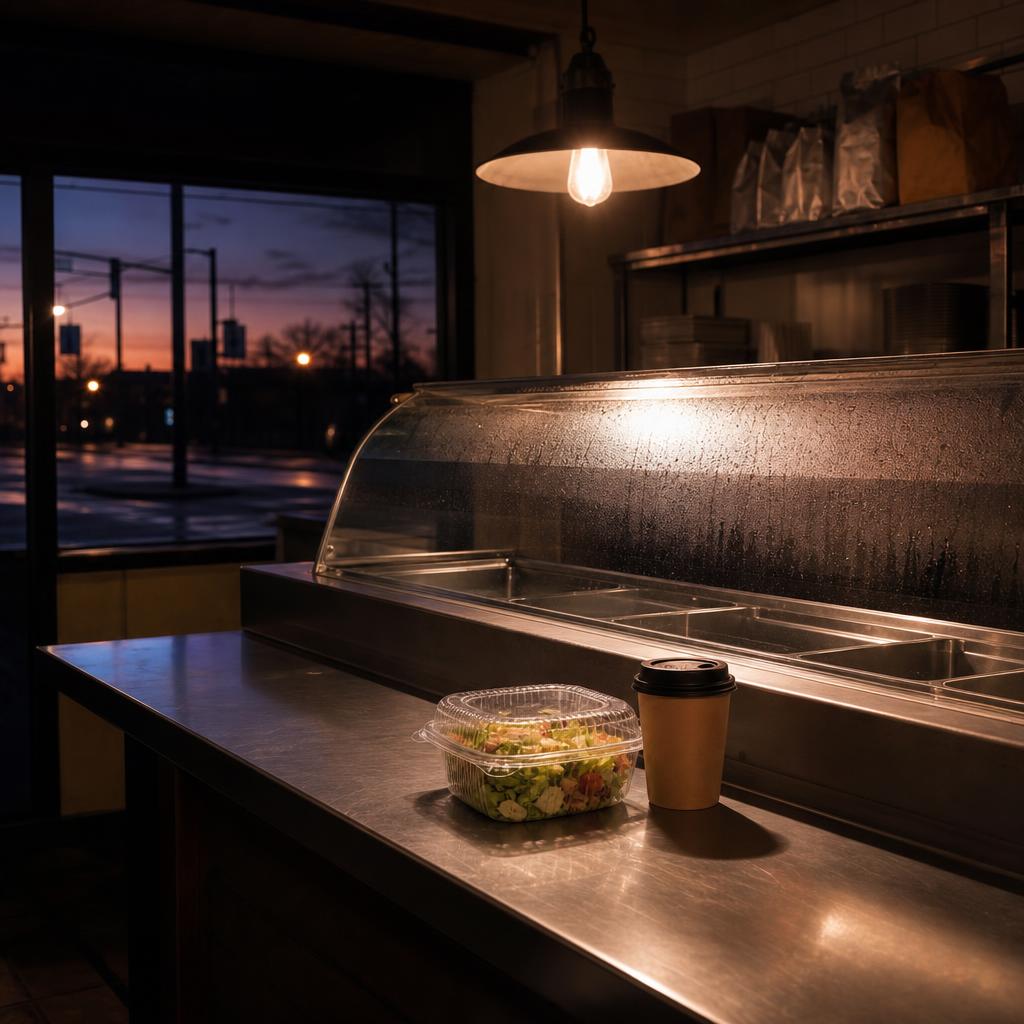
Beneath the editor’s table sat a parallel economy the tax code never touched, because it had never been deductible in the first place. An editorial assistant’s lunch in 1989 came from a coffee cart on the corner or a sandwich counter, paid for out of a salary that left ten or fifteen dollars a day for food altogether, and it had nothing to do with what happened at Michael’s an hour later. What changed across the decade was not the assistant’s budget so much as the format the budget bought. Through the late 1980s the standard lunch below the editor’s rank was a sandwich, a slice, or a hot dog, eaten walking or standing. By 1996 it was, for a majority of Midtown office staff, a weighed salad from a Korean-owned deli’s self-serve bar, carried back to a desk in a clear plastic clamshell and eaten over an open galley or a filing drawer — delis run overwhelmingly by Korean immigrant families who had built the city’s independent deli trade since the mid-1970s.
The components of that lunch had, by mid-decade, become as standardized as a diner’s eight desserts: field greens or romaine sold by the pound, two ounces of grilled chicken, a scoop each of chickpeas and cherry tomatoes, a plastic souffle cup of dressing sealed with a foil lid, a stray handful of crackers taken free from the soup bar beside it. The chains that grew up to serve the same demand arrived on a clear clock: Hale and Hearty Soups opened on West Forty-ninth Street in 1995, Cosi opened in the same corridor the following year, and Pret A Manger, the British sandwich-and-salad importer, opened its first American store on Broad Street in 2000. Each formalized, at a slightly higher price and with a name over the door, what the Korean deli’s self-serve bar had already taught a decade of office workers to expect: lunch as a transaction measured in ounces, eaten somewhere other than a table.
The other daytime ritual the desk salad displaced only partly was the specialty counter, and the sharpest of these belonged to Al Yeganeh, whose Soup Kitchen International had operated at 259-A West Fifty-fifth Street since 1984, drawing a line down the block by midday under an ordering protocol strict enough that Yeganeh became, six years before Seinfeld’s “The Soup Nazi” episode aired in November 1995, the subject of a New Yorker “Talk of the Town” piece in which he put his own rule plainly: “The customer is always wrong.”.9 The soup belonged to the same daytime economy as the Korean deli’s salad bar — priced for a working lunch, eaten fast, carried back rather than sat down to — and it survived the desk salad’s rise precisely because it never tried to compete with it on time. A person who wanted Yeganeh’s soup budgeted the wait as part of the meal.
Beneath even the desk salad ran a cheaper daytime tier that the decade barely touched: a folded dollar-fifty slice at a corner pizza counter, a Sabrett cart hot dog and a Coke at a park entrance, or, for a smaller and more particular clientele, the Recession Special at Gray’s Papaya — two hot dogs and a papaya drink, priced under two dollars for most of the period — eaten standing at a Broadway counter alongside a cab driver, a Wall Street analyst, and a Columbia undergraduate with no other point of contact among the three of them. None of this tier required a plastic fork or a chair, and none of it moved with the tax code at all; it had never been anyone’s expense-account lunch to lose.
The Sidewalk Exile
An ashtray sat on every desk on an editorial floor through 1994, and the phrase “going for a cigarette” did not describe anything, because there was nowhere to go. A senior editor smoked while marking a galley, a copy editor smoked at the light table, and the accumulated tar of a decade sank into the carpet, the drapery, and the spines of the books on the shelf behind the desk closely enough that a cleaning crew wiped the computer terminals for film every week. The single fact that ended this arrangement had a date and a signature. Mayor Rudolph Giuliani signed Local Law 5 of 1995, the city’s Smoke-Free Air Act, on January 10, 1995, banning smoking in most workplaces of fifteen employees or more, in restaurants seating thirty-five or more, and in taxicabs; bars, small restaurants, and separately ventilated rooms were exempted and stayed legal-smoking for years afterward.10 An editorial floor’s ashtrays came off the desks within weeks of the signing.
What replaced the desk ashtray was the sidewalk, and the sidewalk did work the desk had never done. A heavy smoker now left the building six or eight times a day for a round trip of ten or twelve minutes — the elevator down, a few paces to the legal line at the curb, the cigarette, the walk back — and the trip put people together who had no other five minutes in common. A junior copy editor and the editor-in-chief, who might otherwise never share an unscheduled interval in the same day, stood at the same loading dock; a magazine’s photo editor met a rival magazine’s assistant at the same corner, because the two buildings shared a curb even when they shared nothing else. Gossip, complaints, and unguarded pitches moved through that ten-minute window in a way they had never moved through the old smoke-filled office, where everyone smoked in place and nobody had to leave a desk to do it. By 1996 the sidewalk crowd outside a Midtown tower — eight people in fair weather, two dozen in foul — was as fixed a feature of the building as its lobby directory, and a non-smoker’s exclusion from it was, by decade’s end, a documented professional disadvantage rather than a private annoyance; some non-smokers began accompanying the smokers outside and standing at the edge of the huddle holding nothing at all.
A second daytime errand grew up to meet part of the same need, on a clock the cigarette break had vacated only partway. Starbucks opened its first New York City store at Eighty-seventh Street and Broadway on April 23, 1994, and its second, at Astor Place, on March 30, 1995 — eleven weeks after the smoking law took effect — and by 1996 a Starbucks or an imitator sat on nearly every other Midtown corner.11 The coffee walk, five or ten minutes with a colleague sometimes along for it, absorbed roughly half of what the smoke break had done: a reason to leave the floor, a corridor conversation extended onto the sidewalk. It never fully replaced the other half. A cigarette break could happen eight times a day without anyone remarking on the frequency; a coffee run twice in one morning drew a comment.
A third errand absorbed a smaller share still, concentrated in a narrower demographic. As Midtown magazine offices clustered near the health clubs that had opened to serve them, a lunch hour that ran from half past twelve to half past one became, for a slice of upper-tier staff by the late 1990s, a gym hour instead — the shower and the change of clothes replacing the meal itself, the return to the desk unaccompanied by so much as a sandwich. The gym lunch shared nothing with the cigarette break except the hour it occupied and the fact that it, too, left the desk empty on a schedule the rest of the floor learned to work around.
The Office Bottle and the Working Hangover
Drinking in a 1989 magazine office was institutional rather than incidental — the expense-account dinner with two cocktails and a bottle of wine, the after-work drink at the bar around the corner, the launch party, the layout-night vodka tonic poured in the conference room while an issue closed near dawn — and the arrangement left few days of the week on which the body got an actual rest. The working hangover was, for a meaningful share of the staff, the ordinary condition of a weekday morning rather than an event: aspirin with the coffee, a bacon-egg-and-cheese from the cart as the recognized cure, the mythology holding that the writers’ room, the photo department, and the masthead all carried a low-grade hangover most mornings and produced the issue anyway. A Bloody Mary at a desk, poured into a coffee mug for the appearance of it, was visible without being remarked on at a handful of magazines through 1991; the same drink at the same hour a decade later read, at nearly every address, as a problem rather than a style.
Above a certain rank a senior editor’s office commonly held its own supply, a bottle kept in the bottom drawer rather than announced on a shelf — bourbon, scotch, or vodka, poured for a story that had closed well, a manuscript that had been killed, or a Friday-afternoon conversation that functioned as informal mentoring. The bottle thinned across the decade in step with the lunch it echoed: common enough in 1990 to draw no comment, migrated by the late 1990s to the editor-in-chief’s office or the publisher’s suite alone, and largely gone from the ordinary editor’s drawer by decade’s end.
What filled the glass changed on its own clock, independent of the tax code and the smoking law alike. The vodka tonic and the vodka martini dominated the turn of the decade, gin still carrying a faint Prohibition-era suspicion that had never fully lifted; the Cosmopolitan, popularized by the bartender Toby Cecchini at the Odeon in TriBeCa in the late 1980s and treated more fully in this archive’s account of the restaurant at night, spread through the early 1990s and reached a genuinely mass audience once a television comedy about single women in Manhattan began broadcasting on June 6, 1998, by which point ordering one at a magazine dinner signaled almost nothing distinctive at all.13 Bourbon sat, through the entire period, at the bottom of a fifty-year market trough — the young drank vodka, and a well-aged bottle went for the price of an ordinary one, so a character reaching for bourbon in 1995 was reaching for something the market itself had priced as old-fashioned. What the drinking did to the body across years rather than evenings — the liver, the accident, the slow dulling of a mind that still turned up and still filed — is treated at length elsewhere in this archive; on the floor itself, in any given year, the damage was rarely the story anyone told about a colleague who could still make deadline.
A person who did not drink at all was, against this background, a conspicuous fact requiring some kind of explanation, whether or not anyone asked for one out loud. Recovery through Alcoholics Anonymous or another twelve-step program was the most common cover story, followed by pregnancy, religious observance, or a medical condition serious enough to rule the question out entirely; a plain preference for sobriety, offered without a reason attached, barely registered as an available option through most of the period. By the back half of the decade the social cost of declining a drink had eased somewhat — sparkling water proliferated on its own account, a flat “I’m not drinking tonight” sometimes passed without further inquiry — and a visible alumni network from the city’s own recovery rooms had, by then, reached into editorial positions on more than one masthead.
The Body Without a Name
A condition could be common on an editorial floor for a decade before medicine gave it a name, and the male body carried exactly this kind of condition through the 1990s. Harrison Pope, a psychiatrist at Harvard Medical School and McLean Hospital, described a syndrome he called “reverse anorexia nervosa” among male bodybuilders in a 1993 paper, co-written with David Katz and James Hudson; four years later, writing with Amanda Gruber, Precilla Choi, Roberto Olivardia, and Katharine Phillips, Pope renamed the condition “muscle dysmorphia” in a 1997 paper, and the same three later authors did not publish the popular-audience account, The Adonis Complex, until 2000, at the very end of the period this account covers.1415 Through the years in between, a man on a Chelsea gym schedule six days a week, or an editor at his own desk convinced his arms read as small in a mirror no one else was watching, had no public vocabulary for what was happening to him.
The law caught up to the pharmacology in the same window. The Anabolic Steroids Control Act, signed on November 29, 1990, added anabolic steroids to Schedule III of the Controlled Substances Act, making unauthorized possession a federal offense for the first time.16 The same years opened a legitimate channel running alongside the illegal one: the FDA approved oxandrolone for HIV-associated wasting in 1995, and testosterone replacement became standard care for hypogonadal HIV-positive men through the HAART era that began the following year, so that a prescription pad and a black-market gym supplier could produce, in the right Chelsea zip code, a nearly identical result by different paperwork. The visible outcome by 1996 was a recognizable type — broad-shouldered, narrow-waisted, low body fat, the barbed-wire bicep tattoo and the tank top standard enough to read as a uniform rather than a style — tracked geographically to the gyms that had opened to serve it, without either the men who trained for it or the doctors who prescribed around it having a clinical term ready to hand. A black market ran underneath the legitimate pipeline for anyone the prescription pad did not reach: pharmaceutical-grade product imported from Mexico, bodybuilding magazines carrying coded classified advertisements, and human growth hormone priced well into four figures a month for a supply obtained outside any prescription at all.
Women on the same floor met a parallel chemistry with a harder deadline. Fen-Phen, the off-label pairing of phentermine with fenfluramine or its successor Redux, traced to a 1992 clinical study and spread into wide private-practice use, some Manhattan doctors writing dozens of prescriptions a week by mid-decade. In July 1997 the Mayo Clinic reported a heart-valve finding the New England Journal of Medicine formalized the following month, and the FDA withdrew both drugs from the market on September 15, 1997 — a reversal fast enough that a woman on the drug in August was, by October, sitting in a cardiologist’s office for an echocardiogram she had not expected to need.17 Magazine staff, women more often than men but a real cohort of men as well, had been on the drug in the years just before the withdrawal, and the same floor that had never named muscle dysmorphia had, in this instance, a specific date to hold responsible instead of a diagnosis.
Fen-Phen sat inside a wider decade of fat-free bargaining that reached the same desks by gentler means.18 Nabisco’s SnackWell’s line, launched in 1992, sold an entire aisle on the proposition that a cookie without fat was a cookie without consequence, and a string of best-selling diet books — a 1992 reissue of the Atkins program, Barry Sears’s The Zone in 1995 — offered competing rules for the same appetite. Cocaine’s appetite-suppressing effect, treated at length elsewhere in this archive’s account of the drug itself, sat quietly underneath the thinness that fashion and magazine work prized in these years — a chemical explanation available to anyone willing to look past the discipline a very thin editor was otherwise credited with.18
The straight half of the floor’s anxiety about its own body ran almost entirely without vocabulary, professional counsel, or product. A heterosexual editor’s grooming kit in 1989 held soap, a disposable razor, a can of shaving cream, deodorant, and a bottle of cologne given as a gift; a man who owned a moisturizer in 1993 was legible, in most Midtown rooms, as gay, European, or simply unusual. The one exception the straight body did admit to public discussion was hair loss: Rogaine went over the counter in 1996, and Propecia won FDA approval the following year, opening a private chemical option for a condition the plugs and the toupee had made visible for a generation before it.19
The Body’s Chronology, Men
| Year | Marker |
|---|---|
| 1990 | Anabolic Steroids Control Act signed, Nov. 29 |
| 1992 | David Barton Gym opens near Union Square |
| 1993 | Pope, Katz, and Hudson describe “reverse anorexia nervosa” in male bodybuilders |
| 1995 | Oxandrolone approved for HIV-associated wasting |
| 1996 | Rogaine goes over the counter; the Chelsea “circuit body” is a recognized type |
| 1997 | Muscle dysmorphia formally named; Fen-Phen withdrawn, Sept. 15; Propecia approved |
| 1998 | Viagra approved, Mar. 27 |
| 2000 | The Adonis Complex publishes |
What the body did between nine and six, and what it did to itself keeping that schedule, answered to rules the magazine’s own masthead never printed but every editor obeyed anyway: a tax code that decided how long a lunch could last before someone had to account for it; a city ordinance that decided where a cigarette could be smoked, and in doing so turned a private habit into an unlikely daily gathering on the sidewalk; and a slower medicine, running on drugs and diagnoses not yet named, under which a body could change shape for years before anyone had a word for what was happening to it. None of these kept pace with the clock on the conference-room wall, and the gap between them was where an ordinary Tuesday actually lived — in the ninety minutes an editor no longer had for lunch, in the ten spent on a sidewalk with someone from another floor, in a mirror a man checked without telling anyone why. The magazine printed the decade’s arguments; the body kept its own accounts underneath them, and never once stopped.
The August 1993 cut to the business-meal deduction would have read, at the front of the book, as a plain item for The Front — the deduction cut a second time in six years, this one from eighty percent to fifty, and a magazine that carried its own expense accounts through the same tax code would have had reason enough to notice. The piece would have carried no name off the floor, only the plain arithmetic of the change, and it would have reached every masthead in the building the same week the law took effect. The Front would have run it that fall, timed to the statute’s own date rather than to any editor’s discovery of it, in the issue closing that November.
A pitch built from the Anabolic Steroids Control Act would have gone the other way. Whoever carried it into the room would have carried along with it a private taste for the Chelsea gym story underneath the statute, and that taste alone would have bought the pitch a second reading nobody else at the table particularly wanted to give it. The second reading would not have been enough. The room would have closed on it, and the pitch would not have run.
Footnotes
-
Tina Brown, The Vanity Fair Diaries (Henry Holt and Co., 2017), on Condé Nast’s expense culture under S.I. Newhouse Jr. ↩
-
Tax Reform Act of 1986, Pub. L. No. 99-514, §142 (Oct. 22, 1986), reducing the business-meal and entertainment deduction from 100 percent to 80 percent effective the 1987 tax year. ↩
-
Omnibus Budget Reconciliation Act of 1993, Pub. L. No. 103-66, §13209 (Aug. 10, 1993), further reducing the deduction to 50 percent effective the 1994 tax year. ↩
-
Michael’s, the Four Seasons Grill Room, the ‘21’ Club, and Le Cirque are treated at length elsewhere in this archive’s account of class at the table. ↩
-
Hugh Pearman, “Frank Gehry’s Condé Nast Cafeteria,” The Times (UK), 2000. ↩
-
Kurt Andersen, “The Empire,” The New York Times Magazine, 1999, on the Condé Nast move to 4 Times Square. ↩
-
Jane Levere, “New York City Restaurants Celebrate 30th Anniversary of Restaurant Week Promotion,” Forbes, July 31, 2022, on the promotion’s July 1992 origin. ↩
-
Margalit Fox, “Leslie Buck, Designer of Iconic Coffee Cup, Dies at 87,” The New York Times, April 29, 2010. ↩
-
Alex Prud’homme, “Slave,” The New Yorker (“Talk of the Town”), January 23, 1989. ↩
-
New York City Local Law 5 of 1995 (Smoke-Free Air Act), signed by Mayor Rudolph Giuliani, Jan. 10, 1995. ↩
-
Bryant Simon, Everything but the Coffee: Learning About America from Starbucks (University of California Press, 2009), on the chain’s 1994–95 entry into Manhattan. ↩
-
U.S. Food and Drug Administration drug-approval history: Nicorette gum (prescription 1984, over the counter 1996), Nicoderm CQ and Habitrol patches (prescription 1991, over the counter 1996), Nicotrol inhaler and nasal spray (1996), Zyban/bupropion (approved for smoking cessation 1997). ↩
-
Toby Cecchini, Cosmopolitan: A Bartender’s Life (Broadway Books, 2003), on tending bar at the Odeon and the drink’s spread from there. ↩
-
Harrison G. Pope Jr., David L. Katz, and James I. Hudson, “Anorexia Nervosa and ‘Reverse Anorexia’ Among 108 Male Bodybuilders,” Comprehensive Psychiatry 34, no. 6 (1993): 406–409; and Harrison G. Pope Jr., Amanda J. Gruber, Precilla Choi, Roberto Olivardia, and Katharine A. Phillips, “Muscle Dysmorphia: An Underrecognized Form of Body Dysmorphic Disorder,” Psychosomatics 38, no. 6 (1997): 548–557. ↩
-
Harrison G. Pope Jr., Katharine A. Phillips, and Roberto Olivardia, The Adonis Complex: The Secret Crisis of Male Body Obsession (Free Press, 2000). ↩
-
Anabolic Steroids Control Act of 1990, Pub. L. No. 101-647, Title XIX (Nov. 29, 1990), placing anabolic steroids in Schedule III of the Controlled Substances Act. ↩
-
Hartzell M. Connolly et al., “Valvular Heart Disease Associated with Fenfluramine-Phentermine,” New England Journal of Medicine 337 (Aug. 28, 1997): 581–588; the FDA withdrew both fenfluramine and dexfenfluramine from the market on September 15, 1997. The fenfluramine-phentermine combination itself traced to a 1992 clinical study by the pharmacologist Michael Weintraub. ↩
-
Harvey Levenstein, Paradox of Plenty: A Social History of Eating in Modern America (Oxford University Press, 1993), on the era’s fat-free and low-carbohydrate diet cycles. Cocaine’s use as an appetite suppressant in the magazine and fashion trades is treated at length elsewhere in this archive’s account of the drug itself. ↩ ↩2
-
U.S. Food and Drug Administration drug-approval records: Rogaine (minoxidil) switched from prescription to over-the-counter status in February 1996; Propecia (finasteride) approved December 19, 1997; Viagra (sildenafil citrate) approved March 27, 1998. ↩
-
Mark Simpson, “Here Come the Mirror Men,” The Independent, Nov. 15, 1994. ↩