Higher Powers: Twelve-Step, Yoga, and the New Metaphysics, 1989–2001
Subscribe
https://meridian-archive.com/feed.xmlOpen in your app, or paste the link above into any other:
The Program’s Own Law
Alcoholics Anonymous’s Eleventh Tradition, adopted in 1953, held that the program’s public-relations policy rested on attraction rather than promotion, and that a member needed to maintain personal anonymity “at the level of press, radio, and films” — a formula built for the newsreel era that, in 1989, still governed what a New York magazine editor in the program could publish, under her own name, about her own recovery.1 No employment contract wrote the rule down and no outside body enforced it; it operated inside the city’s magazine offices as an unlisted condition of the job for any reporter or editor who belonged to a program, observed on the page even by writers forty blocks from the basement that had taught it to them. The convention was broken periodically and publicly through the recovery-memoir boom of the following decade.2 The violation was itself the story each time; anonymity’s value was measured, in practice, by how much attention its breach produced.
The rooms the Tradition governed were themselves a fixture of the city’s institutional furniture. In the basement of a building at 50 Perry Street, in the West Village, a twelve-step meeting had been convening several times a week without interruption since September 1958. It had never been cancelled — not for weather, not for a transit strike, not on the night in November 1965 when the city’s power failed and a scheduled speaker walked down from the Upper East Side in the dark rather than let the meeting go unheld.3 By 1989 the group, known within the program as the Perry Street Workshop, was thirty-one years old, and it kept meeting on the same schedule through the recession, the crack years, the AIDS decade, and the stock-market boom that followed it, unmoved by any of them.
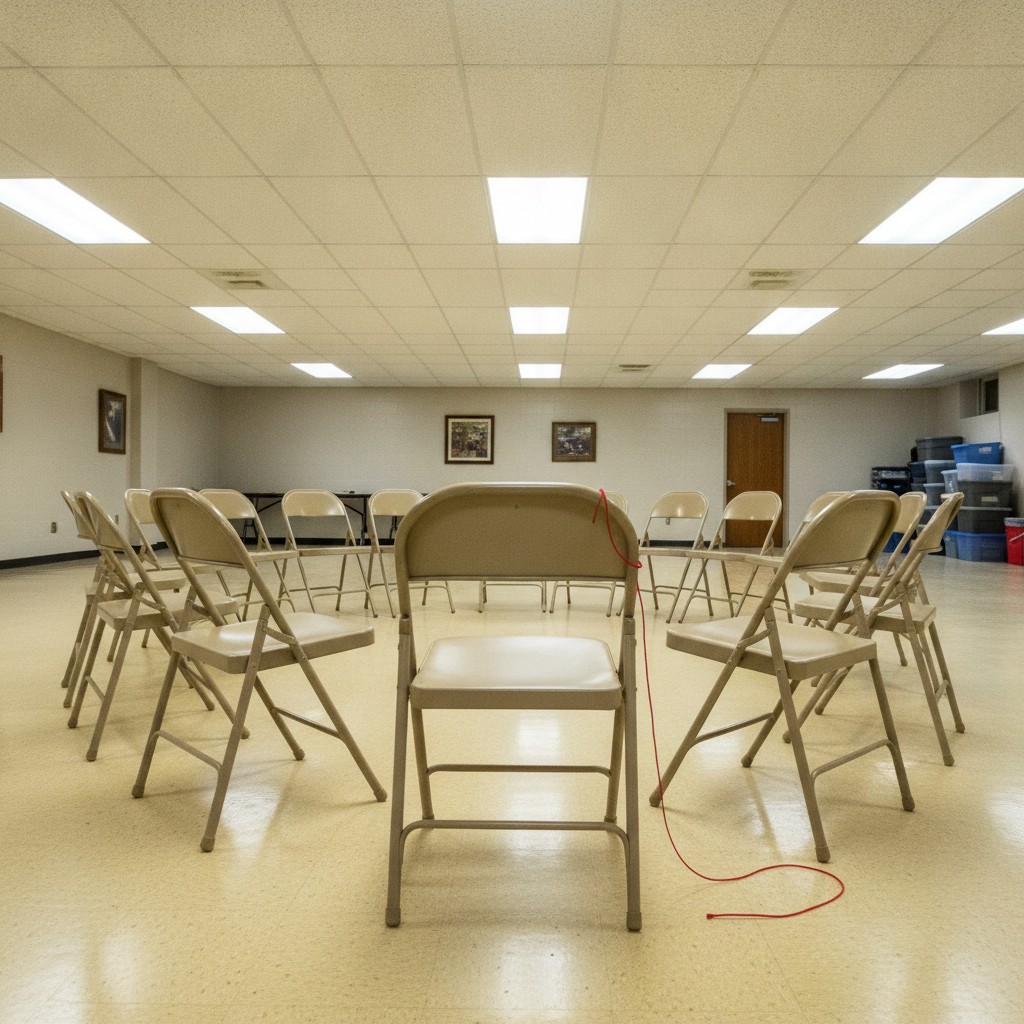
The room’s format — the folding chairs, a chapter of a book read aloud at the meeting’s start, the coffee urn, the newcomer’s raised hand — descended from an evangelical movement called the Oxford Group, inside which the program’s co-founder, Bill Wilson, first got sober in 1934 through the influence of a friend, Ebby Thacher. Wilson and Bob Smith broke from the Oxford Group in 1937, over the older movement’s insistence on subordinating a drinker’s recovery to a broader Christian mission and its lack of any democratic structure among members; the Twelve Steps that resulted kept the Oxford Group’s architecture of moral inventory, restitution, and surrender to an outside authority, while replacing that authority’s denomination with a phrase built to fit any believer or none: a Higher Power, as the newcomer understood Him.4 The compromise was the load the entire program carried afterward — an agnostic magazine editor, a Catholic doorman, a Reform Jewish accountant, and a lapsed Baptist could each walk into the same basement and fill in the same pronoun differently, without the room asking which.
Recovery ran through a second person as much as through the steps themselves: a sponsor, older in the program, available for a phone call at the hour a drink began to look reasonable.
Which meeting a person attended sorted the city almost as finely as which restaurant did.
The Studio
Doing yoga in Manhattan in 1991 required an explanation few of the people making the trip to the mat had ready. Two studios sorted the city’s aspirants by temperament rather than geography. At the Iyengar Yoga Institute of New York, on West Twenty-Second Street in Chelsea, students left their shoes at the door of a bare white room with no music playing, and a teacher trained through a demanding certification process walked each body into a posture and adjusted it by hand — a palm on the sacrum, a strap around a thigh, a wooden block or bolster propping what the body could not yet hold alone. The style, developed by B.K.S. Iyengar and taught in New York from the 1970s on, rewarded precision and repetition over any particular belief; a drop-in class ran twelve to eighteen dollars through most of the decade, and a student could attend for years without hearing a word of scripture.6
A few miles downtown, in the East Village, Sharon Gannon and David Life had founded a different style of yoga in 1984, teaching it above a Thai restaurant and a jazz club on Second Avenue, up a set of rickety stairs, under strings of Christmas lights hung on images of saints and Hindu deities and clouded with the smoke of Nag Champa incense. Jivamukti’s classes opened with a chanted verse and a passage of scripture read aloud, moved through a vigorous vinyasa sequence, and carried an explicit ethic — vegetarianism, animal-rights advocacy — that the Iyengar studio asked of no one. By the middle of the decade the East Village studio had acquired a following the Chelsea studio never sought: Christy Turlington, Sting, and Madonna passed through its classes, and a magazine that had treated the practice as a fringe curiosity in 1990 put a model with a rolled mat on its cover within a few years.7 In 1998, Jivamukti moved its growing membership into a nine-thousand-square-foot studio at 404 Lafayette Street, across from the Public Theater — a lease that measured, in square footage, how far the practice’s audience had travelled from the rickety stairs above the jazz club.
The Centre
The Kabbalah Centre entered Manhattan by a route that ran through Los Angeles rather than through any synagogue. Philip Berg and his wife Karen Berg rebuilt an existing Israeli kabbalistic institution into a commercial spiritual-education organization, opening a Los Angeles centre in 1984; the American expansion accelerated through the early 1990s, and a Manhattan office was operating by the middle of the decade, its exact address unsettled across the years the way a growing franchise’s addresses tend to be.8 What a student bought there was itemized with retail clarity: an introductory course run in cohorts of roughly fifteen, a course on the Seventy-Two Names of God, study groups working through the Zohar, bottled water blessed by the Centre at a premium price, and — the object that outlasted every course description — a length of red string, wound first around the tomb of the matriarch Rachel in Israel, then cut and sold in New York for twenty-six dollars a length.9
The string acquired a second life once the singer and actress Madonna affiliated with the Centre, an introduction made by Sandra Bernhard around 1996 or 1997; by 1998, with Madonna’s involvement public, the string had migrated from a niche spiritual purchase to a recognizable celebrity accessory, worn by Demi Moore and, in time, by a widening circuit of actors and musicians who had never opened a Zohar.9 For the magazine class the Centre produced two postures that ran at once rather than in sequence. One was mockery: a red string on a famous wrist was, in a downtown magazine or a party conversation on the Upper East Side, a punchline about credit-card mysticism, the joke aimed less at the seeker than at the transaction. The other was quieter and rarer — a handful of staff members, disproportionately women in their thirties moving through a stretch of the decade that had unsettled something else in their lives, went to the Centre without irony, paid the monthly fee that ran to the low hundreds of dollars, and stayed with it for a year or two before their lives stabilized and they drifted away. Both postures could be held by the same masthead in the same month, occasionally by the same person.
A Geography of Practice
Each discipline kept a fixed address a Manhattan practitioner could walk to, though not every address held for the whole decade.
| Practice | Address | Note |
|---|---|---|
| Twelve-step (Perry Street Workshop) | 50 Perry Street | meeting continuously since September 1958 |
| Iyengar Yoga Institute of New York | 150 W 22nd Street | teaching there from the 1970s |
| Jivamukti Yoga | Second Avenue, above a Thai restaurant | in use to 1998 |
| Jivamukti Yoga | 404 Lafayette Street, 3rd floor | in use from 1998 |
| Kabbalah Centre | a Manhattan office | address unsettled through the decade |
| Tibet House | 22 W 15th Street | founded 1987 |
| Zen Mountain Monastery | Mount Tremper, NY (Catskills) | founded 1980 |
Cushion and Concert Hall
Manhattan’s Buddhism ran on two tracks that rarely required a person to choose between them. The cultural track was Tibet House, founded in 1987 at the Fourteenth Dalai Lama’s request by the Columbia scholar Robert Thurman, the actor Richard Gere, and the composer Philip Glass, and housed at 22 West Fifteenth Street in the Flatiron district — a library, an exhibition space, a program of teachings, and, from the early 1990s, an annual benefit concert at Carnegie Hall organized by Glass that drew a magazine-class audience curious about the Dalai Lama without any expectation that they take vows. David Bowie played the benefit in 2001; Patti Smith appeared there more than once across the decade.10 Attending required no cushion, no early wake-up, no silence — only an evening’s cultural attention.
The practice track ran two and a half hours north, in the Catskills, at Zen Mountain Monastery, founded in 1980 by John Daido Loori on two hundred twenty acres of forest at Mount Tremper. A newcomer’s introduction was typically a weekend retreat rather than the full multi-day sesshin the monastery also offered: a four o’clock morning bell, thirty-five-minute periods of zazen broken by kinhin, walking meditation, between them, meals eaten in silence from nesting bowls in the formal style called oryoki, and, for a student who requested it, a private interview with the teacher called dokusan, along with the kyōsaku — a flat wooden stick laid across the shoulders at a sitter’s own request to snap a wandering mind back into the room.11 The weekend was survivable in a way the working week back in the city rarely felt; the absence of alcohol for two days was, for some who made the drive, the retreat’s least advertised benefit.
Between the two tracks ran a middle current: Tricycle: The Buddhist Review, founded in New York in 1991 and edited by Helen Tworkov, with contributors including Thurman and the British writer Stephen Batchelor.12 It was Buddhism read on the subway, cover to cover, by staff members who did not call themselves Buddhist and did not drive to the Catskills on a Friday night to prove it.
The Lapsed
Most of the people working in Manhattan publishing in 1989 had been raised inside a religious tradition and no longer practiced it, and “lapsed” described a spectrum rather than a single condition. At one end sat the person who returned once a year — the Christmas Eve Mass, the Yom Kippur service at a family synagogue, the Easter pew occupied without confession or explanation — a body that still knew, on the one day it needed to, when to stand and when to kneel. At the other end sat the person who had stopped attending anything at all, sometimes by a private objection carried since young adulthood. Between them sat a third mode that belonged to neither belief nor attendance: an attachment to the aesthetic apparatus of a religion practiced by other people, or by no one — an educated New Yorker who entered a church not for the service but for the building, the silence, the light through a rose window, without ever intending to sit among a congregation.
The attraction extended to sound as readily as to stone. Thomas Tallis’s forty-part motet Spem in alium, unperformed for most listeners’ lives until a recording brought it back into circulation, became a minor vogue of the decade; Arvo Pärt’s 1984 record Tabula Rasa sat on shelves next to novels and jazz, its composer alive and still working through the decade the record was collected in. The Book of Common Prayer, revised in 1979 for the Episcopal Church, supplied cadences to secular prose the way the King James Bible had supplied them to an earlier generation of writers who never opened either book for its instructions.13 None of this required faith; it required only an ear and a habit of visiting what belief had built.
Faith reasserted itself, when it did, without asking permission. Under a specific kind of pressure — a hospital corridor at three in the morning, a plane dropping through turbulence over an ocean, a sound landing closer than the last one — a person raised Catholic and unbelieving for twenty years found the words of the Hail Mary arriving on their own schedule, a sentence typed into memory at six years old and never fully erased by any subsequent decade of disuse. It surfaced closer to a flinch than a prayer, and the person who heard it come out of their own mouth was rarely able to say, afterward, that they believed anything at all.
The Chart and the Crystal
A curiosity about astrology, tarot, and the body’s supposed energy fields ran through the decade without most of its practitioners calling it a religion or even much of a commitment. Susan Miller launched her monthly horoscope column, Astrology Zone, in 1995, and a magazine staff member could read that month’s forecast on a lunch break the way an earlier reader had read the daily paper’s stars — a Mercury-retrograde joke that started as irony and, by the late 1990s, had become a genuine scheduling consideration for some of the people making it.14 Tarot readers worked weekend tables in SoHo and the Village for twenty to forty dollars a half-hour sitting, dealing the same Rider-Waite-Smith deck a browser could also buy at any downtown bookstore. Reiki, a Japanese energy-healing technique brought to the American mainland by Hawayo Takata in 1973 and taught in New York by a growing number of certified practitioners through the decade,15 ran fifty to a hundred dollars a session in a Chelsea or East Village studio; crystals, aura readings, and Louise Hay’s paperback affirmations sold alongside each other at the same stores.
Deepak Chopra supplied the decade’s most visible bridge from this scattered practice into mainstream publishing. His Ageless Body, Timeless Mind, published by Crown in July 1993, sold more than a million and a half copies and put the vocabulary of quantum healing into casual conversation; his later television appearances carried the same vocabulary to readers who never set foot in a Reiki studio.16 The sociologist Wade Clark Roof named the pattern in 1993, describing a generation of religious seekers operating outside any single tradition; the phrase “spiritual but not religious” itself only settled into general use at the decade’s close, a name arriving for something that had been forming, unnamed, for most of the years behind it.17
The Memorial, Not the Funeral
For a magazine class that was substantially gay and substantially lapsed, and that spent much of the decade’s first half attending an unusual number of deaths, formal religion frequently declined to officiate. A Catholic parish might refuse a funeral rite outright or decline to recognize a surviving partner as next of kin; a Protestant church’s welcome varied parish to parish; an Orthodox Jewish burial proceeded by religious law regardless of the deceased’s sexuality but left an unmarried partner without standing at the service. Many of the dead had themselves been lapsed and had no parish or congregation left to claim them. Where the losses fell on the editorial floor itself, and how the magazine’s own coverage answered them, is an account kept elsewhere;18 what belongs here is the private ritual mourners built in religion’s absence, since building it was itself a form of practice.
The form that emerged repeated with enough consistency across the decade that it functioned, by the mid-1990s, almost as a liturgy of its own. It was held weeks after the death rather than days after, once a family funeral elsewhere had already happened without the chosen family present. It took place in a bookstore, a theater, a gallery, an apartment — a church only when the expected crowd made a church the only room large enough — with no officiant, a friend serving as master of ceremonies, and no requirement of permission before a mourner stood to speak. A slide projector ran through photographs. A song from the dead person’s own record collection played whole, not as background, and a friend read aloud: often a poem, sometimes a paragraph the dead person had written and published, sometimes W. H. Auden’s “Stop all the clocks,” sometimes Mary Oliver’s “Wild Geese.” Afterward the room emptied into a bar, the wake’s oldest form surviving intact even where every other element of a funeral had been replaced.
One further object completed the ritual for those who chose it: a panel for the NAMES Project AIDS Memorial Quilt, an idea begun by Cleve Jones in 1985 and formalized as an organization in 1987, each panel sewn to a fixed dimension of three feet by six feet — the size, exactly, of a grave.19 A New York chapter ran panel-making workshops in which volunteers who had never threaded a needle sat with a mourner, listened to what the dead person had been like, and stitched the story into fabric only afterward: a typewriter appliquéd for a writer, a camera for a photographer, a line copied whole from a letter. Scattering a body’s ashes across the city was, in most cases, illegal or logistically fraught; the panel became the object the city would let a mourner make.
None of this amounted to a single religion replacing the ones the decade’s professionals had left behind; it amounted to a private economy of substitutions, each traded for a specific thing the old religion had once supplied and no longer did — a sponsor for a confessor, a folding chair for a pew, a slide projector for a requiem. The people assembling these substitutes rarely called themselves spiritual seekers; asked directly, most described themselves only as doing yoga, or going to a meeting, or getting through a Tuesday. What they were actually doing was maintaining, piece by improvised piece, the machinery a formal religion is built to run — obligation, repetition, confession, memorial — long after most of them had stopped believing the machinery needed God to operate it. The decade did not resolve what any of it was for. It only proved, city block by city block, that the question never stopped being asked.
The red string would have reached Meridian’s pages only in the thinner version the room’s register allowed. Once Madonna’s affiliation with the Kabbalah Centre went public in 1998, the fuller account — the handful of staff members who would have gone to the Centre without irony, paid its monthly fee, and drifted away from it a year or two later — would have arrived at the desk in a tone the house could not have written straight. What The Front would have carried instead, in the November 1998 issue, would have been the lighter version: a front-of-book item mocking the string as credit-card mysticism on a famous wrist, the joke aimed at the transaction rather than the believer, with none of the quieter reporting left in it.
Tricycle: The Buddhist Review, founded in 1991, would never have reached a pitch meeting. The doubt would have been immediate and durable: whether a quarterly built for practitioners answered to the magazine’s own readership at all, and no one on the masthead would have carried both the standing and the practice to argue it past a paragraph.
Footnotes
-
Alcoholics Anonymous World Services, Twelve Steps and Twelve Traditions (New York: AA World Services, 1953), Tradition Eleven. ↩
-
Caroline Knapp, Drinking: A Love Story (Dial Press, 1996). Pete Hamill’s earlier memoir, A Drinking Life (Random House, 1994), broke the same anonymity convention two years before. ↩
-
“50-Perry-Pamphlet” (50th anniversary retrospective), AA Agnostica, 2008, on the Perry Street Workshop’s continuous meeting history since September 1958 and the 1965 blackout. ↩
-
“History of Alcoholics Anonymous,” Wikipedia, on Bill Wilson’s 1934 sobriety through Ebby Thacher and the 1937 separation from the Oxford Group. ↩
-
New York Inter-Group, “Mustard Seed” meeting listing, nyintergroup.org. ↩
-
Iyengar Yoga Institute of New York, iyengarnyc.org, on the institute’s Chelsea address and teaching method. ↩
-
“Jivamukti Yoga,” Wikipedia, on the 1984 founding by Sharon Gannon and David Life and the 1998 move to 404 Lafayette Street. ↩
-
“Kabbalah Centre,” Wikipedia, on Philip and Karen Berg’s 1984 Los Angeles centre and the organization’s 1990s American expansion. ↩
-
“Red string (Kabbalah),” Wikipedia, on the string’s origin at the tomb of Rachel, its price, and Madonna’s affiliation via Sandra Bernhard. ↩ ↩2
-
“Tibet House US,” Wikipedia, on the 1987 founding, the Fifteenth Street address, and the Carnegie Hall benefit concert. ↩
-
“Zen Mountain Monastery,” Wikipedia, on the 1980 founding by John Daido Loori and the monastery’s practice schedule. ↩
-
“Tricycle (magazine),” Wikipedia, on the 1991 founding and Helen Tworkov’s editorship. ↩
-
Grace Davie, Religion in Britain Since 1945: Believing Without Belonging (Blackwell, 1994). ↩
-
Susan Miller, Astrology Zone, founded 1995, astrologyzone.com. ↩
-
“Hawayo Takata,” Wikipedia, on Takata’s role in introducing Reiki practice to the continental United States by the early 1970s. ↩
-
Deepak Chopra, Ageless Body, Timeless Mind (Crown, 1993). ↩
-
Wade Clark Roof, A Generation of Seekers (HarperCollins, 1993). Robert Fuller’s later study, Spiritual, But Not Religious: Understanding Unchurched America (Oxford University Press, 2001), gave the resulting self-description its settled name at the decade’s close. ↩
-
The empty desks left by the floor’s own AIDS losses, and the magazine’s coverage of the epidemic, are treated at length elsewhere in this archive. ↩
-
“NAMES Project AIDS Memorial Quilt,” Wikipedia, on Cleve Jones’s 1985 founding, the 1987 formalization, and the panel’s fixed dimensions. ↩