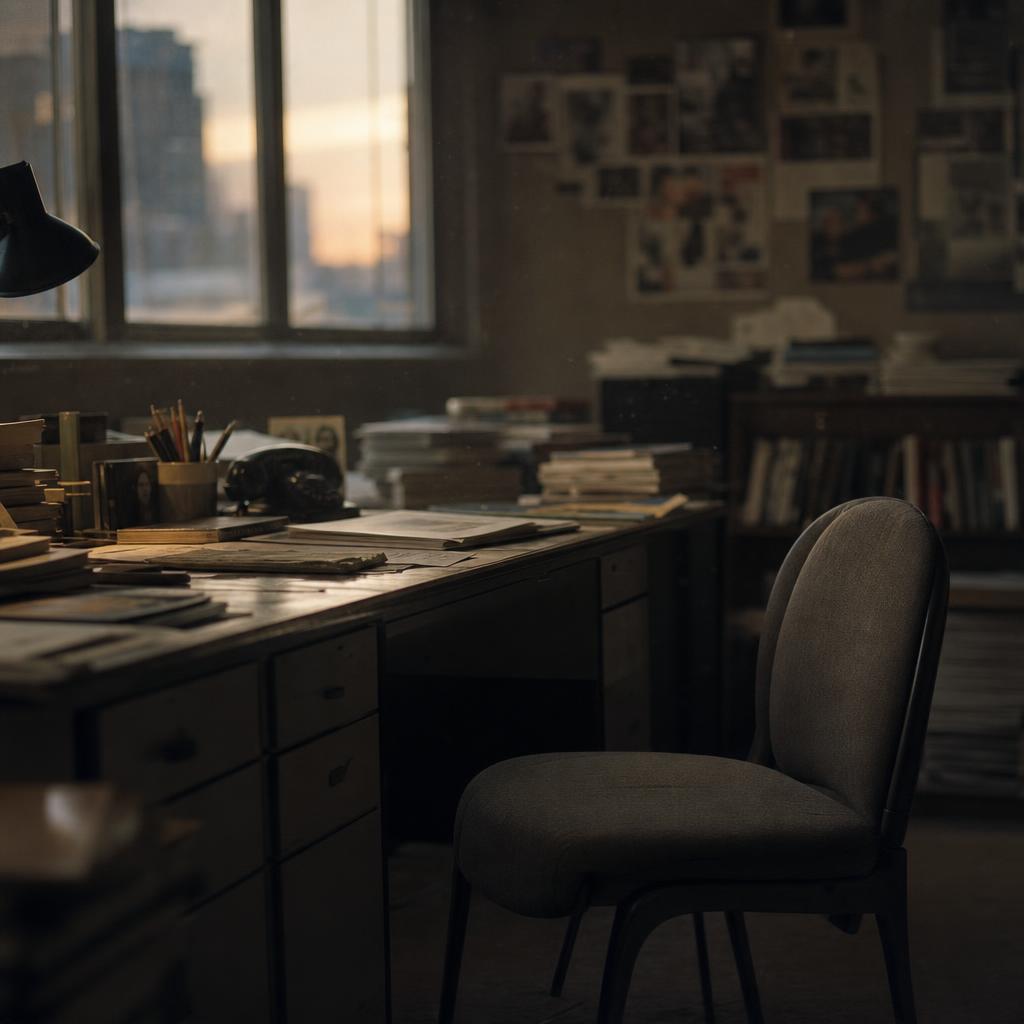
The AIDS Void: Empty Desks and Editorial Decisions
Subscribe
https://meridian-archive.com/feed.xmlOpen in your app, or paste the link above into any other:
The Subject at a Distance
The New York Times stylebook listed homosexual as the correct term of art and forbade gay from the paper’s news columns, a rule set in the middle 1970s and still the enforced standard when the epidemic arrived; it stayed in force until 1987, when Max Frankel became executive editor and struck it.1 No meeting decided, issue by issue, to keep the word off the page. The copy desk applied the rule the way it applied any other point of style — a term flagged, a substitution made, the same mechanical correction a misspelled name would get — and the mechanism needed no one’s judgment once it was written into the book that governed every other word in the paper. A reporter, gay or not, filed around it for more than a decade because the book said so.
Susan Sontag’s story about the epidemic named the disease not once. She wrote “The Way We Live Now” in 1986, and The New Yorker ran it that November — pages of overheard talk among the friends of a man in a hospital bed, his name withheld, his diagnosis withheld, the word everyone in the story was circling never set down on the page.2 The omission was the technique. A reader supplied the word without being handed it, and the supplying was the story’s proof that its reader already lived inside the thing the prose declined to say.
That was one way a serious magazine had decided to hold the epidemic: at the level of the sentence, obliquely, trusting the reader to arrive without a guide. The newspaper’s stylebook had decided differently and earlier, at the level of the term itself. Between the story that would not name the disease and the newspaper that would not name the people who had it, the whole editorial problem of the epidemic was already visible. It was not a problem of whether to report. It was a problem of how close to stand, and in what words.
By the end of the decade the coverage had accumulated. AIDS had been on the pages of the ambitious magazines since the early 1980s, and the reporting had earned the standing that serious reporting earns; the epidemic had produced a literature of its own, Randy Shilts’s And the Band Played On chief among it, a book that treated the years of official inaction as narrative history rather than medical bulletin.3 Sontag returned to the subject in 1989 in AIDS and Its Metaphors, an argument that the language wrapped around the disease — the talk of plague, of invasion, of the guilty and the innocent — did its own harm to the people inside the diagnosis.4 A magazine at the top of the market could feel, with some justice, that it had been present from the start and had covered the thing with rigor. It had, while the subject was still mournful. The mournful part was ending.
The Culture-War Assignment
The contest arrived through the art. Robert Mapplethorpe died in the spring of 1989, and that June the Corcoran Gallery in Washington cancelled the touring retrospective of his photographs rather than absorb the fight over the federal money behind it — the opening battle of what became a decade’s argument about the National Endowment for the Arts. The lever was federal money: that same year Senator Jesse Helms moved to bar endowment funds from work that might be judged obscene, and the restriction that emerged made every grant afterward a potential vote in the Senate.5 In November 1989, at Artists Space in New York, the photographer Nan Goldin assembled “Witnesses: Against Our Vanishing,” a show of work by the sick and the dead; the endowment’s chairman, John Frohnmayer, withdrew the exhibition’s grant over an essay David Wojnarowicz had written for the catalogue, then restored it nine days later on the condition that no federal money touch the catalogue itself, which the Mapplethorpe Foundation then paid for.5 Wojnarowicz’s prose was the reverse of Sontag’s reticence. Close to the Knives, which followed in 1991, set the rage down without a scrim.6
Three weeks after the Artists Space grant was restored, on December 10, 1989, several thousand demonstrators from ACT UP and the Women’s Health Action and Mobilization surrounded St. Patrick’s Cathedral on Fifth Avenue, and a smaller contingent went inside and staged a die-in in the aisles during the Sunday Mass that Cardinal John O’Connor was saying over them; the police carried out more than a hundred.7 Nearly every editorial page in the country condemned the action, the Times among the loudest. And that produced, for a magazine, the assignment that defined the period’s coverage — not whether to report the epidemic, which was long settled, but whether the people fighting it in the aisle of a cathedral were the story or the obstruction. To cover ACT UP with sympathy was to break with the consensus of the respectable press. To cover it with the disapproval of the Times editorial board was to file the disruption under bad manners. There was no neutral copy available. The choice a magazine made in that assignment was a statement about the kind of magazine it meant to be, and it was made, issue by issue, in a room.
The stance carried costs in both directions, which is what made it a decision rather than a reflex. A magazine that celebrated the die-in alienated the readers who had been raised to think a cathedral was owed quiet, and forfeited the pose of the disinterested observer that was the serious magazine’s chief asset. A magazine that scolded the activists kept the pose and lost the thing the activists were right about — that the Cardinal’s opposition to condoms and to explicit prevention teaching had a body count, and that manners were a strange thing to prize against it. Most of the ambitious magazines tried to hold both, admiring the urgency and deploring the tactics in the same paragraph, which satisfied no one and was, for a few years, the house style of the whole prestige middle.
A Craft Losing Its Hands
Underneath the argument about coverage ran a subtraction the magazines seldom covered, because it was happening to them. The people who made the pages were dying. The loss fell hardest on the departments a glossy could least afford to lose — fashion, photography, art, the copy desk — and it registered as craft, not as politics. The fashion industry had begun burying its own before the decade turned: Perry Ellis in 1986; Willi Smith the next spring, among the most successful Black American designers of his generation; the illustrator Antonio Lopez the same year, whose drawings had defined a magazine page in the 1970s. Patrick Kelly, the first American taken into the Paris couture establishment, died on the first day of 1990, the nature of his illness kept quiet until after. Halston died that spring.
The photography went the same way. Mapplethorpe was gone; Peter Hujar, whose portraits of the dying were among the permanent images of the period, had died in 1987. What this meant on an editorial floor was concrete and recurring: the photographer who shot a September cover could be dead by the December issue, and the fashion editor who attended the New York shows saw the gaps in the front rows, the seats that had belonged to men who were not going to fill them again. The contraction of editorial photography budgets that came at the end of the 1990s was charged, at the time, to real estate and to the digital transition, and both were real. Part of it was neither. Part of it was that a portion of the people who would have produced the work were dead, and the depth of talent a magazine could call on had been drawn down in a way no budget line recorded.
This was grief of a particular kind, and the magazines had no register for it. It was not the grief of the obituary page, which required a name and a public standing and a reason the general reader should care. It was the grief of a trade watching its own supply thin — the retoucher, the stylist’s assistant, the second shooter, the man at the color house who had known how to hold a difficult transparency. These were not figures a magazine profiled. They were the hands the magazine was made with, and their loss showed up not as a story but as a slow, unadmitted difficulty in getting the work to the standard, blamed on everything except the reason.
When Plagues End
The turn came in 1996, and it came as good news. Combination therapy built on the new protease inhibitors was presented in its long-term form at the international conference in Vancouver that summer, and for the first time in the epidemic’s history the annual death counts fell. Then came the editorial event of the late period. Andrew Sullivan — editor of The New Republic from 1991 to 1996, and himself HIV-positive — published “When Plagues End” as the cover of the New York Times Magazine on November 10, 1996, and argued that the plague, for those who could reach the drugs, was over: the disease, he wrote, no longer signified death but merely illness.8 The piece was written from inside the reprieve, by a man whose own viral load had just gone undetectable, and it was the most prominent statement in the mainstream press that the emergency had passed.
The reaction from the movement was immediate and bitter. Michelangelo Signorile and Larry Kramer argued that Sullivan had generalized a privileged reprieve into a general truth, and that declaring victory in the country’s most visible magazine would be read as permission — by younger gay men, by men of color, by the uninsured, by everyone for whom the drugs were unreachable or the schedule unkeepable.9 Sarah Schulman later set the piece at the head of a trend she named plainly: white male journalists announcing that AIDS was over.7 For a magazine the argument was not academic, because the position it took on Sullivan was a position on its own future pages. If the plague was over, there was nothing left to assign. If it was not over, the magazine would have to keep covering a story its readers, and increasingly its editors, had begun to experience as finished — the hardest kind of story to keep alive, the one everyone believed they already knew the ending of.
The Story That Stopped Being Pitched
By 1998 the coverage had collapsed. The story that remained was long-tailed and unphotogenic — the tiers of insurance, the drug resistance, the Black and Latino neighborhoods where the count had not come down at all, the disfigurements the drugs left in the bodies of the people they saved, the sunken face and the swelling at the back of the neck the wards called buffalo hump and the paunch the patients named Crix belly for the drug that seemed to bring it — and the cover meeting moved on to subjects with more visible motion in them. The magazine that did the opposite had been founded in the middle of the decline by a man who had the disease. Sean Strub started POZ in 1994 and ran it out of his loft, a magazine made by and for people with the virus, carrying the treatment news and the drug-price fights and the personal advertisements as a matter of survival rather than of coverage.10 It did from the inside what the prestige magazines had done from a credentialing distance, and it kept doing it after the glossies stopped.
The canon the serious magazines had built over the decade turned out to have been a partial one. It preserved the painter, the playwright, the photographer, the designer — the people who were already inside the machinery of cultural production, whose deaths came with a body of work and a reason for the general reader to attend. It had never been built to carry the bookkeeper, the schoolteacher, the man in the Bronx whose death produced no memoir and no obituary above the fold. The dying artist was a real subject and a worthy one. He was also a small fraction of the dead, and the magazines had covered the fraction that resembled their own readers and let the rest go by, mostly without noticing the selection they were making.
By 2000 an editor could pass a full day in a New York newsroom and not hear the word said aloud. No one had decided to stop. There had been no meeting at which the epidemic was struck from the list, no memo retiring the beat. The silence was the sum of a great many separate decisions, each defensible on the afternoon it was made — this piece too grim for the issue, that one already covered, the other one better suited to somebody else — and it was only from a distance, and only later, that the separate defensible choices resolved into a single fact, which was that the largest catastrophe the city’s creative class had lived through had gone quiet on the page while it was still killing people off it.
The serious magazine’s finest instinct about the epidemic was also the mechanism of its forgetting. To decline the lesson, to trust the reader, to name nothing the reader should already know — this was the mark of a magazine that respected its audience, and it produced, in the peak years, coverage of real courage and real craft. But a magazine that will not explain a thing to the uninitiated is a magazine built to stop covering that thing the moment the initiated have heard enough, and the initiated tire before the dying do. The obliqueness that had been a form of respect became, once the drugs arrived and the funerals thinned, a form of exit; the reader was trusted to know, and then trusted to have moved on, and the trust that had once been generous turned into permission to look away. What the empty desk on the floor recorded was never only a death. It was the distance a magazine had kept from its subject — the same distance the floor kept from most of the city it moved through, the reach that let it see the whole world clearly and lay a hand on almost none of it.
The Corcoran’s cancellation of the Mapplethorpe retrospective in June 1989 would have gone into The Essay for the August issue, and the fight that autumn over the withdrawn and restored Artists Space grant would have followed it into The Essay again, for January — the two pieces landing five months apart on what would have read, set beside each other, as one argument rather than two: which images a serious magazine could still put its name behind.
A profile of Sean Strub would have gone nowhere near either section. Strub would have started POZ out of his own loft in 1994, a magazine made by and for the people carrying the virus rather than reporting on them from outside it, and the pitch that would have followed him would have died in the room before it reached a masthead vote. The articles editor who would have carried it there would have clashed with Strub in public the year before, over a freelancer the two of them would have shared, and no one above her would have pushed past that history to overrule it. The piece would have gone down on the argument’s residue rather than on the story’s merits.
The Essay would have claimed the confirmation that came out of the Vancouver conference in the summer of 1996 — that the new combination therapies held past the first year, and that the annual death count had turned for the first time in the epidemic’s history — closing it into the September issue, MER-1996-09.
Footnotes
-
Edward Alwood, Straight News: Gays, Lesbians, and the News Media (Columbia University Press, 1996). ↩
-
Susan Sontag, “The Way We Live Now,” The New Yorker, November 24, 1986. ↩
-
Randy Shilts, And the Band Played On: Politics, People, and the AIDS Epidemic (St. Martin’s Press, 1987). ↩
-
Susan Sontag, AIDS and Its Metaphors (Farrar, Straus and Giroux, 1989). ↩
-
Cynthia Carr, Fire in the Belly: The Life and Times of David Wojnarowicz (Bloomsbury, 2012). ↩ ↩2
-
David Wojnarowicz, Close to the Knives: A Memoir of Disintegration (Vintage Books, 1991). ↩ ↩2
-
Sarah Schulman, Let the Record Show: A Political History of ACT UP New York, 1987–1993 (Farrar, Straus and Giroux, 2021). ↩ ↩2
-
Andrew Sullivan, “When Plagues End,” The New York Times Magazine, November 10, 1996. ↩
-
Michelangelo Signorile, Life Outside: The Signorile Report on Gay Men — Sex, Drugs, Muscles, and the Passages of Life (HarperCollins, 1997). ↩
-
Sean Strub, Body Counts: A Memoir of Politics, Sex, AIDS, and Survival (Scribner, 2014). ↩