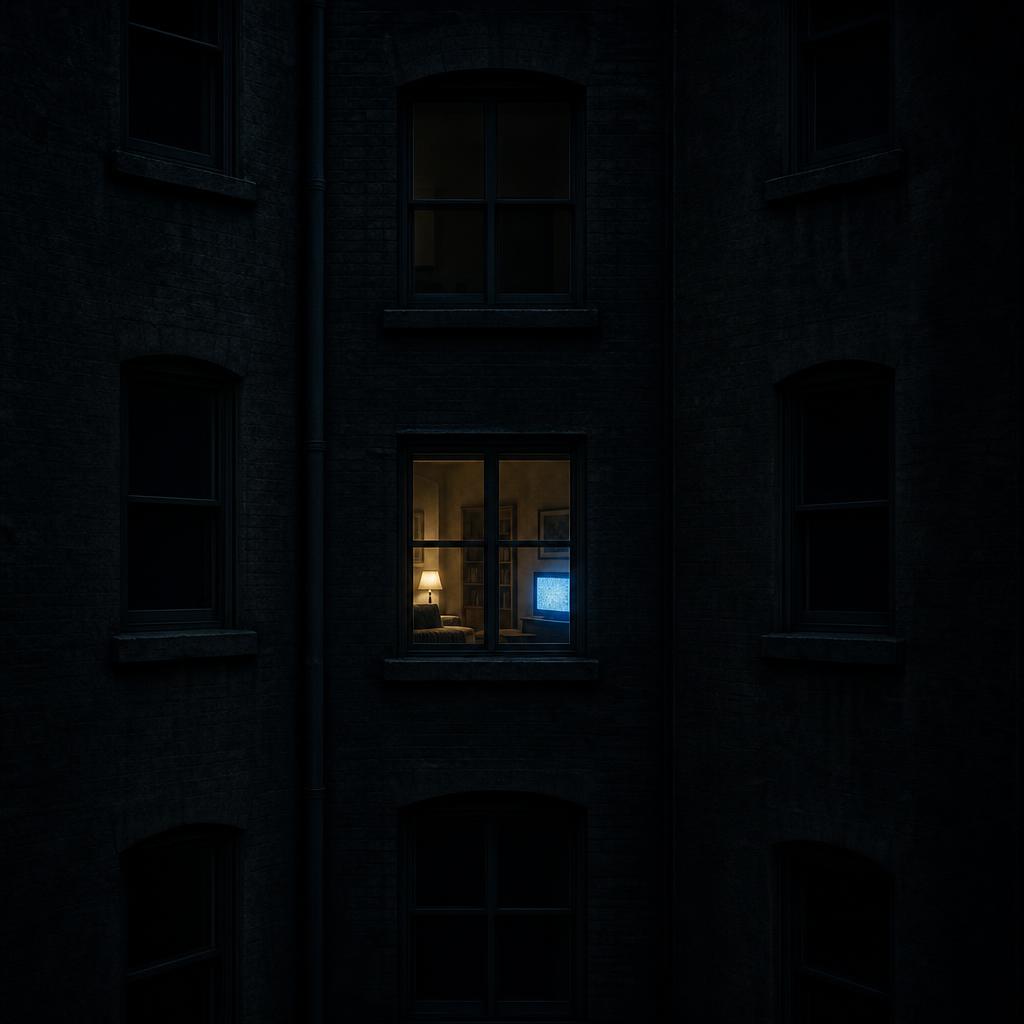
Alone in the Apartment: The Television, the Phone, and the Texture of Solitude, 1989–2001
Subscribe
https://meridian-archive.com/feed.xmlOpen in your app, or paste the link above into any other:
No Channel Went Dark
By 1989 no television signal serving New York City switched itself off for the night. WABC-TV had ended its nightly sign-off in 1986; WNEW-TV had followed within about a year; by the time the decade in question opened, every VHF and UHF station in the market had given up the practice that once closed a broadcast day — the national anthem, a test pattern, color bars, a tone, then static — and had sold the dead hour instead, to infomercials, paid religious programming, and reruns bought in bulk lots.1 A set left on after midnight anywhere in the city, on any of its channels, found something playing on it no matter how late the hour ran; the choice a tenant faced alone after nine o’clock was never whether the television had anything to say, only which of several purchased hours it was saying it in.
After nine at night the apartment contracted to what was actually in it, and what was in it, for most of the decade, was a television that stayed on whether or not anyone in the room was watching it. The company it kept was not incidental; before the internet reached an ordinary apartment as a personal thing, a set left running was simply what filled a room that had gone quiet, the one object that could be counted on to keep talking after everyone else had stopped. The set itself was a cathode-ray tube, nineteen inches in a bedroom or twenty-seven in a living room, the picture curved faintly at the corners, a VCR stacked on top or below it and a cable box beside it if the building carried Time Warner or one of the city’s other franchise systems. Coaxial-only viewers, a shrinking minority as the decade went on, pulled in the seven or eight channels the city had always had — 2, 4, 5, 7, 9, 11, 13 — off a rooftop antenna or a pair of rabbit ears, and no others. On the VCR stacked beside the set, the clock more often than not blinked 12:00, unset and left that way for years; the reasons are its own, told below.
A remote control came with every set, chunky molded plastic in black or charcoal, an oversized red POWER button at the top, a numeric pad, a rocker for channel and volume, and a MUTE button positioned closely enough to VOL DOWN that a hand reaching in the dark hit it by accident more often than not. The battery compartment sat on the back, two double-A cells whose spring loosened by the third year of ownership, so that the remote had to be tapped once against a knee or a coffee table before it would register a command. A licensed TV Guide-branded remote, sold at retail through the early-to-mid 1990s, added its own button for calling up basic on-screen channel information on the cable systems built to read it — a small convergence of the magazine and the set it was meant to schedule. Absent that button, the week’s line-up came printed on paper only — the TV Guide left open on the coffee table, or the listings folded into the back of New York magazine — because there was no other way, in most of the period, to know what channel eleven was running at half past eleven without either owning that week’s issue or waiting through the previous show to find out.
The First Glass
The apartment’s second fixed point after nine o’clock, for a great many solitary evenings, was the drink, and for a private ritual conducted by one person with no one watching, the specifics were remarkably stable: two fingers of bourbon, neat, no ice, no water back, in a heavy-bottomed old-fashioned glass, poured by eye rather than by any measure. The pour happened at the kitchen counter, not the cabinet — the bottle lived out, in view, and only moved to the cabinet when company was expected, a small courtesy performed for a guest and abandoned the moment the guest left.
The decade an evening like this fell in mattered to what was actually in the glass. American whiskey had been losing market share since the late 1960s, and by the middle of the 1990s bourbon was as weak in the market as it had been in decades, in a downturn that ran roughly from the mid-1970s through the late 1990s: distilleries were sitting on well-aged inventory they could not move at a premium, because the premium market for American whiskey had not yet been invented. Blanton’s, the first commercially bottled single-barrel bourbon, had reached shelves in 1984, and Jim Beam’s small-batch line — Booker’s, Baker’s, Basil Hayden’s, Knob Creek — had rolled out between 1987 and 1992, but through most of the period an ordinary bottle of bourbon was ordinary money.2 A fifth of a decent one ran a New Yorker somewhere in the low-to-mid teens for most of the decade — not nothing, but not a special occasion either, a bottle bought the way a carton of milk was bought, replaced without ceremony when it ran low. A drinker who preferred wine to bourbon kept the same ritual in a different vessel — a half-empty bottle sideways in the refrigerator door, a modest amount poured most nights, more on the nights that called for it, the bottle itself dated in pencil on the label the day it was opened so that a week’s worth of half-glasses could be accounted for.
The first glass accompanied whatever the television or the book in hand was doing. The second glass, poured later, was the bedtime glass: carried into the bedroom, set on the nightstand, and often left unfinished by morning, a dried ring on the wood the only evidence, the next day, that the previous night had happened at all. A white Tic Tac chased the last of it before bed, through most of the period the era’s mint of choice; Altoids existed on the same drugstore shelf but read, before the middle of the decade, as an affectation rather than a habit.
The Eleven O’Clock Hour
At eleven the local news ran on the network affiliates — channels 2, 4, 5, and 7 taking turns with the day’s fires, the day’s crime, the day’s weather — while channel eleven, WPIX, ran a rerun of something a decade or two old and channel thirteen carried the second half of the previous evening’s public-television interview program on tape delay. At eleven thirty-five the network late-night hour began: Jay Leno had taken over The Tonight Show from Johnny Carson on May 25, 1992, and Late Show with David Letterman moved to CBS, into the same time slot opposite him, on August 30, 1993.34 The competition between the two, and the debut of Late Night with Conan O’Brien in the slot behind Letterman’s old one on September 13, 1993, belonged to the history of the schedule itself and is told at length elsewhere in this account of the era’s broadcasting; what belonged to the apartment was simply the fact of the choice, made from the couch, between one host’s monologue and the other’s, made the same way most nights without much thought given to why.5
For the apartment that owned a VCR and used it, eleven o’clock or later was also taping hour. Recording a program meant choosing among three speeds — a two-hour Standard Play that preserved the picture, a four-hour Long Play that softened it, and a six-hour Extended or Super Long Play soft enough that it was reserved for marathon viewing rather than anything meant to be watched closely — and a blank tape, usually Maxell, TDK, Fuji, or Sony, bought a few dollars at a drugstore, got a paper sleeve and a handwritten label in ballpoint or Sharpie.67 Programming the timer required setting the channel, the start time, the end time, and the date in sequence, a small procedure prone to the same failure as the clock itself; a tape that had drifted out of alignment needed the tracking dial nudged by hand while the picture stuttered with horizontal interference until it settled. A tape recorded once might be watched a dozen times over several years, the cassette worn soft at the corners, the audio picking up a slight warble the fifth or sixth time through — the price, well understood by anyone who owned one, of a personal archive built one two-hour cartridge at a time.
The Phone After Ten
The apartment’s phone was corded for most of the period — a wall unit in the kitchen with a curly cord that tangled into knots straightened by yanking it loose, and a tabletop unit in the bedroom, an answering machine built into its base by the early 1990s. Cordless handsets existed from the start of the decade, but their reception was unreliable through the middle of it, and a handset tethered to a base that stopped working past the next room was not much of an improvement over a cord; a longer coil-cord replacement, sold cheaply at any electronics counter, did the same job for less money and no batteries. A call taken standing at the kitchen wall was a public domestic call, brief and logistical. A call taken sitting on the closed lid of the toilet, the cord from the bedroom phone pulled through the bathroom doorway so that the door could not quite shut, was a different kind of call — private because the door was closed as far as the cord allowed, the small gap in the doorframe a cost paid willingly for the rest of the privacy. On Sunday mornings, for at least one household in a great many, the same cord carried a call to Europe that ran on its own clock and its own economics entirely, and that call is priced and told in full elsewhere in this record of the transatlantic line; what belonged to the apartment itself was only the fact of it happening there, on that phone, in that room.
The answering machine turned the apartment into a small theater with an audience of one. Three out of five American households owned a machine by 1993, and its two rituals were opposites of each other.8 Screening meant standing in the kitchen while the machine picked up after four rings, the outgoing message played, and the caller began to speak — deciding, in the seconds available, whether to lift the receiver and say “I’m here, I’m here,” or to let the message run to its end and its click and the silence after. Returning meant the blinking red light seen from the doorway, the coat still on, PLAY pressed before anything else, the messages running in the order they’d arrived because most consumer machines let a listener skip ahead but not rewind. The hour after ten carried its own weight on that machine: a call that came in after ten at night, on the machine or live, tended to be the kind of call that made the body go still before the mind understood why — the accident, the overdose, the parent’s last hour — the same ring as any other hour, registering differently anyway.
After Midnight
Past one in the morning the schedule thinned into infomercials, and the products cycled with the years the way anything else did. The ThighMaster, fronted by Suzanne Somers at nineteen dollars and ninety-five cents, debuted in April 1991 and eventually sold past ten million units; NordicTrack’s cross-country ski machine followed through the middle of the decade, and the George Foreman Grill and Ronco’s rotisserie oven after that.9 A viewer who stayed up past all of it might reach, by the back half of the decade, a psychic hotline pitch running its own toll number in a crawl along the bottom of the screen — a different kind of company than the set usually offered, one that took a credit card number and promised, for a per-minute charge, to talk back. For an apartment without a VCR tape cued up, or with one that had run out, the fallback loop before 1996 was reruns — Cheers on WPIX, CNN’s overnight repeat of the evening’s broadcast, a movie on a premium cable channel that sometimes turned to something softer after one — plus, on the cable systems that carried it, the Weather Channel’s continuous rotation of national radar and regional forecasts, set to a synthesizer-and-light-jazz soundtrack that had been the channel’s sound since its early-1980s launch.
That loop changed on April 26, 1996, when the Weather Channel introduced “Local on the 8s,” a branded segment delivering the local forecast at every minute ending in eight, the same smooth instrumental cue now attached to a promise of specificity — a forecast for your own zip code, not the nation’s. The segment was discontinued in early 1998 and did not return until December 2001.10 An apartment kept awake before 1996 had no such fixed point on the dial; an apartment kept awake between the spring of 1996 and the start of 1998 could set its own night by the eights on the clock, the forecast repeating gently enough to be a lullaby rather than information, and an apartment kept awake after 1998 lost that fixed point again until the last month of the period restored it.
The evening’s last object, more often than not, was a notebook — for most of the period a black-and-white marbled composition book, sewn-bound, college-ruled, sold at any drugstore for something close to a dollar and a half, the least pretentious object a person could write in and therefore, for many, the only one that felt honest. A blue or black ballpoint did the writing; the date went in a corner, sometimes with the day of the week. This was the era’s plain notebook throughout its length — the imported leather diary, and the small black pocket notebook that was still years from being a recognizable object at all, had no place yet in an ordinary apartment’s furniture. Modo & Modo relaunched the Moleskine name in Milan in 1997, in a first print run of a few thousand copies; wider European distribution followed in 1998, and the notebook did not reach American shelves in any real volume until 1999, with broad New York availability arriving closer to the decade’s final years.11 A notebook like that on a nightstand in 1993 would have been out of place by several years; on a nightstand in 2000 it was unremarkable. Before it arrived, and alongside it after, the same drugstore composition book did the same job it always had: a line or two, sometimes only a date and a fragment, closed and set aside.
The last ritual, for a certain kind of solitary evening, was the crossword — folded to the right page, worked in pen if the evening’s confidence allowed it and in pencil if it didn’t, finished or abandoned half-done before the light went off. Doing it in pen rather than pencil was its own small performance, visible to no one, of a confidence the rest of the evening might not have earned. It asked nothing of the room in return beyond the twenty minutes it took, and offered, for those twenty minutes, the rare feeling of a single problem with a single correct answer, arrived at without anyone else’s help and needing no one else’s agreement. Then the lamp, and the dark, and in the next room the VCR’s clock, still blinking 12:00, keeping the only time nobody had asked it to keep.
What the Evening’s Objects Cost
Figures below are period retail estimates, hedged where a single precise price could not be confirmed.
| Object | Approximate period price |
|---|---|
| Blank VHS tape, T-120, Maxell/TDK/Fuji | $3–5 |
| Marbled composition notebook (Mead or equivalent) | around $1.50 |
| Smythson pocket diary, via Bergdorf Goodman | roughly $50–75 |
| Smythson Panama notebook, via Bergdorf Goodman | roughly $80–120 |
| Moleskine pocket notebook (US retail, from 1999) | $12–15 |
| Bottle of ordinary bourbon, mid-decade | low-to-mid teens |
None of what filled those hours after nine was designed for company; the set, the glass, the phone on its cord, and the notebook on the nightstand were built for a room with one person in it, and the fact that so many rooms across the city ran the same evening in roughly the same order — the news, the drink, the taping, the machine, the infomercial, the last page — said something about the decade that no single apartment’s private ritual could say on its own. The negative space these hours occupied was as durable as anything the daytime produced, and it changed on its own schedule: a clock segment arriving in 1996, a notebook arriving in 1999, a blinking display that never got fixed at all. What one person did alone after the day’s public hours ended turned out, across enough apartments and enough years, to be some of the most exact evidence the period left of what it was actually like to live in it.
Suzanne Somers’s device would have made an easy claim on The Front — priced at $19.95, already moving past ten million units by mid-decade, the kind of number an articles editor could hang two hundred words on without a phone call. The June 1991 issue would have carried the item and closed it without argument.
Harder to place would have been the Weather Channel’s new segment, the same synthesizer cue now promising a viewer his own zip code rather than the nation’s. Whoever on the floor pitched it would have kept the set running most nights for the identical company-in-an-empty-room reason the item itself proposed to explain, and could not have filed that admission about his own apartment as a media story. It would have gone no further than the pitch.
The notebook reaching American counters that same decade would have wanted an owner nobody on the design or Back bench would have supplied — stationery had no claim on any one desk, and the item would have sat unassigned long enough that by the time a hand reached for it, the object itself would no longer have been new.
Footnotes
-
Major New York City stations had ended nightly broadcast sign-offs and moved to 24-hour programming by around 1990, following WABC-TV’s end of nightly sign-offs in 1986 and WNEW-TV’s move to 24-hour broadcasting by approximately 1987. See Test Card — Wikipedia and Old Timey Herald: Television Sign-Off. ↩
-
On the bourbon “glut era” of roughly 1975–1998 and the early premium releases (Blanton’s, 1984; Jim Beam’s small-batch line, 1987–1992): Tasting Table — Glut Era Bourbon and Imbibe — How America Fell in Love with Bourbon Again. ↩
-
Jay Leno took over as host of The Tonight Show from Johnny Carson on May 25, 1992. See The Tonight Show with Jay Leno — Wikipedia. ↩
-
Late Show with David Letterman premiered on CBS on August 30, 1993, opposite Leno’s Tonight Show. See Late Show with David Letterman — Wikipedia. ↩
-
Late Night with Conan O’Brien debuted on NBC on September 13, 1993, with Andy Richter as sidekick. See Late Night with Conan O’Brien — Wikipedia. ↩
-
Standard 1990s blank VHS tape brands and pricing (Maxell, TDK, Fuji, Sony T-120 cassettes). See Tapeheads — TDK and Maxell VHS Blanks. ↩
-
VHS recording modes — Standard Play (2 hours, highest quality), Long Play (4 hours, degraded), Extended/Super Long Play (6 hours, soft). See Heirloom — SLP VHS Decoded. ↩
-
By the early 1990s, three out of five US households owned an answering machine. See Specialty Answering Service — Evolution of Answering Machines and Answering Machine — Wikipedia. ↩
-
ThighMaster infomercials with Suzanne Somers debuted in April 1991 at $19.95, with over 10 million units sold by mid-decade. See Mental Floss — ThighMaster History. ↩
-
The Weather Channel introduced “Local on the 8s” on April 26, 1996, discontinued it in early 1998, and revived it in December 2001. See Local on the 8s — Wikipedia. ↩
-
Moleskine was relaunched by Modo & Modo in Milan in 1997 with an initial print run of a few thousand copies, reaching wider European distribution in 1998; US distribution began in 1999, with broad retail penetration by the early 2000s. See Moleskine — Wikipedia and The Walrus — Moleskine Mania. ↩