The Favor Bank: The Party as Professional Machine, 1989–2001
Subscribe
https://meridian-archive.com/feed.xmlOpen in your app, or paste the link above into any other:
The Favor Bank
The exchange had a name inside the business, printed nowhere but understood by everyone who worked a party floor: the favor bank. A publicist did not trade a tip for cash or for a promise; she fed a gossip column an item about someone who was not her client at all, gratis, solely to keep a line of credit open for the day a client needed a placement. Bobby Zarem, the publicist whose career ran across the whole period, described the mechanics without much embarrassment. “You give them items not at all about your clients, just to be able to get items in about your clients. Just to keep the door open. If you’re intelligent, it’s not discussed.”1 Placement was never automatic, even for a publicist who had banked goodwill for years; Zarem also put it plainly — “I often have to beg for an item about a client. Literally — I say, I’m begging you.” The trade ran on scarcity as much as favor. A column had a fixed number of inches; a hundred publicists wanted the same six of them on a given morning; the favor bank was the rationing mechanism, informal, unwritten, and administered by people who did the trading for a living rather than for any single evening’s advantage. The column’s contributors were paid a nominal day rate, on the order of three hundred dollars, for gathering the raw material a party produced — a standing, priced job description for a room everyone else in it took for a party and nothing more.
Richard Johnson, who edited the New York Post’s Page Six, was the desk the favor bank fed, and he ran it on a filter as blunt as the trade beneath it. “I have a really short attention span, and our readers’ is even shorter. If a publicist calls me with something and it takes more than ten seconds to explain, forget it.”2 The rule sounded like an editor’s vanity. It set the terms of a transaction instead: a publicist working a party floor that night was pricing a pitch that had to clear in the time it took to walk from the bar to the coat check. The party was the raw material; the column item was the manufactured good. The archive’s account of the era’s newspaper wars treats the column itself and its editorial lineage directly; here the subject is the labor underneath it — the party that supplied the column its material, seven nights a week.
The market was not indiscriminate surveillance dressed up as gossip. Former Page Six staffer Susan Mulcahy insisted the items were reported, not invented: “Page Six items were reported like any legitimate news story… if Page Six started to be filled with inaccuracies, it would lose its luster.”3 A running feud — Johnson’s with the actor Mickey Rourke — was understood on both sides as good for readership rather than bad for the column, a further sign that both parties were managing a shared asset rather than fighting over it. Johnson’s own household sat inside the same economy his desk regulated, since his wife Nadine Johnson worked as a publicist and event planner, one more illustration of how completely the party-throwing world and the item-placing world had folded into each other.4 The favor bank was not a corruption of the party. It was the party’s actual business model, running underneath an evening that everyone else in the room understood as a party and nothing more.
The Working Room
A working reporter or event photographer at an ordinary media party in this period was doing a specific, repeatable job, and the job looked from across the room exactly like attending. Bill Cunningham, whose “On the Street” and “Evening Hours” columns ran weekly in the New York Times from February 26, 1989, shot on manual Nikon bodies loaded with 35mm film, a cord-connected handheld flash his only lighting, the rolls dropped at a Times Square variety store for developing before the paper’s own layout staff worked from the scans.5 Per Women’s Wear Daily, he was inclined to spend ten hours outdoors a day and to cover sixteen or seventeen parties a week, laying out his own page afterward at a Times desk with his assistant, John Kurdewan, and refusing to release it until the arrangement satisfied him exactly.6 He refused all hospitality on the job, a rule he stated without qualification: “I certainly wouldn’t compromise the Times,” he said of the reason he never took even a glass of water at a party he was covering, adding of the freedom the refusal bought him — “if you don’t take money, they can’t tell you what to do, kid.”7 The rule drew a line most of the room could not see: on one side, guests drinking the party’s liquor and eating its food; on the other, a man working the same room on foot for ten hours who touched none of it.
Patrick McMullan, whose “Party Lines” ran in New York magazine, worked the opposite method — not the candid grab but the engineered introduction. In the pre-digital years he shot sparingly, one to three frames of a given subject, because film and time were both limited: “In those days I would take one, two, or three pictures of a person because I didn’t have a big camera… so I wanted to make them count.”8 The photographs that read afterward as spontaneous were frequently staged by McMullan himself, who introduced guests to each other specifically to manufacture the picture — walking Bill Gates over to Tom Hanks, for instance, because the pairing made a better caption than whatever the room had produced on its own. He also treated consent as a first step rather than an afterthought: “If people appeared in a column I did, I wanted them to know, this is a good thing.” The candid party photograph, the genre’s signature product, was very often neither candid nor a record of the party unstaged by the man holding the camera.
The professional media party’s labor force was small in number and specialized — a caterer’s passers, a bar staff comped by the sponsor, a coat-check chokepoint that thickened toward the end of the night, and, cutting across all of it, the publicist and the photographer, working the floor on a clock the guests never had reason to notice. A third documentarian worked the same rooms from inside rather than at their edge: Candace Bushnell’s “Sex and the City” column, which ran in the New York Observer from 1994 and which the archive treats in its own right, wrote the party’s social economy up as first-person dispatch — neither placing items nor shooting candids but reporting the room as a participant in it.
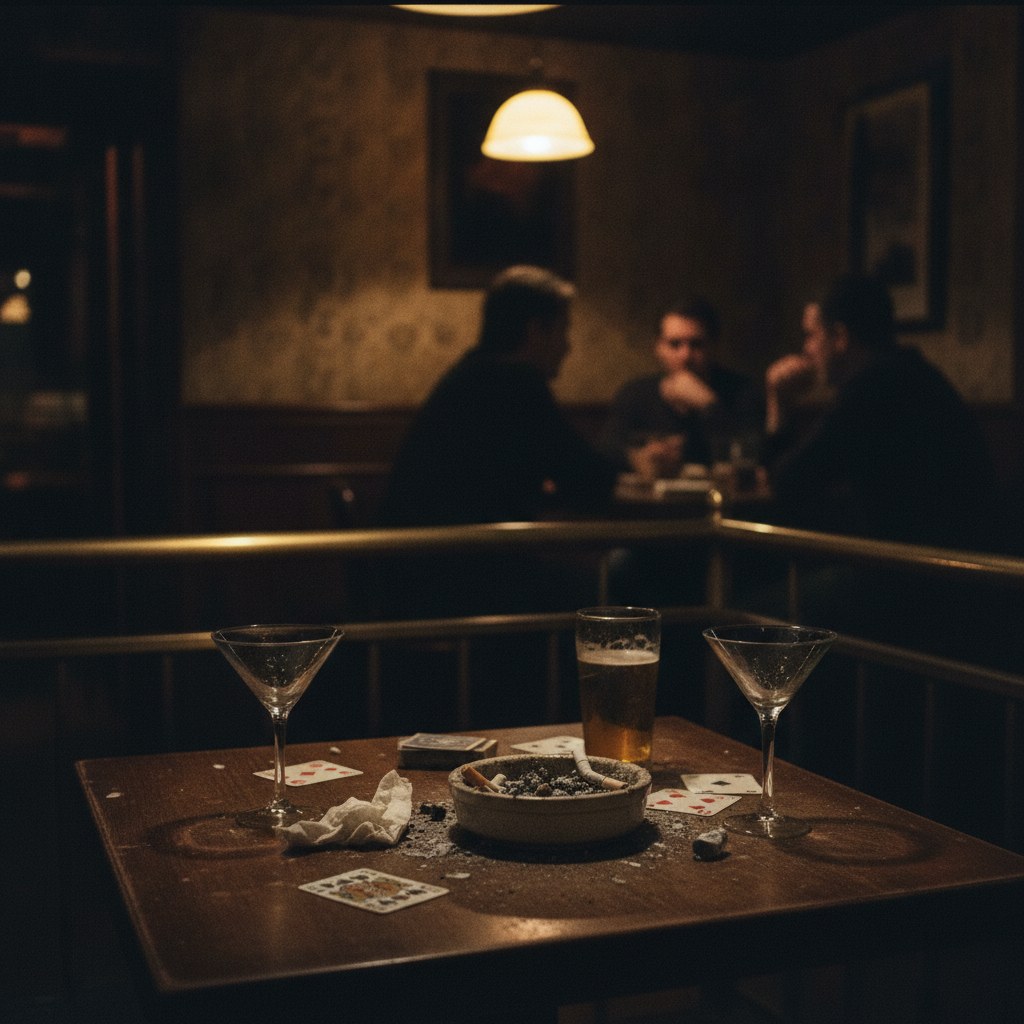
Cigarettes were part of the room’s texture throughout the earlier years of the period without restriction — indoors, at the bar, at the table — and after New York’s Smoke-Free Air Act took effect in January 1995, the smoke did not leave the party so much as migrate: dining rooms went smoke-free while bar areas remained exempt, and by the back half of the decade the smokers at a party had visibly regrouped around the one part of the room the law had not yet reached.9
The Record, Not the Deal
The prior assumption about this world — that a big party was where a career got made, a story got assigned, a marriage of convenience got sealed over cocktails — does not survive close comparison with the documented cases. Tina Brown hired Dominick Dunne, launching the second act of his career, after meeting him at a dinner party given by the writer Marie Brenner, a small gathering rather than a launch or a benefit; she suggested he keep a diary of the trial he was covering, and the resulting pieces made him a Vanity Fair fixture.10 The pattern held elsewhere: the clearest documented instances of an assignment or a hire being decided ran through a dinner table for six or eight, not a room of two hundred under a sponsor’s banner. What the big, publicist-run party manufactured was not the deal but the record of status — the item, the photograph, the line in a column confirming that a given person had been present — and the record and the deal were produced by two different rooms operating at two different scales, however often the same guests moved between them on the same night.
The book-party economy also survived a shock it was not supposed to survive. The 1990–91 recession did not visibly shrink it: trade sales rose through the downturn, and the industry’s own economists judged by 1993 that publishing’s “brush with the 1990–1991 recession” was already behind it.11 Where the recession did bite was the magazine advertising market feeding the party budgets from the other direction — one satirical magazine of the period lost half its advertisers within six months of the downturn’s onset, a contraction of the funding source rather than of any appetite for the parties themselves.12 The party habit, once established, proved sturdier than the economy that was supposed to have killed it; what eventually thinned the book party’s ranks, a decade on, was a publisher’s arithmetic that the party did not sell books, not a recession that had already come and gone.13
What It Cost
The dollar figures that survive from the period arrive mostly through retrospective trade coverage rather than a contemporaneous account book, and they hedge accordingly, but the two poles they describe are wide enough to make the point on their own. A modest, friend-thrown party for a first novel — “food, drinks and people to pass them out” — ran on the order of two thousand dollars; a party built around an author of Bill Clinton’s wattage was priced by a Publishers Weekly editor at “$60,000 or more,” a sum that in one case required renting a red carpet for the arrival.13 Publishing-industry retrospectives framed the lavish, publisher-thrown party as an inheritance of the 1980s and 1990s specifically, a norm that had mostly disappeared by the time trade press went looking for it, replaced by smaller dinners for press and booksellers that the book publicist Paul Bogards judged produced “better chemistry for a lower price.” What no period source pins down is a specific dollar figure for the ordinary mid-list book party or a magazine’s own issue-launch line item — the gap in the record is itself informative, since it suggests these budgets lived inside a general marketing allowance rather than a number anyone at the time thought worth writing down.
Three Parties, Three Budgets
| Party type | Approximate cost | Source and hedge |
|---|---|---|
| Modest, friend-thrown first-novel party | About $2,000 for food, drink, and staff to serve it | Retrospective trade coverage (see body); no contemporaneous 1990s figure survives, only the later framing of it as the era’s low end. |
| Ordinary mid-list book or magazine issue party | Not independently priced in any retrieved source | Understood to have run inside a general marketing budget; the absence of a written figure is itself the evidence. |
| Blockbuster author party (e.g., a Clinton-level appearance) | “$60,000 or more,” including a rented red carpet | A Publishers Weekly editor’s estimate, retrospective (same source as above). |
| Peak dot-com launch party | Lavish five- and six-figure budgets, funded by venture money rather than a publisher | Wikipedia: Dot-com party; describes the form generally, not one named event.14 |
| Late-2000 trade-show mixer (post-crash retrenchment) | $40,000–$60,000, replacing the standalone launch party | Wikipedia: Dot-com party (same source as above). |
The money that could be written down came from sponsors rather than hosts. Absolut, from 1986, converted its advertising budget into event budgets, commissioning artists — Andy Warhol was paid $65,000 for a single work in the campaign — and then staging its own launch parties rather than simply buying space to announce a launch.15 The clearest documented instance put private bottles of the vodka on white-cube tables inside a roped VIP section at the Chelsea bar Go, blown-up versions of the ad campaign covering the walls behind them.16 The mechanism reversed the usual relationship between a brand and a room: instead of the brand paying to be seen at someone else’s party, the brand’s money built the party, and the party’s guest list became, in effect, a controlled audience for the campaign. The same era’s magazine economy supplied the money on the other end of the exchange — Graydon Carter’s account of the decade at Vanity Fair recalled advertisers paying “up to $100,000 a page for an issue that sometimes stretched to around 400 pages,” a volume of ad revenue large enough that a launch or an anniversary issue could absorb a five-figure party without anyone treating the number as remarkable.17 The party’s cost, in other words, tracked not the guest list but which of two much larger economies — magazine advertising or a spirits brand’s marketing spend — happened to be paying for the room that month.
The List
By the late 1990s, a guest list at the top of the trade was not a stack of index cards but a database, and the database was itself the asset. For a September 1998 launch party for AOL 4.0 at the Mercer Kitchen, the publicist Lizzie Grubman received five names from her clients — AOL’s Steve Case and Bob Pittman wanted five specific guests present — and supplied the other thousand herself, drawn from a personal database of ten thousand names, color-coded by category: Model, Celebrity, Fashion, Junior, Older Social, Editor-in-Chief, Clubbers.18 “Honey, this is a Lizzie party,” she said of the arrangement. “This is my crowd.” The categories set the room’s internal order before a single guest arrived — a party stratified in advance, on a spreadsheet, along lines that had nothing to do with who might enjoy whose company and everything to do with which tier of the guest list a given face belonged to.
The room the database produced was, correspondingly, not the mixed democratic crowd its own coverage liked to suggest. Toby Young’s memoir of his years inside Condé Nast’s magazine culture indexed the profession under an entry that told most of the story on its own — “clipboard Nazi” filed a few lines from “Pat Kingsley,” the era’s most powerful movie publicist, access-control rendered as the book’s own organizing principle.19 Young supplied the texture from the inside as well: cornered at a magazine party trying to file a story from the venue’s single pay phone before deadline, no cell phone yet in his pocket, he found himself dressed down by Diana Ross for hogging the line — the reporter’s pre-cellular filing bottleneck playing out in real time, in the middle of the room he was covering.20 This was the professional party, staffed and rostered by a publicist’s spreadsheet — a different room from the downtown gallery and loft crowd the archive treats elsewhere, where the door worked on friendship rather than a database.
Getting past the clipboard without being on it was its own recognized craft. Gate-crashing worked by “blending in… wearing the proper attire,” and the standard defenses were “increasing security, requiring credentials or checking invitations at the door” — the same manual that let David Hampton talk his way into Studio 54 in 1983 posing as Sidney Poitier’s son, then spend years running the same trick on wealthy Manhattan households, a career later fictionalized as Six Degrees of Separation and the archetype every subsequent door-worker at a New York party was measuring a stranger against, consciously or not.21 A party’s real security, in other words, was never the rope alone; it was a database on one side of the door and a folk memory of Hampton on the other.
The New Room
The party that arrived with the venture-funded internet companies after 1998 was not simply a bigger version of the book party or the magazine launch; it changed who hosted it, who attended it, and what the room contained. The host was now a startup, a venture firm, or a service provider rather than a publisher or a magazine, and the guest list mixed “the New York tech and art scene… with potential investors from Wall Street” in a combination the older party economy had never produced — a summary from one contemporary account put it bluntly: “Wall Street never thought to invite half of Manhattan.”14 The party itself carried new physical props that had no precedent in the book-party or media-party tradition: the branded tote of free merchandise known as the schwag bag, product demonstrations staged as entertainment, live bands booked by companies with no prior events budget at all, and an invitation-and-RSVP system that ran over email rather than fax or messenger — an innovation the surrounding event industry kept long after the companies that introduced it had failed. At the form’s furthest edge, Josh Harris’s “Quiet: We Live in Public,” a month-long, livestreamed bunker party running through the end of 1999, dissolved the distinction between the party and its own surveillance, guests sleeping, partying, and using the bathroom in front of a running camera — the party converted directly into content, a genuinely new category rather than a variation on an old one.22
The form collapsed roughly as fast as it had appeared. By late 2000, funding for these parties had begun drying up as corporate spending turned frugal and private; the standalone launch party gave way to trade-show mixers running $40,000 to $60,000, a fraction of what a company might have spent a year earlier, and the 2001 crash added the “pink slip party,” thrown to mark layoffs rather than launches. The era’s clearest single image of the professional party economy’s costs came not from a dot-com collapse but from its older, publicist-run cousin: on July 7, 2001, Lizzie Grubman — the same publicist whose color-coded database had defined the guest-list economy three years earlier — backed a Mercedes SUV into a crowd outside a Hamptons nightclub, injuring sixteen people, after a dispute with a bouncer, Scott Conlon, over her car’s parking.23 The publicist who had spent the decade deciding who got past the rope ended it by injuring sixteen of the people the rope was meant to manage. It was read at the time, and has been read since, as the accidental last word on an economy that had spent twelve years perfecting exactly the kind of access she failed, that one night, to manage.
The party’s labor was invisible by design, not by accident: a photographer who refused a glass of water so no one could tell him what to shoot, a publicist trading unrelated tips to keep a door open for a client’s item, a database sorting a thousand names into categories before a single guest arrived — none of this was legible from inside the room it produced. What the guests experienced as an evening, the people running it experienced as a shift, priced in dollars no contemporaneous account ever wrote down, staffed by people the party’s own coverage rarely named. The room got smaller and larger by turns across the twelve years — a two-thousand-dollar book party, a sixty-thousand-dollar author appearance, a schwag-bag launch funded by venture money that did not survive eighteen months — but the machine underneath it changed less than its budget did. Somewhere between the caterer’s kitchen and the columnist’s desk, an ordinary Tuesday night in Manhattan had been quietly turned into a product — by the very people the evening was built to render invisible, and the ones a later reader, trying to understand how the decade’s rooms actually ran, would most need to find.
A page for the quarterly ad-market wrap would have gone out in the first pass that spring, tracking the recession’s bite on the budgets that funded book parties and magazine launches alike. By the second pass the numbers behind it would have stopped counting as news, and the piece would have come out on the marked proofs rather than gone into any well at all — it would have been killed in galley, the way an item would have died when the calendar outran it rather than the argument.
A fondness of an editor’s own for a young publicist she would have mentored years earlier would have kept a flattering profile of Lizzie Grubman alive in The City that December, long after the sharper draft, the one built around her color-coded database and the favor bank it ran on, would have been quietly shelved. The mechanics that sorted a guest list before a single arrival would have stayed undescribed.
Josh Harris’s month-long bunker, livestreamed through the last weeks of 1999, would have stayed off the floor entirely: nobody presently on staff would have logged the hours downtown that the bunker’s own culture, rather than its spectacle, would have required.
The dot-com party’s collapse through the back half of 2000 — the standalone launch giving way to a trade-show mixer costing a fraction as much — would have run in The Feature Well that November, giving the wider argument about where the decade’s money had gone the length it would finally have needed. An articles editor would have claimed the Grubman crash for The City within days of the wreck, the September close leaving room for a story already sourced from the same publicist’s own decade of documented parties.
Footnotes
-
“Publicists tiptoe around Page Six scandal,” Today/AP. ↩
-
“The New York Post’s Page Six Explained,” PR News, undated retrospective. ↩
-
“How Page Six Became the Most Feared Gossip Column,” The Hollywood Reporter. ↩
-
“Page Six,” Wikipedia. ↩
-
“Bill Cunningham,” Wikipedia. ↩
-
“Unmasking New York Times Photographer Bill Cunningham, One Frame at a Time,” WWD. ↩
-
“Bill Cunningham New York,” Artforum. ↩
-
“Nightlife Photographer Patrick McMullan Explains What It’s Like to Party for a Living,” HuffPost. ↩
-
“New York’s efforts to snuff out smoking,” City & State New York, September 2019. ↩ ↩2
-
“Tina Brown,” Wikipedia. ↩
-
Thad McIlroy, “The Impact of Recessions on Publishing Industries, Part III: Books,” The Future of Publishing, 2019. ↩
-
“Spy Magazine 1986,” Metropolis, retrospective feature. ↩
-
“Publishers close book on signing parties,” Marketplace, July 20, 2007. ↩ ↩2
-
“Absolut’s approach to marketing, then and now,” Hashtag Paid. ↩
-
“Absolut’s Colorful Launch at Club Go,” BizBash. ↩
-
“The Vanity Fairytale,” The Spectator (on Graydon Carter, When the Going Was Good, 2025). ↩
-
“How Lizzie Grubman Went from Party Girl to Party Crasher,” Medium/Rob. ↩
-
Toby Young, How to Lose Friends and Alienate People (Little, Brown, 2001). ↩
-
“Cathy’s World: Toby Young,” UPI, April 10, 2002. ↩
-
“Gate crashing,” Wikipedia. ↩
-
“An Hour About Pseudo.com,” History of the Web. ↩
-
“Publicist Lizzie Grubman led off to jail for Hamptons car [crash],” Journal Times/AP. ↩
-
“Step and repeat,” Wikipedia. ↩