The Great Massacre: The Art Market and Its Frauds, 1989–2001
Subscribe
https://meridian-archive.com/feed.xmlOpen in your app, or paste the link above into any other:
The Ice and the Massacre
New York State printed, on the face of every Broadway theater ticket, the maximum percentage a reseller was legally permitted to charge above face value — twenty percent at most houses, forty-five percent at the largest — an official number that stood alongside an unofficial one the box office collected on its own account, without either number canceling the other in any ledger anyone kept. Insiders called that second number “ice”: the difference between what the ticket said and what a scalper, a favored broker, or a house’s own staff could actually get for the seat, skimmed off before a customer ever reached the window. A box-office manager’s take from ice, old-timers said, had historically run high enough to buy a new Cadillac every year, and the state treated the practice as a regulatory fact to be managed rather than a crime to be denied: Attorney General G. Oliver Koppell opened a formal investigation into ticket-resale practices in 1994, and the state legislature held its own hearings into premium brokers trading tickets among themselves.12 Across town, in the same decade, a different trade found its own numbers had stopped meaning what everyone had agreed they meant.
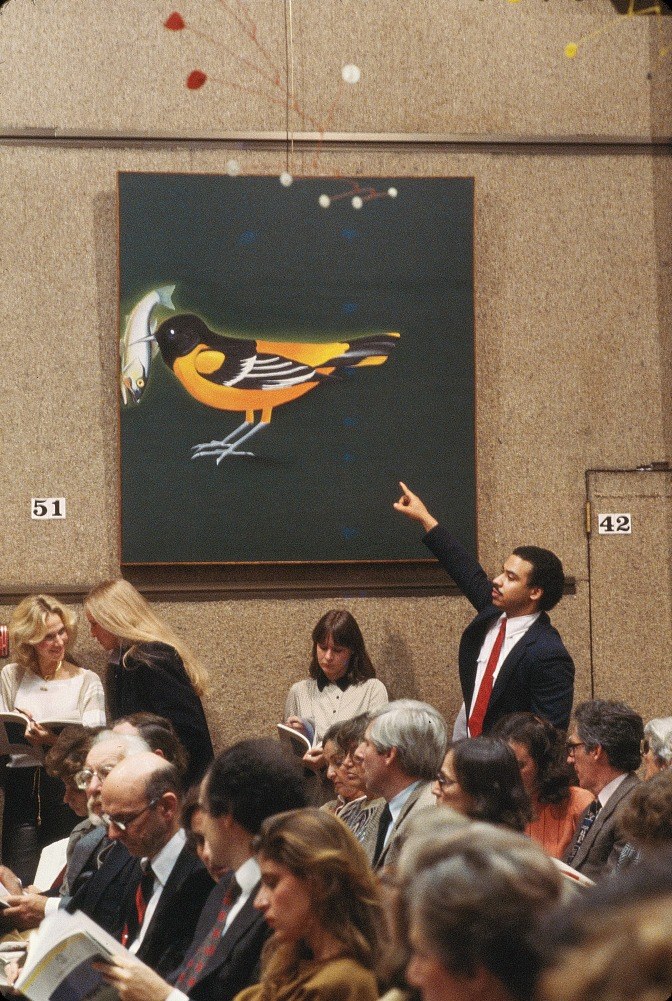
On the evening of November 6, 1990, at Sotheby’s on York Avenue, the chairman John Marion worked a room of five hundred people the way TIME’s reporter described it — “like a paramedic trying to revive an Egyptian mummy” — and could not bring it back. A Julian Schnabel broken-plate painting, Anh in a Spanish Landscape, bought in London the year before for $225,000 and priced afterward in a gallery at $650,000 with no takers, went unsold at $210,000. A Mark Rothko estimated at $1.8 to $2.2 million went unsold at $1.25 million. An Eric Fischl, Northern Girl, estimated at $450,000 to $600,000, went unsold at $300,000. Nothing by Andy Warhol sold that night at all. Japanese buyers, who had accounted for more than half the recorded volume of art bought at auction worldwide as recently as 1988, bid sluggishly or not at all, unnerved by a Tokyo stock index that had spent the year falling. The following evening at Christie’s, forty-eight percent of the lots offered failed to find a buyer.3 Eighteen months earlier, in the same rooms, contemporary painting had been the fastest-appreciating asset class in New York; by the fall of 1990 the same rooms could not give the same painters away at a discount. The art economist Clare McAndrew later reconstructed the scale of the reversal: global art sales had reached $27.2 billion in 1990 and fallen to $9.7 billion in 1991, a collapse the market took fourteen years to fully retrace.4 Auction prices for individual works, tallied by the art historian Olav Velthuis, fell forty-four percent on average between July 1990 and July 1992, with more than half the Impressionist, modern, and contemporary lots at Sotheby’s and Christie’s going unsold that first autumn.5
The word “crash” attached itself to the season immediately and was, from the inside, disputed immediately. Milton Esterow, publisher of ARTnews, told a reporter in 1990 that “what has crashed in the art market is all the speculation.” Amy Page, editor of Art & Auction, put the same point differently: people were saying the market had gone back to 1988 prices, “but that’s still extremely high, that’s not a crash.”6 Both were describing a real distinction the word “massacre” flattened. What had actually failed was the top tier and the money that had chased it there — the flippers, the Japanese buyers who had driven prices through the second half of the 1980s and now sat on their hands as the Nikkei fell, the dealers who had financed inventory against paintings as collateral the way a homeowner financed a house against its rising equity. The gallery floor one rung below the evening sales told a narrower, plainer story. Barbara Toll, who had opened her SoHo gallery on Greene Street in 1981, described the change to a reporter in June 1994 without any of the auction room’s drama: in the 1980s, she said, “everyone wanted to be part of this great explosion and own a piece of the art world,” and now “people are looking, not buying. We’re an entertainment.”7 She closed the gallery after mounting one last show. The dealer André Emmerich, in a January 1993 oral history for the Smithsonian, located the change at the level of the household budget rather than the auction block: the monthly stipends galleries had once advanced against an artist’s future sales, he said, “have gone out the window” with the recession. Emmerich also offered the underlying logic of the whole informal economy the stipends belonged to — “I never thought contracts are worth the paper they’re written on. It’s difficult for a dealer to sue an artist. Bad public relations. And what you need above all is goodwill” — a system built on a decade of prosperity that had just stopped paying its own overhead.8 Painters who kept working through the interruption remembered it, years later, in more equivocal terms than either the saleroom or the stipend suggested. The painter Chris Martin recalled, in an interview conducted long after the fact, “I saw half of Soho disappear (including my own gallery John Good) in the 1990s and I seem to remember that the real artists kept on working” — naming the painters Bill Jensen and Tom Nozkowski as two who used the interruption to deepen what they were already doing rather than stop. The dealer Jay Gorney, recalling the same years from his own gallery on the eve of the Gulf War in 1991, remembered it as “belt-tightening and unfortunately needing to sell things from my inventory” to stay open at all. Both accounts are recollection rather than contemporaneous record, offered decades after the recession they describe.9 The recession had not closed the art world. It had closed the part of it that had been, for most of the preceding decade, mistaken for the whole. The same salerooms recovered enough by mid-decade to auction off entire estates — Jacqueline Kennedy Onassis’s in 1996, the Duke and Duchess of Windsor’s in 1998 — for sums that dwarfed anything a living painter commanded; that was a different transaction, old money converting a name into cash rather than a market pricing new work, and it ran on its own separate logic.10
The Move to Chelsea
The neighborhood the crash emptied out did not stay empty, and what filled the vacancy told its own story about what had actually broken. SoHo’s galleries had operated for two decades in cast-iron loft buildings whose ground floors, by the middle 1990s, were worth more to a clothing retailer than to a dealer selling paintings on consignment. A Washington Post reporter touring the neighborhood in June 1994 could name the replacements storefront by storefront: what had been the Michael Walls Gallery was now Palazzetti, selling furniture; Perry Ellis had taken the space that once held the Louver Gallery.7 Rents that had run cheap in the 1970s, when the galleries first colonized the empty manufacturing lofts, had climbed to retail rates by the middle of the following decade — a level no consignment business, selling on a fifty-fifty split with an artist and hoping for one good year in three, could sustain against a retailer’s markup on ready-made goods.
The empty ground had already opened elsewhere, and it had opened seven years before the crash gave SoHo’s dealers a reason to look for it. The Dia Art Foundation had converted a warehouse on West Twenty-Second Street, in a stretch of Chelsea then dominated by parking garages and light industry, into an exhibition space in 1987 — an anchor institution with no retail pressure and no reason to leave.11 Larry Gagosian had tried a short-lived gallery in the same neighborhood in 1985 and abandoned it; the location had not yet found its moment. It found it in 1994, when the dealer Matthew Marks opened the first Chelsea gallery meant to stay, and recruited two SoHo colleagues, Pat Hearn and Paul Morris, to follow him north.12 The decisive difference between this migration and every ordinary rent-driven relocation a city produces every decade was structural rather than economic: the first wave of Chelsea dealers did not lease their converted garages, as their SoHo predecessors had leased their lofts. They bought them. A gallery that owned its building was insulated, permanently, from the mechanism that had just emptied SoHo — a landlord’s discovery that a boutique would pay more than a dealer ever could.
SoHo’s remaining commercial holdout ran the opposite direction from Palazzetti and Perry Ellis: Comme des Garçons kept a store in the neighborhood through the decade as retail’s lone concession to the district’s old identity, a boutique dressed, deliberately, to look like nothing was for sale. A SoHo opening on a Saturday afternoon by the middle of the decade had become a street event in its own right, part commerce and part party — the guest-list-less sorting of who belonged inside one such loft is its own, separately told story.13 The dealers who moved were, by the standards of the crash three years earlier, an unlikely coalition to be expanding at all — Pat Hearn and Colin de Land had weathered the recession running SoHo galleries through its worst years, and both joined the founding of an improvisational alternative to the trade fairs the established houses already controlled — staged in a hotel rather than a warehouse. The Gramercy fair the four of them staged in 1994, and again with new interventions by artists such as Mark Dion and Karen Kilimnik in 1996, functioned as a low-overhead proof that the gallery business could still generate an audience and a market without the institutional weight — or the retail-grade rent — that SoHo now demanded. Pat Hearn, one of the four, died of cancer at the decade’s end; an emergency sale her fellow dealers staged to cover her care became the seed of a cancer foundation carried in her and Colin de Land’s names.14 What Chelsea offered by the second half of the decade was the older SoHo bargain restored on different terms: large, cheap, ownable space, at the geographic edge of a media and money economy that had not yet decided the neighborhood was fashionable enough to bid the price back up.
The Commission
The auction houses recovered from the 1990 collapse by tightening the one lever the collapse had exposed as movable: the commission each house charged. Sotheby’s and Christie’s had spent the boom years discounting the seller’s commission competitively, dealer by dealer, collection by collection, in a market flush enough to absorb the concession — a consignor with a strong collection could play one house against the other and walk away paying next to nothing to sell. The recession made every point of margin worth defending, and in March 1995 Christie’s introduced a non-negotiable, sliding seller’s-commission scale, replacing case-by-case bargaining with a fixed schedule that fell as a sale’s value rose; Sotheby’s matched it within five weeks, on April 14. Ordinarily a pricing decision this dry would have drawn no attention beyond the trade press. It became, four years later, the overt act in a federal antitrust case, because the two houses had not arrived at parallel non-negotiable schedules through parallel competitive instinct. They had arranged it.
The arrangement was finalized in a car. In February 1995, Sotheby’s chief executive Diana “Dede” Brooks met her counterpart at Christie’s, Christopher Davidge — who had flown in on the Concorde and landed at 9:25 that morning — in the back seat of her Lexus to fix the commission structure both houses would announce weeks apart as an independent decision. Davidge, for reasons his own side never fully explained, kept notes of the meetings. When the scheme unraveled in 2000, those notes were the only physical record of a conspiracy that both houses’ chief executives had otherwise been careful to keep out of any file. Brooks pleaded guilty in October 2000 and testified for the prosecution; Davidge, granted immunity, testified alongside her. The trial reached up past both chief executives to Sotheby’s chairman, A. Alfred Taubman, the Michigan shopping-mall developer who had bought the house in 1983 and sat, prosecutors argued, at the top of an arrangement his own chief executive had merely executed. A jury convicted Taubman of price-fixing in December 2001.15 The commission both houses charged sellers, restored to a fixed and non-negotiable schedule five years earlier as a defense against a market that had just shown both houses how little pricing power either one held alone, turned out to have been restored by an agreement neither house’s own board had approved and neither house’s own history, until Davidge’s notes surfaced, had left any trace of at all.
The Invoice
Livent, the Toronto-based company that built and ran a chain of Broadway and Toronto theaters through the 1990s under its founder Garth Drabinsky, ran a second set of books beneath the first for the better part of a decade, and did it by a method that left almost no trail for an outside auditor to find. Beginning in 1990, Drabinsky and his partner Myron Gottlieb arranged for two vendors to inflate their invoices to Livent; the company paid the inflated amounts, and roughly seven million Canadian dollars flowed back to the two men, with a portion of it capitalized on Livent’s books as legitimate preproduction cost. As the decade advanced the method grew more ambitious. Preproduction costs for shows such as Ragtime — money spent on advertising, an expense that should have hit the current year’s earnings — were shifted onto the company’s balance sheet as capital investment in theater construction, in Chicago and in New York, where the expense could be depreciated slowly instead of subtracted all at once — a device the SEC’s own filings later labeled the “amortization roll,” production costs rolled forward year over year so that a loss due in the current column never quite arrived in it. Between 1996 and 1997 the company booked at least $34 million in revenue from transactions carrying secret side agreements requiring Livent to pay the money back — sales of production rights that were not, in the sense investors would have understood the term, sales at all.16
The mechanism of concealment was invoice by invoice rather than entry by entry, and the distinction mattered because it was designed to defeat the specific way an auditor reads a company’s books. An adjusting journal entry — the ordinary tool for moving an expense from one account to another — leaves a visible trail that a competent audit is built to follow. Livent’s controllers, Diane Winkfein and D. Grant Malcolm, avoided that trail entirely: they identified the individual invoices they needed to relocate, changed the distribution dates and account codes, deleted the originals from the computerized general ledger, and re-posted them under the new codes — a few invoices at a time, repeated across years, so that no single adjustment was ever large enough, or strange enough, to draw a reviewer’s eye.17 The finance vice president Gordon Eckstein, instructed at one point to convert a twenty-three-million-dollar loss into a two-million-dollar profit, described the daily discipline the fraud required of the people executing it: “I have to keep all the lies straight. I have to know what lies I’m telling these people. I’ve told so many lies to different people I have to make sure they all make sense.”18 By the SEC’s later accounting, the company understated its expenses by $3.5 million in 1995, $18.1 million in 1996, and $8.5 million in 1997, across at least seventeen false filings.16 New management under Michael Ovitz and Roy Furman discovered the irregularities in August 1998; the U.S. Attorney for the Southern District of New York indicted Drabinsky and Gottlieb on sixteen felony counts each — conspiracy plus fifteen counts of securities fraud — the following January.19
The Ladder
Broadway’s top ticket price had held near fifty dollars through most of the 1980s and stood at fifty-five for Jerome Robbins’ Broadway in 1989 — a price a producer could raise only so far before a different, older mechanism absorbed the difference. For as long as the legal ticket price sat well under what the market would actually bear, the gap between the two numbers stayed somebody’s income rather than nobody’s — ice’s whole economy ran on that gap, and Koppell’s 1994 inquiry and the legislature’s hearings documented the mechanics without much altering them, since a cap set well under the market price guaranteed that somebody, inside the box office or just outside it, would keep collecting the difference. The producer Cameron Mackintosh confronted the arithmetic directly in 1990, pricing the front mezzanine of Miss Saigon at one hundred dollars — the first hundred-dollar ticket on Broadway — while holding the rest of the house at sixty and setting aside a hundred and two rear-mezzanine seats for students at fifteen. Scalpers working through New Jersey brokers were already getting $145 to $175 for Phantom of the Opera, Mackintosh said, and “that money disappears forever.”20 Raising the legal price did not so much abolish ice as reclaim a share of it for the box office that had been printing the cheaper ticket.
Whether a given show could command that ticket at all still ran partly through the New York Times’s drama critic, Frank Rich, whose outsized reputation for closing shows with a single review is its own, separately documented story;21 the ladder climbed steadily and unevenly through the rest of the decade — Show Boat and Sunset Boulevard pricing near seventy-five dollars by 1994, the top settling around ninety by the decade’s final years — until The Producers reset it twice within the space of a single season. Mel Brooks and Susan Stroman’s show opened in April 2001 with a top ticket of ninety-five dollars, raised to ninety-nine dollars the day after its reviews ran, and by late October the production announced it would set aside fifty of the best seats at every performance for four hundred and eighty dollars each — “that’s not a misprint,” in Playbill’s own phrasing — the highest price a Broadway ticket had ever carried. The announcement, delayed several weeks out of deference to the city’s mood that September, arrived with a provision that a portion of each premium ticket would go to a fund for the families of the attacks; the pricing decision itself, though, had been settled on its own commercial logic before that September arrived, aimed less at raising revenue outright than at moving the last, most valuable seats out of the ice economy entirely. Equity’s executive director, Alan Eisenberg, called the four-hundred-eighty-dollar seat “a red flag” — proof, in his reading, of what an actor’s presence in the house was actually worth once a producer stopped pretending the legal price and the market price were the same number.22 The ladder that had started at fifty dollars in 1988 and reached four hundred eighty in 2001 had not, across thirteen years, changed what the seat was worth. It had only changed who was permitted to say so out loud. The musicians in the pit, unionized under the American Federation of Musicians’ Local 802, worked the whole climb under scale sheets the union itself kept out of print; asked years later for period pay figures, Local 802 told an interviewer plainly that it “did not want any information on Broadway musicians’ pay published.”23 The house’s own arithmetic, in other words, stayed legible only from the side that sold the ticket.
The Broadway Top-Ticket Ladder, 1988–2001
| Year | Production | Top ticket | Note |
|---|---|---|---|
| 1988 | (house standard) | $50 | The prevailing top price before the decade’s escalations began. |
| 1989 | Jerome Robbins’ Broadway | $55 | A modest, pre-crisis increase. |
| 1990 | Miss Saigon (front mezzanine) | $100 | The first $100 Broadway ticket, announced ahead of the 1991 opening; rest of house held at $60, 102 rear-mezzanine seats at $15. |
| 1994 | Sunset Boulevard | ~$75 | Approximate, mid-decade climb, hedged. |
| 2001 | The Producers | $95 → $99 → $480 (premium) | Opened at $95; raised to $99 after its reviews; 50 premium seats/performance added at $480 that fall.22 |
Two industries that shared nothing structurally — one selling unique objects at auction, the other selling identical seats by the thousand — spent the same twelve years discovering the same fact about a market that had let its own mechanics go unexamined for too long. A commission nobody negotiated and a ticket price capped below what a scalper could get were both, in their own vocabulary, an agreement to look away from what something actually cost; both held only until someone with an incentive to look closely enough did the arithmetic in public. The recession that emptied SoHo’s storefronts and the notes Christopher Davidge kept in a Lexus were not, on their surface, the same story, and neither pretended to teach a lesson. What both left behind, once the prices had finished moving, was a clearer account than either business had ever volunteered on its own — of what a painting, a theater seat, and a company’s own books had been worth all along, and who had been quietly deciding not to say so.
The January 1991 issue would have carried the Sotheby’s collapse into The Back, the paramedic line and the unsold Rothko and the Warhols that found no bidder at all, told through the room’s own disputed word for what had happened to it. Three years on, an articles editor would have claimed the move to Chelsea for the same section in November 1994 — the SoHo landlords discovering a boutique tenant, the new dealers buying rather than renting their garages, the fair the four of them staged in a hotel’s guest rooms.
The Sotheby’s-Christie’s commission scheme, fixed in the back seat of a Lexus in February 1995, would have reached the December 2000 issue as something smaller than what Christopher Davidge’s notes actually held: a shorter culture turn on the auction houses’ clubby manners and Old World discretion, Brooks and Davidge rendered as characters in a saleroom social history, the antitrust mechanics folded into one paragraph and left to the wire services. The piece would have cut too close to the masthead’s own habits and friendships to run whole, the checking desk unable to clear what it would have had to say about people the arts desk would have dined with. The Livent fraud, breaking in August 1998, would have arrived at the February 1999 close reshaped the same way: a theater-desk profile of Garth Drabinsky’s fall as producerial hubris, the amortization roll and the SEC’s invoice-by-invoice forensic account left out entirely, because no one on the floor would have carried both a theater beat and an eye for a restated balance sheet, and the gap between the two would have outlived the story.
The June 1991 issue would have opened on Miss Saigon’s hundred-dollar mezzanine seat, the first of its kind on Broadway, set beside the sixty-dollar house and the hundred and two seats held back for students at fifteen, and the piece would have found its natural home in The City. A decade on, the December 2001 issue would have closed on the same ladder’s far end — The City’s beat for a decade of ticket prices arriving at its logical extreme — the ninety-five-dollar top on The Producers raised to ninety-nine within a day of its reviews, and by October fifty seats a night at four hundred and eighty dollars, a price Playbill itself called no misprint.
Footnotes
-
Note on New York’s ticket-resale statute and box-office “ice,” Brooklyn Law School Journal of Law and Policy. ↩
-
“Obstructed View,” Office of the New York State Attorney General, report on ticket-resale practices. ↩
-
“Art: The Great Massacre of 1990,” TIME, November 1990. ↩
-
Clare McAndrew’s global art-sales data, cited in “How Will a Global Recession Affect the Art Market?,” Apollo, September 2022. ↩
-
Olav Velthuis, “Accounting for Taste: The Economics of Art,” Artforum International, April 2008. ↩
-
“Art Market Armageddon: Is the Reporting on the Market Fair, or Is It All Hyperbole?,” ARTnews (retrospective on the 1990 collapse, quoting Milton Esterow and Amy Page). ↩
-
“On a Stroll Through SoHo,” Washington Post, June 4, 1994. ↩ ↩2
-
Oral history interview with André Emmerich, Archives of American Art, Smithsonian Institution, conducted January 1993. ↩
-
Recollections of painter Chris Martin and dealer Jay Gorney, gathered years after the recession in retrospective interviews for the New York Foundation for the Arts; cited here as memory, not contemporaneous reporting. ↩
-
See 4.14, “Old Money Institutions,” on the Sotheby’s contents sales of the Onassis (1996) and Windsor (1998) estates — a distinct auction-house story of provenance and old-money dispersal, not the contemporary-art market’s price collapse. ↩
-
“After a $20m Renovation, Dia Is Poised to Re-emerge as a Force in Chelsea,” The Art Newspaper, April 12, 2021. ↩
-
“From Grit to Glitter: A Look Back at 25 Years of the Armory Show,” The Art Newspaper, March 6, 2019. ↩
-
See 9.10, “The Guest List: Who Came to the Opening, 1991,” on the sorting mechanism of a Tribeca loft opening. ↩
-
“Colin de Land,” Wikipedia (on the 1997 emergency sale for Pat Hearn’s medical costs, the Pat Hearn and Colin de Land Cancer Foundation, and Hearn’s 2000 death). ↩
-
“Ex-Sotheby’s Chairman Convicted of Price-Fixing Conspiracy,” Fox News, December 2001. ↩
-
U.S. Securities and Exchange Commission, Administrative Proceeding, Release No. 34-40937, In the Matter of Livent Inc. ↩ ↩2
-
U.S. Securities and Exchange Commission, Litigation Release No. 16022, SEC v. Garth H. Drabinsky et al. ↩
-
The Canadian Encyclopedia, “Drabinsky Charged.” ↩
-
“SEC & U.S. Attorney Hit Ex-Livent Chief Garth Drabinsky on 16 Felony Counts,” Playbill, January 13, 1999. ↩
-
“Broadway’s $100 Ticket,” Washington Post, March 3, 1990. ↩
-
See 3.13, “Print Journalism’s Existential Crisis,” on the critic-power question surrounding the Times’s Frank Rich. ↩
-
“B’way’s Producers Raises 50 Top Tickets to $480 Each,” Playbill, October 26, 2001. ↩ ↩2
-
“How Much Money Do Broadway Actors Make?,” Playbill. ↩