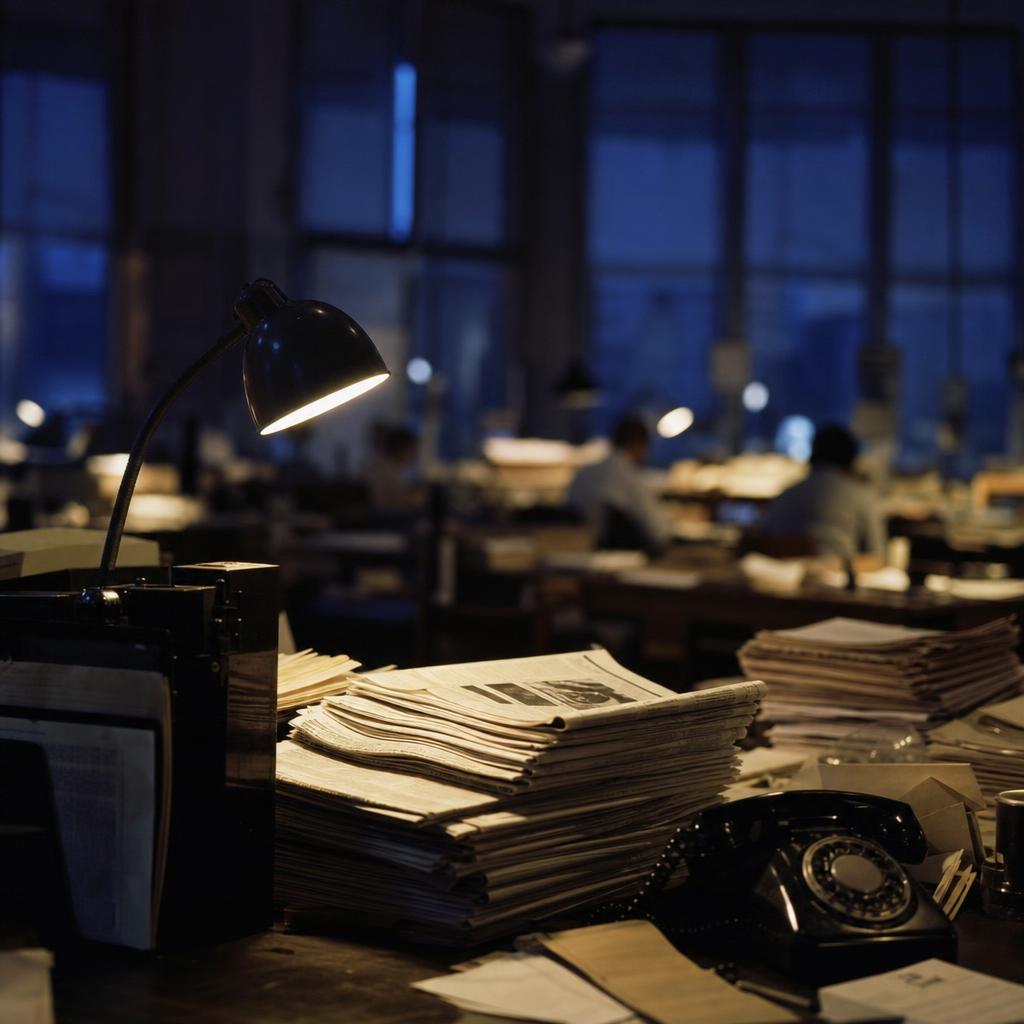
Year Zero: November 1989
Subscribe
https://meridian-archive.com/feed.xmlOpen in your app, or paste the link above into any other:
Tuesday, November 7
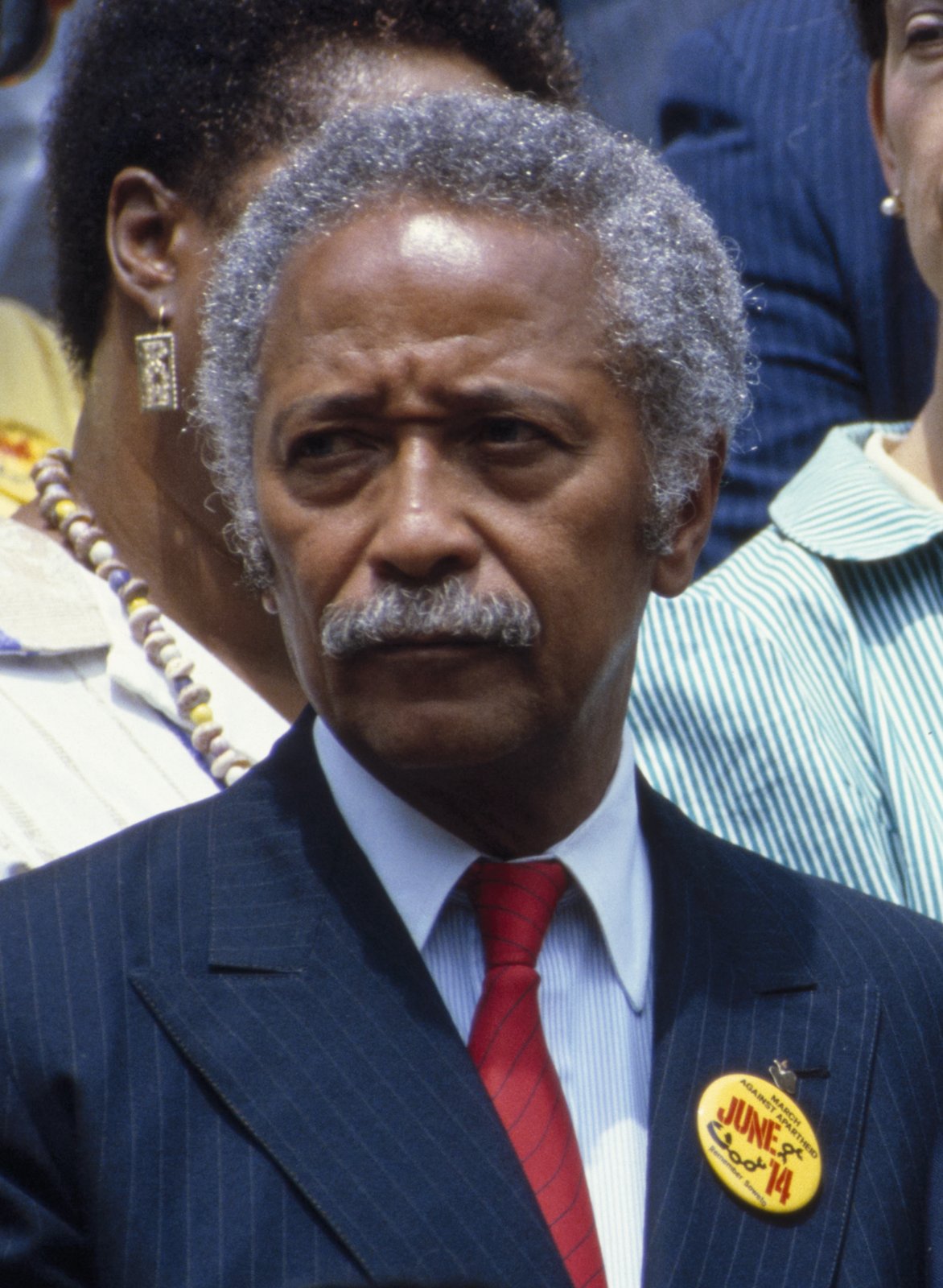
A city that could not, by its own charter, simply raise a tax had, in 1989, funded a police expansion by inventing a container for the money instead of a new tax: the state legislature authorized a personal income-tax surcharge collected only within the five boroughs, its proceeds barred by statute from the general fund and directed to nothing but new officers, filed under a program name — Safe Streets, Safe City — that the city’s own budget office used in press releases as though it required no further explanation.1 The mechanism was arcane by design: a surcharge was not a tax increase in the way voters punished a tax increase, and a dedicated fund was not a budget line an incoming administration could raid for something else. David Dinkins had campaigned on it, and it was slated to begin under him in the new year, one of the few concrete instruments a mayor-elect had in hand before he had a budget of his own.
That was the administrative floor the city built for itself even as it went to the polls on November 7. The margin it produced was not a mandate. Dinkins won by roughly 47,000 votes out of a turnout of 1.75 million — the kind of number that a single bad weather system in Brooklyn or a different headline in the Post might have flipped.1 The coalition that elected him had been assembled across the preceding twelve years of Edward Koch’s mayoralty, and its internal tensions were precisely what the summer had exposed: Black and Latino voters in Harlem, Brownsville, and the South Bronx had voted for Dinkins at rates above 95 percent; the West Side and much of Queens had come in with him; the Giuliani precincts were the outer-borough white neighborhoods that had watched the previous year with mounting alarm. The word Koch had given Dinkins in September — when Dinkins defeated him in the Democratic primary by roughly eight points — was gorgeous mosaic, repurposed from Dinkins’s own nomination speech, and it had entered circulation as both a description of what New York was and a wager on what it could become.1
The twelve years that produced the mosaic had not been simple. Koch had inherited a city at the edge of fiscal collapse in 1978 and had overseen a recovery that restored municipal solvency and rebuilt much of the institutional capacity that the fiscal crisis had gutted. He had also presided over a city in which racial tensions hardened visibly through the 1980s under the twin pressures of crack cocaine and a policing apparatus that was coarser, by documented measure, in Black and Latino neighborhoods than in white ones.2 By the summer of 1989, two events had concentrated that accumulated tension into something acute. On August 23, Yusuf Hawkins, sixteen, was shot and killed by a white mob in Bensonhurst; he had gone to the neighborhood to look at a used car and was mistaken for the boyfriend of a local girl.3 The marches through Bensonhurst that followed ran through September. Separately, the Central Park jogger case — five Black and Latino teenagers indicted in May for the April 19 attack on a woman jogging near the 102nd Street transverse, the trials still pending — saturated the city’s coverage through the summer; the confessions on which the prosecution rested would be argued, by defense attorneys, to have been coerced, and the city divided along lines that roughly tracked its geography.4
Into this, on May 12, 1989, the Metropolitan Transportation Authority had withdrawn the last graffiti-covered subway car from passenger service.5 The IRT and BMT now moved in clean steel. The tile work in many stations was still streaked. The city Dinkins won on November 7 was a city that would close 1989 with 1,905 homicides on the books, crack at full amplitude, a recession forming in the financial district though not yet visible on the street. The Safe Streets, Safe City program — a police-force expansion financed by a city and state income-tax surcharge — was part of what Dinkins had campaigned on, slated to begin under his administration in the new year. The inauguration was scheduled for January 1, 1990.
Thursday, November 9
The day began as a normal Thursday in New York. At 12:53 in the afternoon Eastern time, a press conference was called in East Berlin by Günter Schabowski, a member of the Socialist Unity Party’s Politburo, who read aloud from a regulation he had only just received and had not yet read in full.6 The regulation concerned travel. A reporter asked when it would take effect. Schabowski, reading from the paper, said: immediately, without delay. The wires began to move. In New York, the afternoon was already in late rush hour.
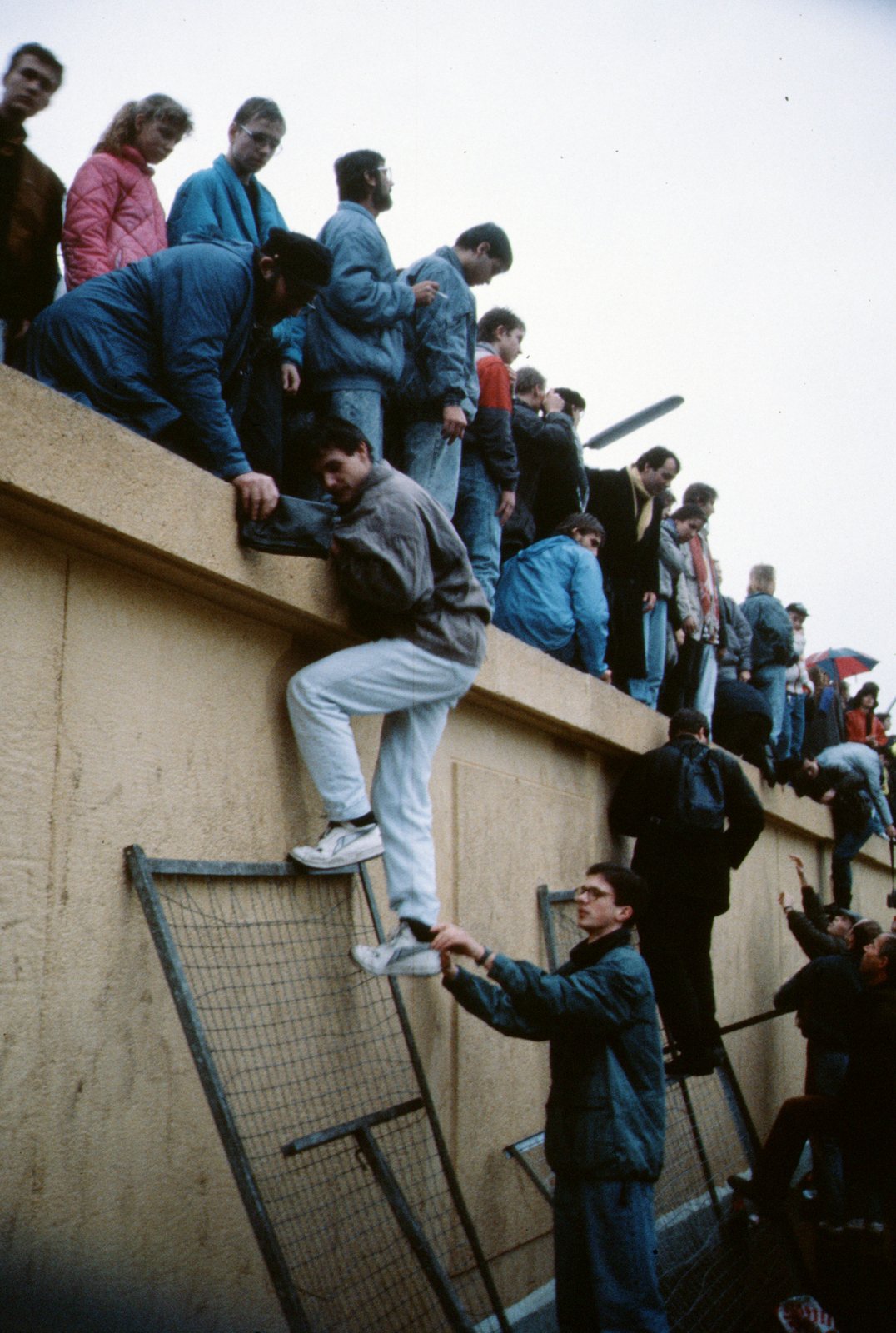
The Bornholmer Strasse checkpoint, the northernmost crossing in the inner-city border, opened its gates at 4:45 PM Eastern — 10:45 PM in Berlin — after crowds had pressed against them for hours and the border guards, receiving no coherent orders from above, made a unilateral decision to let people through.6 Some New Yorkers heard it on car radios going home. At six o’clock, the network evening news programs led with it: NBC was uniquely positioned, its anchor Tom Brokaw already in Berlin on assignment, broadcasting live from the foot of the Wall as the first crowds crossed. By seven, CNN had gone wall-to-wall. Young Germans sitting on top of the Wall at the Brandenburg Gate, arms raised, a West Berliner pouring champagne into the mouths of Ossis through a checkpoint barrier — the footage was circulating by the late evening, replayed on every set still on in Yorkville.
New York’s German community in 1989 was concentrated in Yorkville on the Upper East Side, considerably diminished from its mid-century density but still anchored on East 86th Street and the surrounding blocks by the institutions that had survived. Schaller & Weber, the butcher at 1654 Second Avenue, had been there since 1937 and was still operating. The Heidelberg Restaurant occupied 1648 Second Avenue, between 85th and 86th — the last of the original German restaurants on the block. Kleine Konditorei and Café Geiger were within a few blocks. The Goethe-Institut, which had occupied 1014 Fifth Avenue opposite the Metropolitan Museum since 1961, was closed that fall for a renovation that had begun in April and remained unfinished, running into 1991; it could not host the public gathering it would otherwise have organized.
The generational split in the community was visible that night. New Yorkers of German background in their twenties were, by various accounts, already in West Berlin or had booked flights to get there; the event belonged to their generation and they understood this. Those in their fifties and sixties stayed. They crowded around the CRT sets in the Yorkville bars — a UPI/Bettmann photograph from that night shows them at a bar likely along the 86th Street corridor, six or eight figures in their middle years, men in collared shirts and cardigans, women in blouses with beaded necklaces, pressed together around a single wall-mounted television; two of them were visibly weeping. They called cousins in Hamburg and Stuttgart. They stayed until three in the morning.
The Front Pages
The Friday morning papers were the first place most New Yorkers saw the two stories in the same frame. The New York Times ran both above the fold — Berlin as the lead, with the photograph; the Dinkins transition team in the second column. The layout was not a design choice so much as an obligation: the news had arrived adjacent, and the paper had to set it that way. The New York Daily News, a tabloid with a working-class readership and a tradition of economical declarative headlines, ran the Wall as the whole front page on November 10: “FREEDOM!” in heavy slab-serif type running the full width, a photograph below of young West Berliners standing atop the Wall with their arms raised and the Brandenburg Quadriga visible behind them.7 The following morning, November 11, the Daily News gave the same real estate to “WUNDERBAR!”.8 The Post and Newsday took the Wall as the primary lead and the Dinkins transition as the regional anchor. In each case, the proximity was the same: the two stories occupied adjacent space not because any editor had decided they belonged together but because they had no choice except to be adjacent.

Television criticism in the Friday papers noted NBC’s logistical advantage — Brokaw had been in Berlin on an unrelated assignment when the news broke, giving the network a live presence neither CBS nor ABC could match that evening. By the time the Saturday papers appeared, the East German government’s further collapse was already crowding the coverage: Egon Krenz, Honecker’s replacement since mid-October, was himself under pressure, and the political geography of the German Democratic Republic was dissolving faster than American television could locate correspondents to cover it.
At the newsstands at Grand Central Terminal, Penn Station, and the mezzanines of the major IRT stations, papers stacked deeper than usual that Friday morning; in the midtown newsstands the Wall image on the Daily News sold past the first printing, by various accounts. The Friday print run, at some stands, had been replenished by mid-morning. What arrived on the editorial floors of the weekly and monthly publications that Friday was the stack of dailies plus, already, the first wire dispatches for the next cycle — and the Dinkins transition memos, which were their own stack.
Two Cities
What made the week singular was not the events individually but what the city did with them in combination, which was essentially nothing. They occupied adjacent columns in the Friday papers and adjacent conversations in the coffee lines and lunch counters, but the editorial and social work of reading them as a single phenomenon — of asking what it meant that a city that had just turned over its mayoral coalition to its first Black mayor was simultaneously watching the European cold-war order dissolve — was not performed. It was not declined. It was not attempted. The two registers operated in parallel without intersection, in the way that a city’s simultaneous lives usually do.
The Friday morning ran to two extremes. In Morris Heights in the northwest Bronx, in one of the five-story brick walkups on University Avenue that had survived the arson crisis of the 1970s, a GE clock radio on a Formica countertop clicked on at 6:30. Sunrise was still minutes away; outside, under sodium-vapor streetlights still burning amber, the bare branches of a sidewalk tree were just legible against a lightening sky. The radio was tuned to WBLS 107.5 FM, Inner City Broadcasting — the station for Black New York — where the morning drive host had recently been poached from a rival station’s morning show; between news breaks it ran mid-tempo R&B: Soul II Soul’s “Back to Life,” Janet Jackson’s “Miss You Much,” Luther Vandross, Bobby Brown. The news breaks referenced Dinkins. The inauguration was six weeks away. The steam radiator banged and hissed against the baseboard, on schedule. A livery driver at the corner of Fordham and University had his radio set to 1010 WINS: You give us twenty-two minutes, we’ll give you the world. Wall coverage cycled at the top and bottom of every quarter-hour. He heard it as news from overseas, which it was.
In Yorkville that same morning, the bars that had stayed open past three were closed or had their last patrons in the back rooms. The older Germans and German-Americans who had watched through the night had not, in many cases, gone home. The morning light came through the window glass of the Heidelberg and Schaller & Weber at a low angle, the November sun barely thirty degrees off the horizon even at noon, the shadows long and directional on the pavement of East 86th.
The New York Times that Friday morning had set the two stories adjacent above the fold because that was where they fell. It had not drawn a connection between them because no one had assigned a piece to draw it. The connection — that the city watching a wall fall in Berlin was the same city that had just elected its first Black mayor, that the gorgeous mosaic was in some sense contemporaneous with the mosaic being destroyed and rebuilt in central Europe — was available but unassigned. The homicide count for the coming year was still accumulating precinct by precinct, headed for the highest total in the city’s modern record. The German reunification calendar was beginning, though the formal date — October 3, 1990 — was eleven months away. That week, the crime count, the coalition math, and the Wall’s aftermath ran on separate clocks, each visible, none read together. The city received them the way it received most things: in parallel, without synthesis, at volume.
A city is not obligated to make sense of the news it receives. The two events of the first week of November 1989 were not, by any structural logic, the same story: one concerned a municipal election in the largest city in the United States; the other concerned a checkpoint on the inner-German border whose opening set off a chain of political consequences that would not fully resolve for another year. That they arrived three days apart and occupied adjacent columns in the Friday papers was the accident of chronology, not an argument. And yet a city that had just elected its first Black mayor by 47,000 votes on a platform of rebuilding the coalition — a city raw from Bensonhurst and the Central Park convictions, a city in which the cold-war frame had functioned, through four decades, as a shared backdrop against which domestic disputes could be understood as secondary — that city had received, in the same week, two events that were each, separately, the kind of event that reorders what a society believes is possible. That they were received in parallel, processed in parallel, and not read as a single question was not a failure. It was simply what a city does when two things happen at once, which they almost always do. The book opens here because this is where the premise begins: a city living in two registers simultaneously, moving between them the way the eye moves between columns on a page, without stopping to notice the gutter.
The Foreign File, closing for the December book, would have taken the checkpoint at Bornholmer Strasse as its spine — the argument the magazine had been running since the postwar settlement, over whether 1989 completed 1945 or opened onto something the old frame no longer covered. The City would have carried the Dinkins piece in the same close: the forty-seven-thousand-vote margin, the coalition assembled across a decade under Koch, weighed against a summer that had produced Bensonhurst and the pending Central Park trials. Neither assignment would have required debate.
An editor near the top of the masthead, Berlin-born, decades out of the city, would have read the Bornholmer wire copy twice before it would have gone down to layout, and would have moved her Sunday call to her father up by a day that week.
The piece that would have needed both stories — that the gorgeous mosaic and the collapsing frontier were, in their way, the same question about whether composite societies hold — would have gone unassigned. Raised at a senior lunch, it would have died on a plain accounting: a twin subject, not a single one; no writer in the stable would have been fluent in both Berlin and the Bronx; and beneath it, an unspoken doubt that the reader being edited for would not clearly have held both without losing the thread. Nobody would have argued for it twice. The room’s most recent hire, from Morris Heights, would have carried both stories downtown with no assignment attached to either; on her block the returns would have settled well before she left for the train, and at Lincoln Hospital, where her mother worked nights, the ward would have had the same count before the first edition closed.
Footnotes
-
David N. Dinkins, A Mayor’s Life: Governing New York’s Gorgeous Mosaic (Public Affairs, 2013). ↩ ↩2 ↩3
-
Jonathan Soffer, Ed Koch and the Rebuilding of New York City (Columbia University Press, 2010). ↩
-
John DeSantis, For the Color of His Skin: The Murder of Yusuf Hawkins and the Trial of Bensonhurst (Pharos Books, 1991). ↩
-
Sarah Burns, The Central Park Five: A Chronicle of a City Wilding (Knopf, 2011). ↩
-
Joe Austin, Taking the Train: How Graffiti Art Became an Urban Crisis in New York City (Columbia University Press, 2001). ↩
-
Mary Elise Sarotte, The Collapse: The Accidental Opening of the Berlin Wall (Basic Books, 2014). ↩ ↩2
-
New York Daily News, front page, November 10, 1989. ↩
-
New York Daily News, front page, November 11, 1989. ↩