Working-Class Material Culture: The Morris Heights Apartment
Subscribe
https://meridian-archive.com/feed.xmlOpen in your app, or paste the link above into any other:
One Number, Voted Once a Year
Nine people, appointed by the mayor and meeting in public session each June, set the rent for the fourth-floor apartment on University Avenue — not the rent as a dollar figure, but the percentage by which it was allowed to rise on the next lease. The Rent Guidelines Board did not inspect the building, price the neighborhood, or ask whether the boiler had held sixty-eight degrees the winter before; it voted a single number, most years in the low single digits, and that number applied by law to every one- and two-year renewal signed in the city’s roughly one million rent-stabilized apartments at once — the same figure for a walkup on University Avenue and a prewar building on Central Park West, regardless of what either landlord had or had not done to earn it.1 The tenant learned the figure only when the management company’s renewal notice arrived in the mail, a form letter naming the new number and asking for a signature; nothing about the unit itself — its wiring, its paint, the year its stove had last been serviced — entered into the calculation on either end.
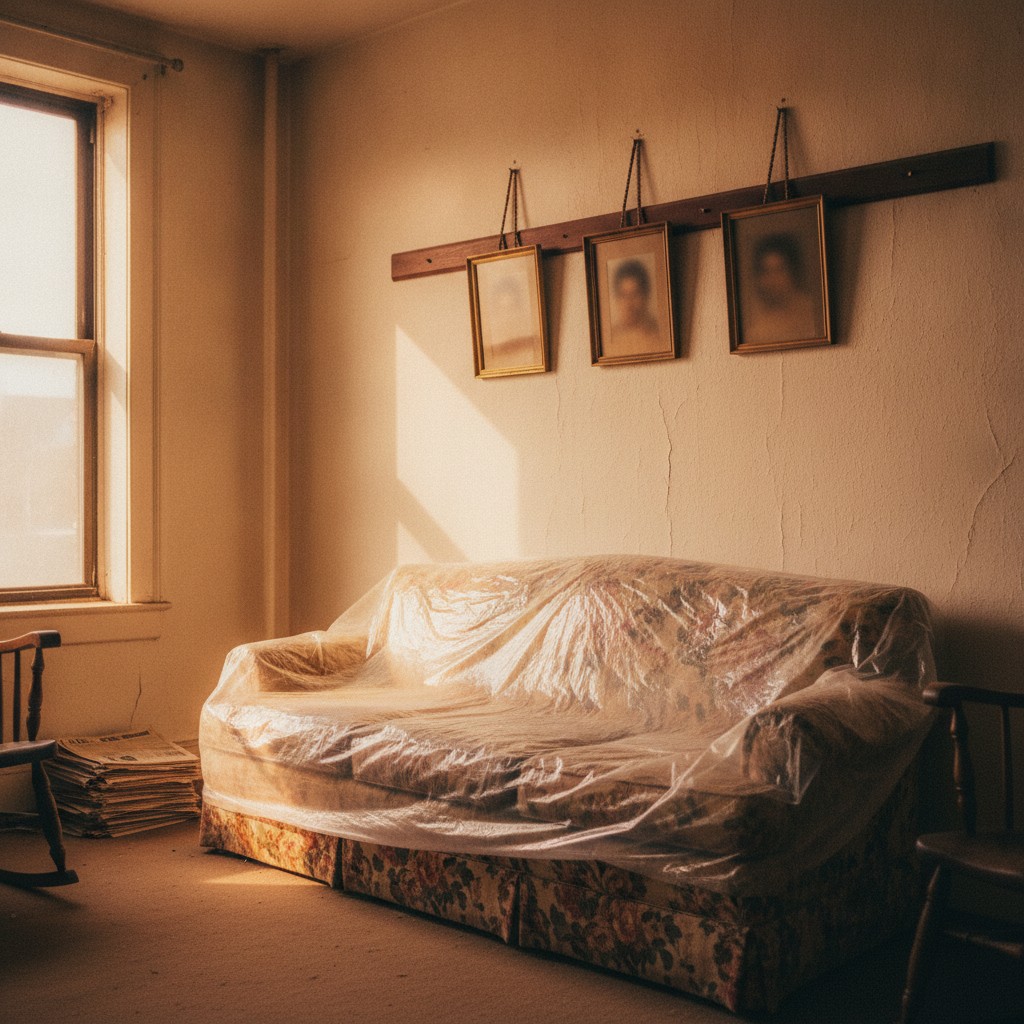
On the living-room wall of that same fourth-floor walk-up, a different kind of record accumulated on its own schedule, one the Board’s arithmetic never touched: three decades sat one behind the other, and none of them had been removed. Under a dozen coats of paint lay the original 1920s plaster — pre-war lath and horsehair, a picture rail running the room’s perimeter, cracked faintly where the building had settled over sixty years. Laid over that, from a landlord’s cut-rate rehabilitation sometime in the 1970s or early 1980s, ran the visible seams of a later decade: vinyl base molding glued rather than nailed, a ceiling medallion painted shut where a chandelier had once hung, a single fluorescent ring fixture wired in after a code inspection. And fixed on top of both, added rather than replacing anything, hung a Sacred Heart of Jesus in a gilt frame beside a portrait of John F. Kennedy in a matching frame — a pairing familiar enough in Latino households across the Bronx through the middle 1990s that it read less as decoration than as a household’s own timeline, displayed rather than dated. Nothing on that wall had ever come down, and nothing in the rooms behind it had either — a household economy in which new things arrived rarely enough that old things simply stayed.
The apartment itself was one of thousands like it in Morris Heights: a five- or six-story brick walk-up built to a railroad plan, rooms strung off a single long hallway with the kitchen at one end and the living room at the other, one bathroom serving the whole unit, cast-iron radiators in every room, in a rent-stabilized building whose tenants, almost without exception, had never owned the unit they lived in. What distinguished any one of these apartments from its neighbors was not its layout but its accumulation — the specific, economically logical choices a household had made across years and had no occasion, and often no means, to unmake. A renovation happened once, when the landlord judged it necessary. A purchase happened once, on layaway or credit, and then stayed. The apartment did not get redecorated. It got added to.
Late in the year, the light that crossed that wall told a related story. At the Bronx’s latitude the sun climbed barely a third of the way up the winter sky even at solar noon, and the day ran short — sunrise near seven, sunset before four-thirty — which left most of the daylight hours slanted rather than overhead.2 The five- and six-story walk-ups along University Avenue stood close enough to open sky that a fourth-floor window took in a wide dome of it, and the dark brick facing the block absorbed most of what fell on it rather than bouncing it back, so a south-facing room received its light direct and warm instead of diffused. Forty blocks south and a world away, the same November sun reached a Midtown office tower through a slot of sky cut narrow by thirty- and forty-story limestone, arriving as a cooler, glass-reflected glow. The wall with three decades on it took the other kind of light: low, amber, and uninterrupted, crossing the floor in a single beam for most of a winter afternoon.
Six-Thirty in the Morning
The radiator had already announced the day before anything else did.
The boiler itself sat in the basement, tended by a superintendent who fired it on a timer calibrated to the code rather than to any particular tenant’s comfort, and who answered, when a radiator went silent in January, to a call routed through the landlord’s management office rather than to the tenant directly. A cold radiator was a violation the city’s housing department could in principle enforce; in practice it was a complaint logged, a visit scheduled, and a wait measured in days rather than hours. The system worked, most winters, well enough that a cold radiator in January was the exception a tenant registered and called about, not the rule.
By the time the radiator finished its sequence, the street outside had begun its own. The BX12 pulled north along Fordham Road on its crosstown run; a garbage truck worked a block at a time, its compactor cycling in a hydraulic crunch; sirens, at any hour, were close to constant. Underneath all of it, in a year when New York recorded roughly a hundred and forty-seven thousand stolen vehicles citywide — the peak of the decade, one car taken for every few hundred residents — ran the six-tone cycle of a car alarm nobody had come down to silence.4 Through a single-pane window with worn weatherstripping, the alarm carried into the apartment at something close to ordinary conversation volume: present, specific, and, after enough winters, no longer registered as sound at all.
What the Landlord Left and What the Tenant Added
The kitchen floor was sheet vinyl, not true linoleum — printed, patterned to imitate brick or stone, laid in a wide roll sometime in the renovation years and, by the late 1980s, curling at the seams near the sink. The countertop was Formica in a butcher-block or faux-marble laminate, chipped at the corners, scorched in a small crescent near the stove where a pot had sat too long. The range was a white thirty-inch gas model with standing pilot lights that a tenant relit by hand after every gas-company interruption, its chrome drip pans yellowed, one control knob a mismatched replacement the building superintendent had pulled from a supply closet rather than order new. The bathroom carried the same layer: a pedestal sink and a cast-iron tub original to the building, a medicine cabinet with a mirrored door that no longer closed flush, tile from a mid-century patch job that did not quite match the tile it had replaced. None of it had been chosen by the person who lived there. It had been chosen, cheaply, by whoever managed the building in the year the landlord decided a renovation was owed.
What the tenant chose sat on top of the landlord’s layer and read differently. A twenty-five-inch Zenith console television, the last brand still assembled at an American plant into 1990, occupied a laminate stand bought to hold it.5 A black plastic clock radio with red LED digits sat on the Formica counter, cheap enough to have come from any drugstore or five-and-dime, and woke the household most mornings tuned to whatever station whoever had set it last preferred. A framed wedding photograph, decades old, hung near the Sacred Heart and the Kennedy portrait. Each object marked a year and a decision — a purchase made when money allowed it, kept afterward because there was no reason, and rarely the means, to replace something that still worked.
The Room From Seaman’s
The living-room sofa had come, like a large share of Bronx living rooms in the 1980s, from Seaman’s Furniture — by 1989 the second-largest furniture retailer in the country, thirty-one stores and roughly two hundred seventy-five million dollars in annual revenue, built on the strength of a jingle, “See Seaman’s First,” that ran constantly on New York television through the decade.6 Kohlberg Kravis Roberts had taken the company private in a leveraged buyout agreed in late 1987, a transaction that left Seaman’s carrying debt its own operating profit could not service; the chain filed for Chapter 11 in January 1992.7 None of that was visible from the showroom floor, where a family bought a matching sofa, loveseat, and coffee table on a layaway plan and carried nothing else away that day. The set arrived floral-printed, plastic-slipcovered against wear, and built to outlast the layaway payments: it did not match anything acquired before or after it, and it did not need to.
Layaway, not rent-to-own, was the standard route into that furniture for a household with steady income and no cushion — a deposit down, the balance paid over months, delivery on the day the last payment cleared. Rent-to-own storefronts were expanding aggressively into neighborhoods like Morris Heights across the same years, offering the same furniture for a fraction of the weekly cost and a far larger total; a household that could manage layaway generally avoided the difference. The sofa that came home under those terms in 1989 stayed the identifiable center of the room for over a decade — reupholstered in nothing, replaced by nothing, eventually wearing a slipcover of its own over the plastic that had already been protecting it.
The rest of the room filled in around it on the same terms. A console television sat on a wood-veneer stand with a wood-grained videocassette recorder on top, bought once the machines had grown affordable enough for a working household rather than a novelty for one with money to spare. A velvet painting — horses, or a scene from the island a grandparent had left — hung in the hallway; a plain wood crucifix hung over the front door. In the bedroom, a dark-stained particleboard headboard came from the same Seaman’s floor plan as the living-room set, and later, from the Caldor on Bruckner Boulevard, a set of polyester sheets bought to replace ones worn through at the corners. None of it had cost much. All of it outlasted the years it was expected to.
The Hierarchy of Wrapping
The kitchen’s cheapest objects carried the most information — more, in their way, than the furniture, because no one had chosen them to be seen. A brown paper bag, printed with a grocer’s name, was folded flat behind the refrigerator, kept for a second or third use as an outer wrapper rather than thrown out with whatever it had carried home; paper still dominated New York grocery checkouts in these years, the plastic bag only beginning its slow takeover of the register. Cut-Rite wax paper — the Reynolds brand that had defined the category since a Hoboken paper-machine maker introduced the roll-and-serrated-cutter box in 1927 — wrapped a sandwich for a lunch carried to work.8 A margarine tub from Country Crock, the three-pound brown plastic container the Shedd’s Spread division had introduced in 1982, held the previous night’s leftovers, reused for exactly as long as it survived a dishwashing.9
Reynolds Wrap aluminum foil, when the meal was cornbread or a chicken thigh rather than a sandwich, did the same job in a heavier material. An empty Wonder Bread bag, its printed dots still legible on the plastic, was saved rather than thrown out with the loaf and put back into service holding chips or cookies. Ziploc sandwich bags existed by 1989, with a clear press-to-close seal rather than the colored zipper strip the brand introduced later — Ziploc added color to the closure only in 1997 — but they cost more per use than a reused bag or a fold of wax paper, and a household working to a weekly budget spent them on whatever most needed sealing rather than on everything.10
The logic was consistent across every object in that hierarchy: the cheaper and more replaceable the wrapping, the further from home it was allowed to travel. A lunch wrapped in Cut-Rite and carried in a reused margarine tub could be left behind, forgotten, or lost without loss. The Tupperware never left the kitchen. The distinction cost nothing to maintain and organized the entire economy of the shelf.
1989, 1994, 1998, 2001
In November 1989 the household of record was a single wage-earner, established in the apartment for the better part of a decade, and the apartment held what that decade of steady, unspectacular income could buy on layaway: the Seaman’s suite, the Zenith console, the Sacred Heart and the Kennedy portrait, a particleboard bedroom set from the same store. It was not yet one of the city’s kinship-care cases. Within a few years, it was one of them too.
By 1994 the household had taken in one or two grandchildren whose mother could not care for them, supported by the same child-only grant, calculated by age rather than household need. Nationally and in New York specifically, the pattern had a name and a growing academic literature: grandmothers, disproportionately Black, assuming sudden or negotiated permanent care of grandchildren orphaned in practice by the crack epidemic and, increasingly, by AIDS.11 The Seaman’s furniture, five years old, was still there; a thirty-two-inch tube television and a video-game console had joined it, a microwave bought at the Caldor on Bruckner Boulevard sat on the kitchen counter, and a cordless telephone, bought for well under fifty dollars, had appeared on the nightstand.
By 1998 the Caldor on Bruckner Boulevard had been in Chapter 11 for three years, selling down its stock rather than restocking it, its last stores not yet shut.12 What began, slowly, to take its place in the borough’s discount-retail geography were national chains still new to the city: Target had opened its first New York–area stores in the suburbs beyond the city line by the late 1990s, years before any store reached the Bronx itself.13 In the apartment, a beige computer tower and a monitor had joined the entertainment center, dialing into a service through a modem at fifty-six kilobits; a grandchild’s shelf of trading cards and small plastic figures had claimed a corner of the bedroom.
By 2001 the grandmother was raising two teenagers on her own, the furniture from 1989 still load-bearing: the Seaman’s sofa, twelve years old, wore a slipcover over its original plastic. The console television was gone, replaced by a flatter, larger tube model bought at a big-box electronics store. The dial-up connection had become a subscription DSL line. A bedspread printed with characters from Toy Story 2, in theaters since the fall of 1999, was already fading at the corners where the sun reached it most afternoons. The Sacred Heart and the Kennedy portrait had not moved from the wall they had occupied since before any of it. Three layers were legible in that living room at once: the building’s original 1920s construction, the furniture bought once and never replaced, and the electronics that arrived one machine at a time without displacing anything that came before them. The fourth-floor window, on a clear November afternoon, still received the same low sun at the same angle it had received in 1989.
The apartment on University Avenue was not poor in the manner of an empty room, a list of things missing. It was a household that had made a small number of large decisions and then lived inside them for a very long time, adding without subtracting, because subtracting cost money it did not have and adding, once, on layaway, had been the one extravagance the budget allowed. The sofa bought in 1989 outlasted the decade whose fashions it had matched, and outlasted, too, the household that had first sat on it, which by 2001 was a different household living under the same wedding photograph on the same wall. The grant that fed two more children did not know their names, only their ages, and it did not know or need to know that the sofa those children sat on had been chosen for a family that no longer lived there in the form it once had. What accumulated on that wall and in that kitchen was not clutter but a record, kept by necessity rather than sentiment, of every year the household had gotten through — and the record was still being kept, one more year at a time, long after anyone in the well-lit offices further downtown had stopped imagining it existed.
A profile of the Bronx grandmothers taking in the grandchildren the crack years were leaving behind — the city’s kinship-care rolls climbing toward seventeen thousand by 1990,14 a public grant of a few hundred dollars a month standing in for a foster-care check that would never come15 — would have been argued for at the features desk more than once and would each time have stalled on the same doubt: whether the man the pitch was built around could have been counted on to sit through the reporting the story would have cost him, or would only have come away flattered for having read it. Nobody at that desk would have said so in as many words, and it would not have needed saying to do its work.
A staffer who followed the pitch meeting’s arguments as closely as anyone at that table, and who had grown up on the same blocks the piece would have described, would have known the arithmetic of that grant without being told its figure — not from any file that crossed her desk, but from the plain fact of whose children her own street had raised. She would not have pitched it herself. Her mother, a nurse who would have come off a night shift some of those same mornings, would have known that arithmetic from the other side of it, from a hospital a few blocks from where she lived — a fact that would never have crossed the pitch table at all.
Footnotes
-
NYC Rent Guidelines Board, “History of the Board and the Rent Regulation System”; New York State rent stabilization law and history (New York State Division of Housing and Community Renewal archives). The Board’s nine mayoral appointees voted annually on a uniform percentage increase applied citywide to one- and two-year rent-stabilized lease renewals, without unit-by-unit inspection. ↩
-
timeanddate.com, “Sun & Moon: New York, NY, USA,” late-November solar data (sunrise approximately 6:50 a.m., sunset approximately 4:30 p.m., sun elevation near 29 degrees at solar noon). ↩
-
New York City, Administrative Code § 27-2029, “Minimum Temperature to Be Maintained.” ↩
-
New York State Office of the Attorney General and New York City Police Department, joint press release, “A.G. Schneiderman & NYPD Commissioner Kelly Announce 14 Arrests & Dismantling of International Luxury-Vehicle Theft Ring,” 2012 (citing 1990 as the peak year for New York City motor-vehicle theft, at approximately 147,000 vehicles). ↩
-
Tekla S. Perry, “The Day the U.S. TV Industry Died,” IEEE Spectrum, April 2015; Wikipedia, “Zenith Electronics,” https://en.wikipedia.org/wiki/Zenith_Electronics. ↩
-
“History of Seaman Furniture Company, Inc.,” FundingUniverse. During fiscal 1989 Seaman’s was the nation’s second-largest furniture retailer, with 31 stores and annual revenue of about $275 million; Kohlberg Kravis Roberts & Co. had taken the company private in a leveraged buyout agreed in late 1987, at roughly $26 a share and about $354 million, leaving debt the operating profit could not service. ↩
-
“Seaman Furniture Chain Files Chapter 11 Petition,” UPI Archives, January 3, 1992. ↩
-
Jura Koncius, “Wrapped Up,” The Washington Post, April 26, 2005, on Cut-Rite Wax Paper’s 1927 introduction by the Automatic Paper Machinery Company. ↩ ↩2
-
Wikipedia, “Country Crock,” https://en.wikipedia.org/wiki/Country_Crock, on the brand’s 1982 launch by the Shedd’s Spread division in a three-pound brown plastic crock. ↩ ↩2
-
Wikipedia, “Zipper Storage Bag,” https://en.wikipedia.org/wiki/Zipper_storage_bag. Dow Chemical marketed press-to-close reclosable bags as Ziploc beginning in 1968; the brand’s colored zipper closure was introduced in 1997. ↩
-
Kathleen M. Roe, Meredith Minkler, and Rama-Selassie Barnwell, “The Assumption of Caregiving: Grandmothers Raising the Children of the Crack Cocaine Epidemic,” Qualitative Health Research 4, no. 3 (1994): 281–303. ↩
-
“Caldor Seeks Bankruptcy Protection,” The Washington Post, September 19, 1995. Caldor filed its Chapter 11 petition on September 18, 1995, and closed its remaining stores in 1999. ↩
-
“Target Opens New Store in Union Square as NYC Footprint Grows,” amNewYork, October 2023, noting the chain’s first New York metropolitan-area stores opened in 1997, in suburban locations beyond the five boroughs. ↩
-
“Grandmothers Bind ‘Cracked’ Families,” Deseret News (Associated Press wire), November 18, 1990, reporting a rise in New York City’s kinship foster-care caseload from roughly 150 children in 1985 to about 17,000 by 1990, attributed largely to parental crack-cocaine addiction. ↩
-
U.S. Department of Health and Human Services, Office of the Assistant Secretary for Planning and Evaluation, “Informal and Formal Kinship Care,” June 19, 1997, reporting that kinship foster placements as a share of the national caseload rose from about 18 percent in 1986 to about 31 percent in 1990, with New York among the states carrying most of the growth; the same report notes formal child-only public-assistance grants to relative caregivers fell well below licensed foster-care reimbursement rates. ↩