Elite Material Culture: The Upper East Side Apartment
Subscribe
https://meridian-archive.com/feed.xmlOpen in your app, or paste the link above into any other:
A Room Without a Face
A doorman building on the Upper East Side ran on a cash economy that had nothing to do with rent, and by the late 1980s the number had a going rate: a “good” holiday tip ran $100 to $500 per staff member, paid every December to the doorman, the superintendent, the elevator operator, and whoever else held a key to the building’s daily operation, an annual ritual heavy enough that tenants traded notes on the correct figure the way they traded notes on private-school admissions.1 No doorman ever stood in the lobby of the apartment that follows, and no envelope changed hands there each December. Its owner, a German-born features editor at a Condé Nast–tier magazine, kept the cash economy of the Upper East Side at a plainer distance: she rented a walk-up rather than buy into a staffed building, in a neighborhood the doormen and their annual tribute had mostly passed over.
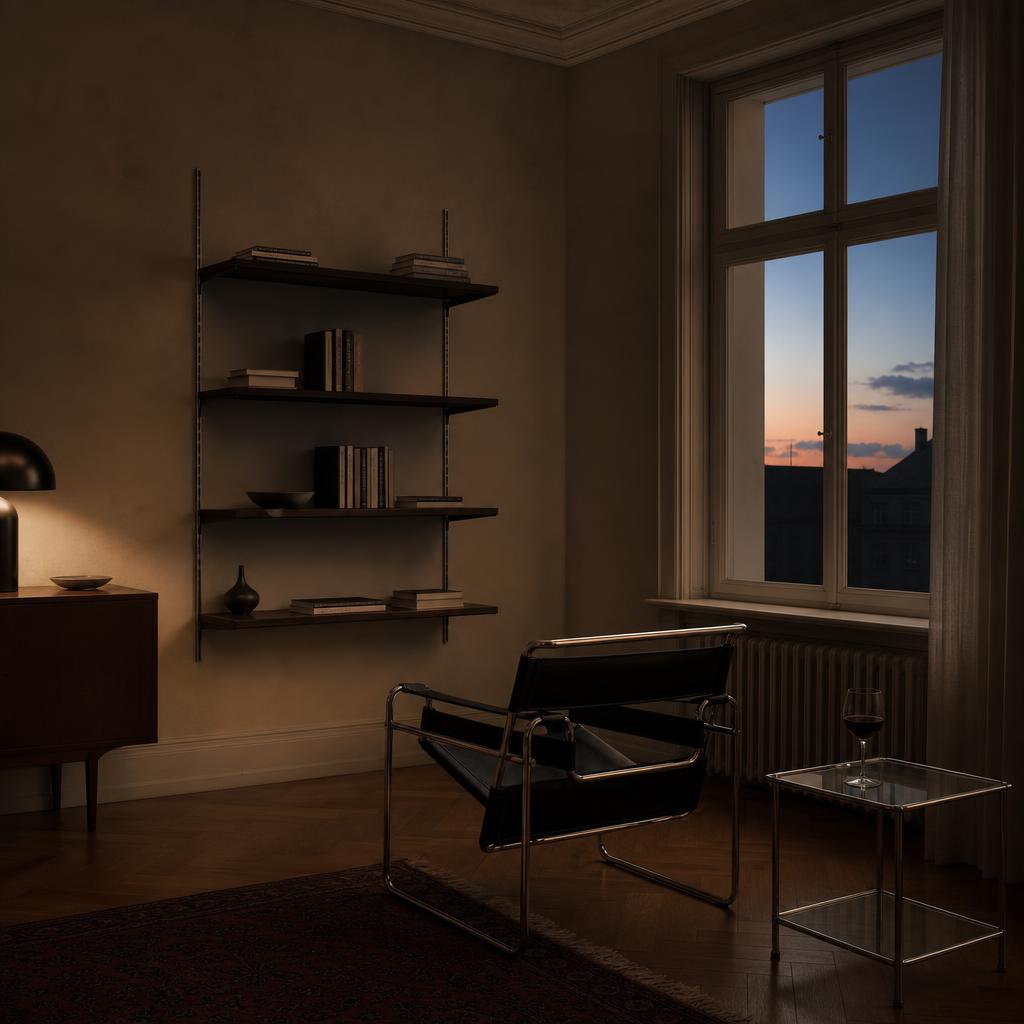
No photograph of a single person hung anywhere in the apartment she kept in the last months of 1989 — not on the wall, not on the refrigerator, not propped on the single shelf reserved for such things in most New York apartments of the period. One chair in the living room faced the window rather than any other seat. The refrigerator held a bottle of Riesling, a stick of butter, a jar of mustard, a lemon, a bunch of parsley, and nothing else, arranged with the sparseness of a hotel minibar rather than a kitchen anyone cooked in. The apartment sat in Yorkville, the blocks of the Upper East Side between Second and Third Avenues in the high Seventies and low Eighties that had been the city’s German quarter since the nineteenth century and still carried the trade: Schaller & Weber, the butcher and delicatessen at 1654 Second Avenue, had sold wurst and pâté from the same address since 1937.2
The building was the kind Yorkville still supplied in quantity and the rest of the Upper East Side, by 1989, mostly did not: a five- or six-story prewar walk-up, built in the first two decades of the century, no doorman, hardwood floors, crown moldings, tall windows that took the afternoon light on a high floor. Citywide, the average one-bedroom rented for about $857 a month in 1989; the Upper East Side commanded a premium over that average, though the precise margin for a Yorkville walk-up specifically was not a number any single source fixed with confidence.3 A magazine features director at the era’s more lavish titles drew a salary in the neighborhood of $50,000 to $65,000 a year — the era’s money went disproportionately to contributors and cover subjects, not staff — which by the conventional rule of spending no more than thirty percent of income on rent put a one-bedroom in the range of $1,250 to $1,600 a month comfortably within reach. Rent stabilization, which capped the annual increase a landlord could impose on a pre-1974 building’s tenant and required renewal on comparable terms rather than eviction to market rate, made the arithmetic still more favorable to a long-tenured renter; the walk-up’s absence of an elevator and a doorman was, for a tenant paying under a stabilized lease, less a deprivation than the reason the number worked at all.
The Shelf and the Silence
What furnished the rooms argued, in every particular, against sentiment. A Marcel Breuer Wassily chair — tubular chrome and black leather, the Bauhaus design of 1925–26 — stood alone in the living room, not paired with a second seat, angled to face the window rather than a guest.4 Beside it sat an Eileen Gray adjustable table in chrome and glass, designed in 1927 for the house Gray built for herself on the French Riviera, its swiveling arm meant to hold a breakfast tray rather than serve as a place to set down a drink and talk.5 On the wall, a Vitsœ 606 shelving system — Dieter Rams’s aluminum-track design for the Frankfurt firm, in continuous production since 1960 — carried books arranged with visible gaps between them, negative space treated as a design choice rather than an absence to be filled.6 A Richard Sapper Tizio lamp, its counterbalanced arm engineered for the Italian manufacturer Artemide in the early 1970s, lit a desk that held no family photograph either.7 In the bedroom, an Alvar Aalto birch stool from 1933, in continuous production at the Finnish firm Artek since its debut, did the modest work of a nightstand.8 Most of it came from one shop: Conran’s, the British-founded home-furnishings store that had occupied ground-floor retail space in the Citicorp Center, at Lexington Avenue and East Fifty-fourth Street, since the tower opened in 1977.9 What Conran’s did not stock, the MoMA Design Store and the Scandinavian-modern retailer Workbench filled in — a paper Noguchi Akari pendant, its light diffused rather than thrown, hung in the corner in place of an overhead fixture.
What money did not stretch to buy, taste supplied at a smaller scale. An offset lithograph from a Gerhard Richter museum-exhibition catalogue and a small Joseph Beuys multiple, bought before she emigrated, hung in thin black frames with wide margins of bare wall around each — three or four pieces total, never more. On the kitchen shelf, beside the Krups grinder, sat a tin of Bahlsen Leibniz-Keks, a box of Melitta filters, and marzipan from Lübeck’s Niederegger house; a single Wüsthof knife hung from a magnetic strip over the counter. Among the German porcelain, a single piece carried the mark of the Königliche Porzellan-Manufaktur, the Berlin works that had supplied the Prussian court since the eighteenth century. On a shelf near the turntable, half out of its sleeve, sat a Bowie record from his Berlin years — a West German pressing, the jacket soft at the corners from handling.
The shelf itself was legible as biography to anyone who could read it. Paperbacks from Suhrkamp Verlag, the German publishing house whose art director Willy Fleckhaus had given its books a coded system of cover design in the 1960s so distinctive that the spines announced the imprint from across a room, carried the German-language originals — Ingeborg Bachmann, Paul Celan, Thomas Bernhard — and sat beside English editions of Walter Benjamin and Hannah Arendt and novels in translation, Günter Grass’s The Tin Drum and Heinrich Böll’s among them.10 An American shelf ran alongside the German one — Joan Didion, Don DeLillo’s Libra, Susan Sontag’s On Photography, Roland Barthes’s Camera Lucida — criticism and reportage, kept to the same register as the books beside them, no novel with a plot to get lost in. A copy of August Sander’s Citizens of the Twentieth Century, the photographer’s decades-long inventory of German faces by trade and class, published in English by MIT Press in 1986, occupied the space a family portrait might have occupied in a different apartment.11 The books did the remembering the walls did not do. What the apartment withheld — the photograph of a parent, a childhood, a face — was not absent by oversight. Every other surface argued for order: two plates, two bowls, two wine glasses, kept in a kitchen that otherwise served one; a single coffee cup in the dish rack, never two; a coat on a wooden hanger in the closet rather than thrown across a chair. The single exception — a book left face-down on the arm of the chair — was the one sign in the whole apartment that a life was actually being lived there.
Two of Everything
A different kind of encoding governed a second apartment, several blocks and one income bracket removed. It belonged, on paper, to no one who could be named on a lease: an old-money publisher in his fifties kept it as what the household he actually lived in called, without further comment, a place he “worked late” from — a pied-à-terre near Gramercy Park, the square whose surrounding lots had been held in a private trust and governed by a key since Samuel Ruggles deeded the land in 1831.12 The apartment itself argued nothing about its purpose. A pre-war co-op with high ceilings and a working fireplace, floor-to-ceiling bookshelves built into two rooms, a worn Persian rug underfoot that had been inherited or bought at auction rather than ordered new — every surface read, correctly, as the accumulation of years rather than a single decorator’s afternoon. Two reading chairs of different vintages sat near the fireplace, a George III wingback beside a Charles Eames lounge chair from 1956, an arrangement that announced two people of related but distinct taste occupying the same room on different evenings.
It was in the details a visitor was not meant to add up that the apartment told what its lease never would. Two pairs of reading glasses sat on the nightstand, one tortoiseshell and one wire-rimmed. Two razors stood in the medicine cabinet, an electric Braun and a safety razor with a badger brush. Two coats hung on the hall hooks, a Burberry and a plain overcoat; two sets of keys sat on the console table by the door. In the closet, two men’s wardrobes hung together — one the conservative Brooks Brothers and J. Press of a Madison Avenue office, the other cut with a slightly more European hand. None of it, examined singly, was a confession. Two coffee cups in a sink belonged, in isolation, to any dinner guest who had stayed the night. It was the accumulation across every room — the doubled razor, the doubled coat, the doubled key — that turned ordinary domestic redundancy into a legible architecture, and the legibility depended entirely on a viewer already positioned to read it. The clearest evidence in the apartment was the one photograph it did not contain: a group vacation picture on the mantel, taken somewhere in Italy, showed both men among a crowd of others, and nowhere in the rooms did a single frame hold the two of them alone. The absence occupied exactly the position the missing family photograph occupied three miles north, in a walk-up that kept no pictures at all.
What the Walls Argued
The books and the pictures carried the argument the furniture made discreetly. On the coffee table sat Paul Monette’s Borrowed Time, published in 1988 as a memoir of nursing a partner through AIDS, Larry Kramer’s Reports from the Holocaust, and Susan Sontag’s AIDS and Its Metaphors, published the same year as the apartment’s own moment, 1989.13 On the shelves stood the collected poems of Constantine Cavafy, E. M. Forster’s Maurice, Thomas Mann’s Death in Venice, Christopher Isherwood’s A Single Man, James Baldwin’s Giovanni’s Room, the complete Proust in French and English — a shelf of the twentieth century’s most legible discreet-literary canon, arranged beside stacks of the New York Review of Books as though the two belonged to the same reader, which they did. On the wall hung a lithograph from David Hockney’s 1966 series illustrating fourteen poems by Cavafy — etchings of two men in bed, in a bath, in embrace, published the following year by Editions Alecto in London — beside a Robert Mapplethorpe photograph, not one of the explicit studies but a single calla lily, exquisitely lit.14 Mapplethorpe had died on March 9, 1989, eight months before the apartment’s cross-section, his final exhibition already the center of a fight in Washington over what a museum could show; owning one of his flowers, in a year when owning anything of his was a declaration, needed no further comment.15
The clothes told a second version of the same story. At the office, Brooks Brothers or J. Press — a natural-shoulder suit in charcoal or navy, an oxford-cloth button-down, a repp-striped tie. On a Saturday morning inside the pied-à-terre, an old Yale sweatshirt, chinos gone soft at the knee, boat moccasins worn without socks — clothes no one from his office had ever seen.
On the liquor cabinet stood a bottle of the Macallan aged eighteen years, the era’s most legible prestige single malt, beside Tanqueray gin, a bottle of Laphroaig for the smoke-forward drinker, and a bottle of Angostura bitters worn soft at the label from handling. And on the mantel, beside the group photograph from Italy, sat a small engraved card — an invitation to a benefit for the American Foundation for AIDS Research, founded in 1985, or for Gay Men’s Health Crisis, in operation in the city since January 1982.16 The epidemic had by 1989 killed thousands of New Yorkers, and its reach did not stop at the co-op board’s door; a well-connected patient at this address could expect a private internist, a hospital room without a wait, and access to azidothymidine at roughly eight thousand dollars a year before a price cut that September brought the figure down by a fifth — a set of advantages that changed the experience of the disease without changing its outcome.17 The benefit card on the mantel was a piece of the crisis reaching into a world that could otherwise, by every other object in the room, have kept it at a distance.
Access to an apartment like it was never simply a matter of rent. The Good Buildings’ co-op boards — 740 Park, 820 Fifth, and 834 Fifth chief among them — administered their unreviewable discretion over every applicant, famous or not, and a discreet publisher wanted no part of standing before one.18 A pied-à-terre near Gramercy Park, several blocks removed from those boards, offered a degree of privacy they existed to deny. A working-class apartment of the same years ran the material logic in reverse — nothing withheld from view, nothing thrown away, the walls carrying everything the tenants owned rather than concealing it — proof that the withholding practiced on the Upper East Side was a resource of money and education, not a universal habit of the private apartment.
Two apartments eight months and a few blocks apart argued the same case in different vocabularies: a room furnished by someone with the money and the education to know exactly what its objects meant told a visitor everything except the one thing that mattered, and did it by omission rather than by lying. The Yorkville walk-up withheld a family; the Gramercy pied-à-terre withheld a marriage that was, in every material sense but the legal one, already occurring in its rooms. Neither apartment’s owner set out to make a statement. Both simply arranged their lives around the one photograph that said too much, and left it out. A city that read class by the object on the wrist and the bag on the shoulder read intimacy the same way — by the frame that was missing, hung where a frame belonged, in a room built to survive a visitor’s glance without answering a single question it did not choose to ask.
An apartment like the Yorkville walk-up would have furnished a paragraph inside a larger portrait more often than not — the interior read as evidence of character in the second paragraph of a City piece or a Feature Well profile, described as a matter of course. A piece setting the walk-up’s severity against a Park Avenue co-op’s studied disorder, the price of disappearing weighed against the price of accumulating, would have found a ready home in the Back or the City section, and a senior editor would have signed off on it without much argument.
A harder assignment would have stalled at the memo stage: a piece reading a discreet old-money interior plainly, two lives arranged in rooms the building, the doorman, and the co-op board would have learned to narrate as one. Proving it would not have been the obstacle; a features editor, having stood in enough of these apartments across a career, would have known the grammar cold, the doubled razor and the absent photograph as legible to her as a byline. The address book would have been the real obstacle. The boards such a piece would have had to name would have sat, in practice, on the same floors as the trustees and the advertisers Meridian’s own publisher answered to, and a story reading one Park Avenue interior this closely would have read, to everyone on the ninth floor who mattered, as a story aimed at all of them. Editors would have debated it, judged it accurate, and set it aside, because the readership the magazine most needed comfortable would have been exactly the readership the piece would have named without naming.
She would have walked home past Schaller & Weber some evening, never knowing that the apartment she had just left would have held the very story she had spent an afternoon almost writing. She would have walked home never knowing she had already decided, before she reached the street, that she would never file it. She would have walked home never knowing that her own rooms, read by anyone fluent enough, would have made exactly the argument she had just declined to make about someone else’s — a family withheld in one apartment, a marriage withheld in the other, the same grammar spoken twice, in two different rooms, in the same city.
Footnotes
-
“Confessions of Upper West Side Holiday Tippers,” West Side Rag, December 10, 2024, on the doorman-building holiday-tip custom and its going rate of roughly $100–$500 per staff member by the late 1990s. ↩
-
“Schaller & Weber, 1654 Second Avenue,” Friends of the Upper East Side Historic Districts (German delicatessen and butcher shop trading at the address since 1937). ↩
-
“Proof: New York Really Was Way Cheaper in the 1980s,” BrickUnderground, on citywide average one-bedroom rent of approximately $857/month in 1989; the Upper East Side premium over the citywide figure is not independently sourced to a period-specific dataset and is stated here without a fixed percentage. ↩
-
Marcel Breuer, Club Chair (Model B3, the “Wassily” chair), designed at the Bauhaus, 1925–26; example in the collection of the Museum of Modern Art, New York. ↩
-
Eileen Gray, Adjustable Table, designed 1927, The Museum of Modern Art, New York, object no. 4339. ↩
-
Dieter Rams, 606 Universal Shelving System, 1960, manufactured by Vitsœ, Frankfurt; The Museum of Modern Art, New York, object no. 91953. ↩
-
Richard Sapper, Tizio Table Lamp, 1971, manufactured by Artemide, Milan; The Museum of Modern Art, New York, object no. 2599. ↩
-
“Stool 60,” Artek (Alvar Aalto, designed 1933; in continuous production by the Finnish firm Artek since its debut). ↩
-
“Citigroup Center,” Wikipedia (Conran’s occupied ground-floor retail space in the Citicorp Center, Lexington Avenue and East 54th Street, from the tower’s completion in 1977). ↩
-
“Design, Revolt, Rainbow: The Pioneering Work of Graphic Designer Willy Fleckhaus,” It’s Nice That, July 18, 2017, on Fleckhaus’s color-coded cover system for Suhrkamp Verlag’s paperback lists. ↩
-
August Sander, Citizens of the Twentieth Century: Portrait Photographs, 1892–1952, ed. Gunther Sander (MIT Press, 1986). ↩
-
“Gramercy Park Was Established in 1831,” Untapped New York, on Samuel Ruggles’s 1831 deed of the surrounding lots to a board of trustees and the private, key-holding governance that followed. ↩
-
Paul Monette, Borrowed Time: An AIDS Memoir (Harcourt Brace Jovanovich, 1988); Susan Sontag, AIDS and Its Metaphors (Farrar, Straus and Giroux, 1989). ↩
-
David Hockney, Illustrations for Fourteen Poems from C. P. Cavafy, 1966, published by Editions Alecto, London, 1967; Tate, London. ↩
-
“Robert Mapplethorpe,” Wikipedia (died March 9, 1989; his retrospective “The Perfect Moment” became the center of a 1989–90 congressional dispute over National Endowment for the Arts funding). ↩
-
“amfAR, The Foundation for AIDS Research,” Wikipedia (the American Foundation for AIDS Research was founded in September 1985; Gay Men’s Health Crisis, founded January 1982, operated continuously in New York City through the period). ↩
-
“Price of AZT to Be Cut 20 Percent,” The Washington Post, September 19, 1989, on the drug’s roughly $8,000-a-year cost before the cut. ↩
-
Michael Gross, 740 Park: The Story of the World’s Richest Apartment Building (Broadway Books, 2005), on Good Building co-op boards’ all-cash and personal-interview requirements; Barbra Streisand’s rejection at 1107 Fifth Avenue and Madonna’s 1985 rejection at the San Remo per contemporaneous real-estate reporting collected in “From the ‘Seinfeld Law’ to Doggie Interviews, The Craziest Co-Op Board Stories Around,” 6sqft. ↩