The Magazine World's Physical Geography, 1989–2001
Subscribe
https://meridian-archive.com/feed.xmlOpen in your app, or paste the link above into any other:
The Front Room
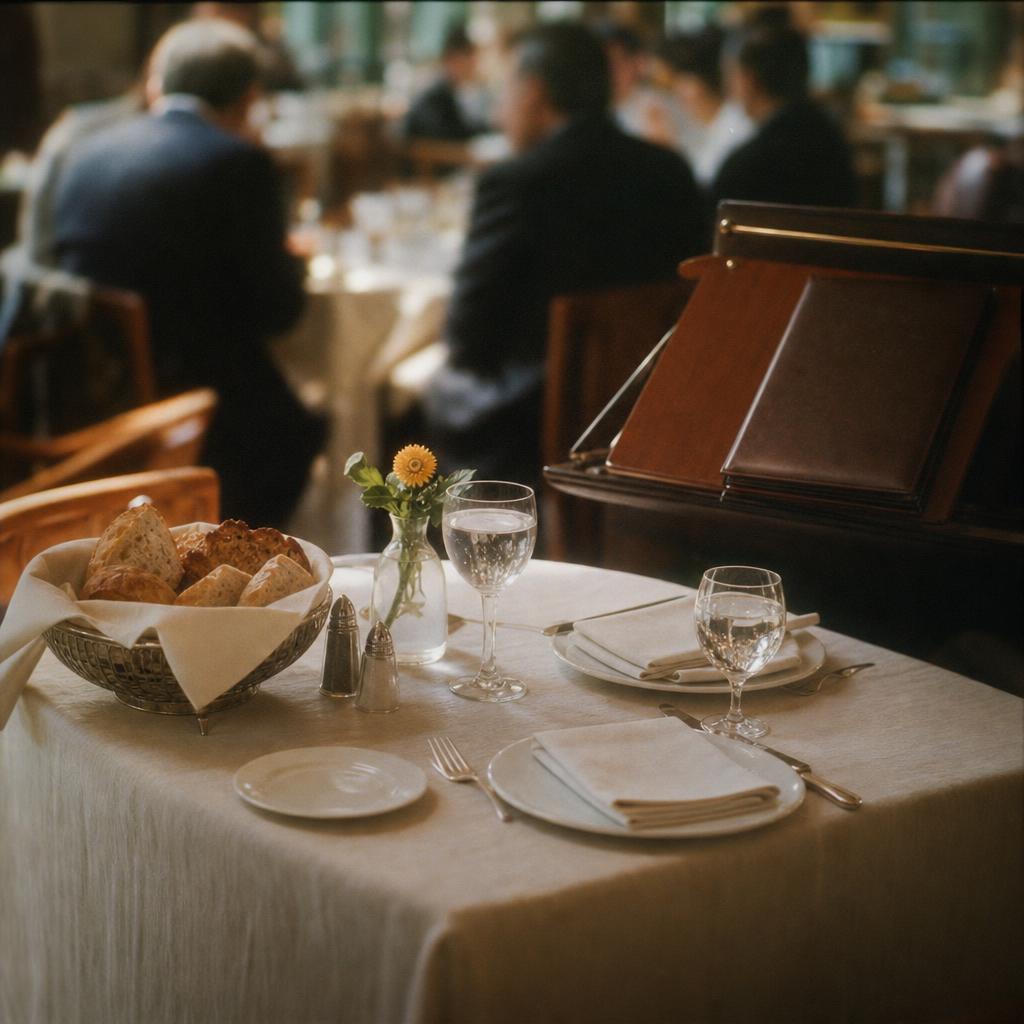
By the early 1990s, Michael’s front room — Tables 1 through 6, the row nearest the door at 24 West Fifty-Fifth Street — functioned as an unpublished seating chart of the magazine industry, and anyone who worked in the industry could read it without being told.1 The editors, publishers, and owners of the major titles held regular places there, and a given figure’s presence at a given table on a given day was itself a piece of information, confirmed by no memo and denied by no one.1 The same arrangement ran two blocks south at the Four Seasons, where the phrase “power lunch” had hardened from a 1970s magazine coinage into an operating fact: table position in the grill room indexed a diner’s standing in the city’s media hierarchy as legibly as a masthead did, and the wrong table was not a mistake anyone made twice.2 Neither restaurant issued a chart. Both enforced one, at lunch, six days a week, through a maître d’s reservation book that no outside authority ever saw and no insider needed explained.
The concentration was not an accident of the 1980s boom. It was an inheritance from earlier infrastructure — from the printing district that had gathered in the West Thirties and along the Hudson Street corridor beginning in the early twentieth century, from the advertising agencies that had colonized Madison Avenue in the postwar decades, and from the passenger rail terminals at Grand Central and Penn Station that made Midtown the city’s most accessible address for a national workforce and a national readership. By 1989, the printing had migrated — to Connecticut, to the Midwest, to printers in Canada and later overseas — but the leases had stayed. The editors had stayed. The addresses on the mastheads carried the authority of decades, and in publishing, the address on the masthead was not incidental.

Condé Nast occupied 350 Madison Avenue, at Forty-Fifth Street, from before the period through January 2000. The building was an undistinguished postwar tower of limestone and glass — no more architecturally notable than any of the midblock offices between Grand Central and Fifty-Seventh Street — but inside it ran the country’s dominant consumer magazine publisher.2 The titles under that one roof, by the early 1990s, included Vogue, Vanity Fair, GQ, Glamour, Self, Mademoiselle, Architectural Digest, Bon Appétit, Brides, House & Garden, Gourmet, Details (acquired in 1988), and Allure, which launched in 1991. A reader scanning the era’s newsstands could buy eight or ten magazines whose mastheads all listed the same zip code without registering that the address was not coincidence. The Newhouse family, which owned the company through the holding company Advance Publications, had built the portfolio by acquisition and retention rather than consolidation and efficiency; each title maintained a degree of operational separation from the others.3 The building held them all the same.
Two blocks south and one block west, The New Yorker occupied 25 West Forty-Third Street through most of the same decade. S.I. Newhouse had purchased the magazine in 1985, but the acquisition did not produce an immediate physical merger: the magazine kept its own building, its own elevator banks, its own floor plan worn in by more than six decades of use. A small lobby, a single elevator bank, the corridors of what had been — and in operating culture still was — an editorially independent institution. The New Yorker joined the Condé Nast operation at 4 Times Square only in late 1999 and early 2000, making the physical merger fifteen years younger than the corporate one.2
The rest of the cluster was organized around two axes. On the east side, along Madison Avenue and the side streets around Grand Central, the address-prestige of the postwar publishing industry had accumulated. Newsweek operated from 444 Madison Avenue, between Forty-Ninth and Fiftieth, owned by the Washington Post Company; the magazine’s editorial and production apparatus ran from that Midtown address, while its Washington bureau supplied the political reporting that gave the magazine its capital-city sourcing. On the west side, along Sixth Avenue and Eighth, the scale shifted. Time Inc. occupied the Time-Life Building at 1271 Sixth Avenue, at Fiftieth Street — a tower that was itself a piece of mid-century corporate ambition, the building and the company named together. From those floors, Time, People, Sports Illustrated, Fortune, and Money were produced, joined in 1990 by Entertainment Weekly and in 1994 by In Style, each launch adding staff to floors that were already among the most densely populated in American magazine publishing. Hearst, at 959 Eighth Avenue, between Fifty-Sixth and Fifty-Seventh, occupied the building that the impresario Joseph Urban had designed for the company in 1928 — a six-story neo-Renaissance base that would not receive its tower until well after the period. The titles running out of 959 Eighth by the early 1990s included Cosmopolitan, Esquire (acquired in 1986), Harper’s Bazaar, Town & Country, Good Housekeeping, and Redbook, with Marie Claire launching a United States edition in 1994 and O, The Oprah Magazine following in 2000. Bertelsmann, the German media conglomerate, anchored its American book operations at 1540 Broadway beginning in 1992, adding another address to the cluster’s western edge.
Magazine Row and the lunch corridor, 1989–2001
- Condé Nast — 350 Madison Avenue, to January 2000
- The New Yorker — 25 West 43rd Street, to 1999
- Time Inc. — Time-Life Building, 1271 Sixth Avenue
- Hearst — 959 Eighth Avenue
- The Four Seasons — Seagram Building, Park Avenue at 52nd Street
- Michael's — 24 West 55th Street, from 1989
- The Royalton — 44 West 44th Street, from 1988
- 4 Times Square — Condé Nast from June 1999
The buildings’ proximity was operationally significant in ways that the phone and the fax did not eliminate. The fact-checking culture of the period was built on paper: on clip morgues maintained by each publication’s library staff, filing cabinets of newspaper and magazine cuttings organized by subject and person, assembled over years and consulted in person. The Lexis-Nexis terminal, which began appearing in magazine research departments in the late 1980s, sat on a single dedicated desk per floor in the early years — a bottleneck the size of a monitor, shared by a department. The Rolodex occupied its assigned position at every fact-checker’s right hand, the cards typed or handwritten, the entries accumulated and revised. A fact-checker at Vanity Fair who needed to confirm a date with a colleague at Time could walk from 350 Madison to 1271 Sixth in fifteen minutes; the phone call was faster, but the reference shelf was not on the phone. The buildings held the paper that the magazines could not have published without.
What the cluster had selected — and what kept it in place — was the weight of its own adjacency. A photographer’s studio on West Twenty-Sixth Street could get a chrome to an art department on Forty-Fifth in under half an hour by messenger. An editor knew which floor of which building the photo department was on, which corridor led to the art director’s office, which lobby required a visitor’s badge and which did not. The knowledge was ambient. The geography was the professional mind of the industry organized in space.
The Lunch Corridor
The social information system of the American magazine industry in this period did not run on the telephone or the memo. It ran on lunch. The venues were geographically specific, functionally differentiated, and as carefully mapped — by the people who used them — as the buildings from which those people emerged each weekday at noon.
The Four Seasons occupied the ground floor of the Seagram Building at Park Avenue and Fifty-Second Street, in Philip Johnson’s 1959 dining room. The restaurant’s claim to the phrase “power lunch” predated the period by a decade — Esquire had identified it in the 1970s — but by 1989 the claim had hardened into institution, and Si Newhouse, who owned Condé Nast through Advance Publications, held court at a regular table.2
Michael’s, at 24 West Fifty-Fifth Street between Fifth and Sixth, was a different institution and a different intelligence. Michael McCarty had opened his New York outpost of his Santa Monica original in 1989, and within three or four years the front room had become the magazine industry’s working lunchroom.1 The room had a calendar predictability that the rest of the industry’s social life did not. The cobb salad. The roasted chicken. The kitchen knew the standing orders before they were placed.
The Royalton, at 44 West Forty-Fourth Street, operated on a third register. Ian Schrager had opened the hotel in 1988 with a Philippe Starck interior — high-backed velvet banquettes, a long narrow dining room, a design language that was simultaneously theatrical and cold. The bar and restaurant became, by general and largely unspoken agreement, the magazine industry’s commissary through the 1990s.4 The hotel’s location was structural: one block north of The New Yorker at 25 West Forty-Third, and within a ten-minute walk of every address in the cluster. An editor at the Royalton at one o’clock on a Tuesday was plausibly there to meet any of two dozen people who might be relevant to any of a dozen ongoing projects. Graydon Carter has described the lunch traffic of the decade in terms that suggest the Royalton was less a venue than a standing arrangement.5
The Algonquin, two doors west at 59 West Forty-Fourth Street, carried the longer literary inheritance. The Round Table mythology of the 1920s had not been entirely consumed by nostalgia; the hotel retained a clientele of book reviewers, New Yorker editors with long tenures, writers who regarded the Royalton’s Starck interior as a category error. The distinction between the two venues on the same block was legible to anyone who needed to know it and opaque to anyone who didn’t.
Le Bernardin, at 155 West Fifty-First Street in the Equitable Building, had opened its New York location in 1986 and by the early 1990s was the fine-dining register of the corridor — the restaurant for the lunch that required more than Michael’s could schedule, the lunch where a contract or a commitment was the subject. The 21 Club at 21 West Fifty-Second Street carried the establishment register, a midcentury New York institution that remained relevant to editors whose institutional memory reached back to the 1960s and whose expense accounts reached to the tab the 21 Club presented.
The outer geography was organized around distance from the cluster and what that distance meant. Da Silvano on Sixth Avenue at Houston — Silvano Marchetto’s Italian restaurant in the Village — was far enough south to require a Town Car but close enough to Condé Nast that Anna Wintour and the fashion editors used it with some regularity. It was the fashion crowd’s downtown lunch; the distance was the point. Da Umberto and Bottino in Chelsea served the gallery crowd on a slightly different axis. Pastis, which Keith McNally opened on Little West Twelfth Street in February 2000, arrived at the Meatpacking District already gentrified enough to receive it and added a post-2000 coda to the lunch geography that coincided, not accidentally, with the magazine industry’s own move west and south.
The lunch was the medium by which an industry with no formal floor — no exchange, no trading pit, no published price for the transactions it was conducting — kept itself coordinated. An editor at Michael’s on a Tuesday could see, in one room, the writers who were about to be poached, the publicists working the same relationships, the editors at competing titles whose presence or absence in the front room was itself a form of information. The bill for two ran to several hundred dollars. It was picked up by the editor, the publisher, or the publisher’s expense account, and its cost was unexamined.
The Independents
The magazines that did not occupy the cluster were not absent from the industry; they were operating on different terms, in different buildings, and in neighborhoods whose distance from the midblock Forties and Fifties was an editorial premise as much as an economic one.
New York Magazine had been sold by Rupert Murdoch to K-III Communications — the publishing arm of Kohlberg Kravis Roberts — in 1991, and later passed to Primedia. The magazine continued to produce from Midtown offices, its editorial identity fixed as the city’s general-interest title while its corporate structure changed underneath it. The transaction did not move the building or the masthead address.
The Village Voice occupied Cooper Square, in a building separate from any address in the cluster by geography and by self-description. The Voice had been founded in 1955 in Greenwich Village; by the 1980s it had moved to Cooper Square, on the east edge of the East Village, and the address was load-bearing. A Voice writer did not eat lunch at Michael’s. A Voice writer ate lunch at the Cooper Square diner or at Veselka, the Ukrainian restaurant on Second Avenue and Ninth. The distance from the front room at Michael’s was not a slight and not an ambition. It was the working condition.
Spy Magazine had been founded in 1986, edited from offices on Union Square West. The satirical monthly occupied a distinct position in the period’s magazine culture — it was the publication that covered the culture of the publications, that named the people in the front room of Michael’s and described what they were doing there, that maintained, for eight years, a running account of the media industry’s pretensions from an address sufficiently removed from the cluster to write about it without obligation to it.5 Spy folded in 1994, after a sale and a series of relaunches that could not sustain the original editorial proposition. The Carter who took Vanity Fair in July 1992 had been, two years earlier, still running Spy from Union Square — a transition that was, among other things, a change of address.
Paper Magazine operated from 365 Broadway in SoHo. Kim Hastreiter and David Hershkovits’s downtown title was organized around downtown New York’s fashion, art, and nightlife scenes; its geographic position south of Canal Street was its editorial identity, not a constraint it was waiting to outgrow. Vibe, Quincy Jones’s hip-hop and Black culture monthly launched in 1993 in a partnership with Time Inc., began in Time Inc.’s orbit on Sixth Avenue and within a few years was operating more independently; its geography over the decade was unsettled in ways that the Midtown titles’ geographies were not.
Spin occupied smaller offices in the Flatiron district, south of the cluster; Rolling Stone, despite its counter-establishment identity and its origins in San Francisco, operated from 1290 Sixth Avenue, between Fifty-First and Fifty-Second, a block and a half from the Time-Life Building. Jann Wenner’s monthly was, by address, a member of the cluster its editorial identity had been founded in partial opposition to. A writer leaving the Rolling Stone office at noon could walk to the front room at Michael’s in seven minutes.
Wired’s editorial center of gravity was San Francisco. Its New York presence was a smaller operation, a bureau rather than a headquarters; the absence of a major Wired floor in Midtown was the kind of structural fact the industry understood without discussing. The magazine’s geography reflected its argument: that the story was happening in Northern California, not in the thirty-block rectangle between Grand Central and Fifty-Seventh Street.
The separation was not random and it was not chosen. It was the residue of which institutions had been able to afford Midtown rents in the 1970s, when the alt-press infrastructure took its current shape, and which had formed in the cheaper and more permissive geography of Lower Manhattan and the outer boroughs. The Voice could not have produced the Voice from a Madison Avenue floor. Paper could not have been Paper from anywhere north of Canal Street. The buildings had made a selection, and they continued to make it, year after year, through the cost of the lease.
The Move
The 42nd Street Development Project had been a state-and-city collaboration since 1976, organized around the ambition of clearing the pornographic theaters, the three-card-monte economy, and the general disorder of West Forty-Second Street between Seventh and Eighth Avenues and replacing them with corporate tenants and tourism infrastructure. For much of the 1980s, the project moved without decisive private commitment. The towers at One Times Square and 1540 Broadway — Bertelsmann’s address from 1992 — stood largely vacant through the early years of the decade, office shells in a neighborhood still organized around peep shows and penny arcades and the scatter of legitimate Broadway houses operating at reduced capacity.2
The decisive private commitment came in May 1995, when Disney Theatrical signed a forty-nine-year revenue-share lease on the New Amsterdam Theatre at 214 West Forty-Second Street. The renovation, by the firm Hardy Holzman Pfeiffer, began immediately; the New Amsterdam reopened on April 2, 1997, with The Lion King opening in November of that year. Disney’s presence was the signal the development project had spent nearly two decades waiting to send: that the redevelopment of Times Square was now real, that a brand whose audience was families had decided the block was safe enough to put its name on.
Condé Nast’s decision followed the same signal. The company signed a lease for 4 Times Square — the Durst Organization tower then under construction at the corner of Forty-Second Street and Broadway — in 1996. The building rose to 48 stories and more than a million square feet of office space.6 It was, when leased, the largest commercial lease in Times Square in a generation, and its announcement in the trade press was read, correctly, as confirmation that the neighborhood had crossed from redevelopment aspiration to corporate reality.2
The first move-in came on June 21, 1999. The titles in the initial wave were the smaller-revenue books: Brides, House & Garden, Women’s Sports and Fitness — roughly two hundred employees who arrived by car and elevator while limousines clogged Forty-Second Street between Broadway and Sixth that week, the corporate transportation desk routing cars in shifts.2 The remaining titles followed through the fall. The corporate move from 350 Madison Avenue to 4 Times Square completed in January 2000, bringing Vogue, Vanity Fair, GQ, Glamour, Allure, Architectural Digest, Bon Appétit, Gourmet, Self, Mademoiselle, Brides, and House & Garden under one roof — and, for the first time in the fifteen years since the Newhouse acquisition, The New Yorker as well, occupying floors of the same building it had avoided joining for most of a decade.2
Frank Gehry’s cafeteria opened in the spring of 2000 on a high floor of the building. The room was curved titanium and glass, a Gehry signature executed at corporate expense, and it was not a public restaurant. It was a canteen, offered by the company as a benefit to its staff, intended to keep the lunch hour inside the building and away from the restaurants whose prices the company had previously been paying.2 Whether it succeeded in this is not clear; the rooms at Michael’s and the Royalton continued to fill. What the cafeteria accomplished with certainty was different: it became, within a year of opening, the most photographed corporate dining room in American magazine publishing.
The move’s logic was not primarily about rent. Condé Nast did not move from Madison Avenue to Times Square because the new address was cheaper. The company moved because the city and the Durst Organization had organized Times Square around exactly the kind of anchor tenant Condé Nast could be, and had offered terms that reflected this. The magazines were recruited as the visible occupants of the rebuilt neighborhood; the neighborhood’s reconstruction had depended, in part, on the ability to recruit them. The deal was circular, and both parties understood it as such.
What the move left behind was more legible in retrospect than it had been in progress. The floors at 350 Madison cleared. The Royalton lunch continued, but the population thinned. By 2001, the center of gravity of the lunch corridor had shifted west and south, following the magazines to their new address — or had dissolved into the Gehry room, which was not on any street at all. Magazine Row, as a piece of Midtown geography with a name and a center and a thirty-block coherence, had ended.
The magazine cluster that occupied thirty blocks of Midtown Manhattan through the 1990s had not been assembled for reasons that still obtained by 1989. The printing that had drawn publishers to the neighborhood in the early twentieth century had long since relocated to cheaper facilities in the interior of the country. The freight infrastructure that had made Midtown accessible was a memory. What remained was the weight of the addresses themselves — leases that cost too much to abandon, lunches that required a clientele too valuable to disperse, buildings that had become, over decades, the industry’s idea of where the industry lived.
The cluster held itself in place by the social weight of its own routines. An editor who left for a cheaper address was an editor whose lunch invitations arrived less reliably. An editor who stayed on Madison could walk to the Four Seasons, to Michael’s, to the Royalton, in the time it took to make a phone call. The geography was not incidental to the work. It was the medium in which much of the work’s social substrate was produced and reproduced, year after year, in the same rooms at the same tables with the same standing orders.
The move to 4 Times Square in 1999 and 2000 was not, then, merely a real-estate transaction. It was the first time the industry’s concentration on that particular ground had ended — not by dispersal, but by coordinated relocation to a different piece of ground, organized by a developer and a city and a single anchor tenant’s decision. The new cluster was not Magazine Row. It was something else: a purpose-built corporate address whose identity had been constructed around its tenants rather than inherited from a century of adjacent industries. What the Durst tower had, the old cluster had accumulated. The geography of a city’s industries is read backward from what was nearby — and what was nearby, in the cluster’s long life, was usually older than anyone working inside it could comfortably see.
The Front would have carried three items across the decade — none of them long, none of them cover-page work, all of them the section’s ordinary business. Spy’s folding in October 1994 would have run there as a trade obituary: a magazine that had spent eight years naming the front rooms and grill-room tables at Michael’s closing without an irony Meridian could claim as its own. The Front would have carried Condé Nast’s 1996 lease on 4 Times Square as confirmation, in the August issue, that a redevelopment the industry had watched from a distance for a decade had become a signed commitment to a forty-eight-story tower not yet risen. And the Front would have carried Pastis, filed in the early issues of 2000, as a note on a magazine crowd’s evening address drifting downtown while its daytime one stayed put.
The City would have run the Disney Theatrical lease on the New Amsterdam Theatre in its July 1995 issue, at exactly the scale the section existed for: a forty-nine-year commitment that would have read, at the time, as one signature among many. The Feature Well would have carried the June 1999 morning when the first Condé Nast staff crossed from 350 Madison to 4 Times Square while cars idled three deep on Forty-Second Street — a well piece earning its length the way the well always did, by the number of desks the move actually touched. The Back would have run the Gehry cafeteria’s opening in the spring of 2000 as a short item on a room built to keep an editorial staff from leaving its own building at lunch.
New York Magazine’s 1991 sale to K-III would have died in the room, and the reason would have been the plainest one on the sheet: the confidentiality the deal’s own lawyers had written into the paperwork would have left nothing Meridian’s checking desk could clear past a paragraph, and a story counsel would not have cleared would not have survived to the next month’s calendar.
Footnotes
-
Michael McCarty, Welcome to Michael’s: Great Food, Great People, Great Times (Lyons Press, 2017). ↩ ↩2 ↩3
-
Michael M. Grynbaum, Empire of the Elite: Inside Condé Nast, the Media Dynasty That Reshaped America (Simon & Schuster, 2025). ↩ ↩2 ↩3 ↩4 ↩5 ↩6 ↩7 ↩8 ↩9
-
Carol Felsenthal, Citizen Newhouse: Portrait of a Media Merchant (Seven Stories Press, 1998). ↩
-
Tina Brown, The Vanity Fair Diaries: 1983–1992 (Henry Holt, 2017). ↩
-
Graydon Carter, When the Going Was Good: An Editor’s Adventures During the Last Golden Age of Magazines (Penguin Press, 2025). ↩ ↩2
-
Council on Tall Buildings and Urban Habitat, Skyscraper Center, “4 Times Square,” https://www.skyscrapercenter.com/building/4-times-square/907. ↩