MDMA: Club Culture and Its Discontents, 1989–2001
Subscribe
https://meridian-archive.com/feed.xmlOpen in your app, or paste the link above into any other:
The Program With No Statute
New York City ran, through the second half of the 1990s, a standing raid on its own nightclubs that existed nowhere in the city’s law books. The operation had a name — MARCH, Multi-Agency Response to Community Hotspots — and a fixed method: the police department, the fire department, the buildings department, the health department, and the state liquor authority arrived together at a club near its peak crowd, cut the music, held several hundred patrons in place, and worked the room until an inspector found a code violation sufficient to padlock it that night — an exit sign gone dark, an occupancy count exceeded, an ice machine draining wrong.1 No ordinance created MARCH and no statute defined it; it was an administrative practice, assembled by the mayor’s office out of five agencies’ standing authority to inspect, and it ran for years as routine business, one club at a time, backed by no legal instrument beyond the agencies’ own decision to show up together.
The rooms MARCH worked hardest were built on a drug no summons ever named. The Sound Factory sold no alcohol. It opened around midnight on Saturday at 530 West 27th Street and ran until Junior Vasquez stopped playing, which was often noon on Sunday, and for those twelve hours it moved a thousand people across a wooden floor without a liquor license, without a bar, and without the bottle revenue every other club in the city was built to collect.2 The model was members-first and music-first; because it served no alcohol it answered to no liquor authority, and it could run straight through the morning while licensed rooms went dark at four. What kept the room open was not what the crowd drank. It was what the crowd had swallowed on the way in.
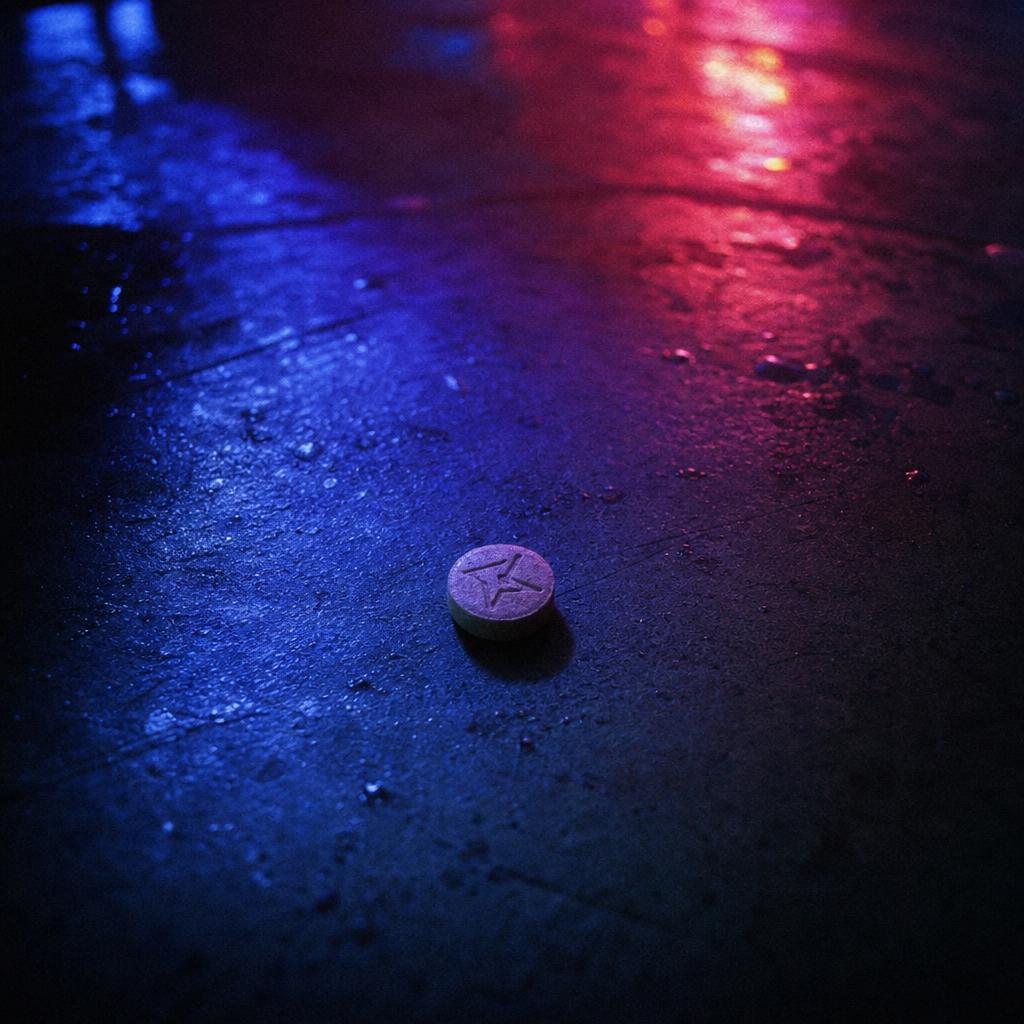
The drug was MDMA — ecstasy, on the street and the flyers — sold in pressed pills stamped with logos and traded on the floor and in the bathrooms rather than over any counter. It came up over thirty to sixty minutes into a warmth that the era’s cocaine did not produce: not the sharpened, talky aggression of a bump taken in a stall, but a lowering of the guard, a tactile openness that turned a dance floor into a room of near-strangers touching fabric, passing water, holding prolonged eye contact without embarrassment. The visual grammar of the New York floor after 1989 — the bottled water, the sweat, the hours of dancing without a drink in hand — was the grammar of a serotonergic high, and the club economy reorganized around it. A room that made its money on the door instead of the bar did not need to turn the crowd over every few hours. It could let a thousand people dance until the light came up.
The Chemist’s Scale
The drug on that floor had a paper trail to one man. Alexander Shulgin, a California chemist, had resynthesized MDMA in 1976 and, nearly alone, championed it; he classed the compound an empathogen — a drug that lowered social defenses rather than distorting the senses — and it was his advocacy, more than any prior history, that carried it from a therapist’s office into circulation.3 By the time it reached the clubs it was already illegal: the Drug Enforcement Administration had placed it on Schedule I on an emergency basis effective July 1, 1985, the first drug the agency ever scheduled that way.4
MDMA’s chemistry ran opposite to cocaine’s. Cocaine flooded dopamine and produced confidence, speed, and by the small hours a creeping paranoia; MDMA flooded serotonin and produced the opposite — confessional, earnest, tending toward the sharing of childhood stories and romantic feelings with an intensity that embarrassed the user by Tuesday. The comedown had a name in the clubs, “Suicide Tuesday,” the flattened midweek mood that followed a heavy weekend as the depleted brain recovered. It was a drug badly suited to a business built on the cutting remark.
The Rooms
The high needed a room, and for a decade Manhattan supplied the best of them. The Limelight occupied the deconsecrated Episcopal Church of the Holy Communion at Sixth Avenue and West 20th Street, a Gothic Revival building Richard Upjohn had completed in the 1840s, its sanctuary the main dance floor and its confessionals turned into booths.6 Peter Gatien, who had bought the church in 1983, ran the Wednesday party Disco 2000, the headquarters of Michael Alig’s Club Kids. On Twelfth Avenue, the Tunnel — a former Hudson River freight terminal with a genuine train tunnel running through it — gave over its Sunday nights to hip-hop under Funkmaster Flex. When the Sound Factory closed, its West 27th Street building reopened as Twilo, where the English pair Sasha and John Digweed took a residency in 1998 and played all-night progressive-house sets that defined the room’s final years.
The Club Kids around Alig built a costume-driven celebrity out of the Wednesday party — profiled on Geraldo, Joan Rivers, and Donahue, an underground the fashion magazines chased for a few years — and for a while the transgression was itself the product the room sold. These were, at their peak, among the most mixed spaces in the city — gay and straight, Black and Latino and white, downtown and uptown pressed onto one floor by a drug that made the mixing feel like the point. The floor behavior was specific to the chemistry: an hour into the come-up, dancers hugged near-strangers, ran their hands over fabric and walls, and talked with a confessional earnestness that embarrassed them three days later. The media floors overlapped with the rooms heavily. Editors, photographers, and assistants spent Saturday nights at the Sound Factory or Twilo and stumbled into Monday meetings, and the overlap was real enough that the clubs were a known quantity in the conference room. But the drug did not travel back to the office the way cocaine did. Cocaine could be taken in a supply closet before a close and returned a person sharper; MDMA belonged to the specific night, and its earnest, un-ironic warmth did not survive contact with the desk. The drug stayed where it was taken.
The Law and Its Origins
The instrument that closed the rooms was older than any of them. A 1926 city ordinance required a cabaret license for dancing in any establishment that served food or drink, and it had been written, in its origins, to control the integrated dance halls of the Harlem Renaissance; the language was racially neutral and the enforcement was not.7 Most of the city’s bars had dancing and no license, and for decades that gap was governed by selective non-enforcement — a policy of looking away that held under Koch and Dinkins. The law sat on the books as a latent power that no administration had yet chosen to use.
That administration arrived on January 1, 1994. Under Rudolph Giuliani the looking-away ended, and the cabaret law became one lever among several. The MARCH raids ran on schedule, one club after another, precisely as the program was built to run. A civil nuisance-abatement statute, first written for brothels, let the city padlock a venue on a civil finding, without a criminal conviction. The pattern of who got raided was consistent, and Frank Owen reported it as it happened: the hip-hop nights at the Tunnel, the house nights at the gay-mixed Sound Factory, and the Latin nights at the salsa rooms drew heavy enforcement, while white rock nights at comparable clubs drew little.2 The selective pattern of the 1990s reproduced the law’s original purpose. The Sound Factory closed on January 12, 1995, a combination of a lease takeover and fire-department pressure in its final weeks. A heavily publicized raid put a squad of officers into the Limelight that fall and produced almost no arrests, a dealer having been warned off in advance.
The Cover and the Chemistry
Two failures then arrived together. The first was a killing. In March 1996, Michael Alig and his roommate Robert Riggs killed Andre Melendez, a dealer who had worked the Limelight, in an argument over a drug debt in Alig’s apartment; Michael Musto broke the story as a veiled blind item in the Village Voice of April 26, a reported fight between a “Mr. Mess” and a “Mr. Dealer.”8 The body was identified that November, and Alig and Riggs were arrested in December.2 The murder was the proximate end of the Club Kid celebrity, and it gave the city moral cover for enforcement it had already begun. Gatien was indicted federally for operating his clubs as drug enterprises and acquitted in February 1998, the defense resting without calling a single witness; the city pursued him afterward through tax and license actions instead.9 The scene’s own impresario of transgression had become the state’s argument against it.
The second failure was in the pill. The ecstasy of the early years carried a reputation, in club-kid lore, for a particular clean warmth; whether or not the chemistry bore that out, the tablets of the decade’s end plainly did not. Through the late 1990s the pill stamped with a logo contained less and less of what it claimed: surveys of seized ecstasy found rising proportions of amphetamine, the cough suppressant dextromethorphan, and para-methoxyamphetamine, a compound more toxic than MDMA and slower to take effect, so that a user who felt nothing redosed and overdosed.10 Other drugs took the place it left — ketamine, snorted as a powder for a dissociative drift, and above all GHB, a clear liquid dosed by the capful and sold through the decade in health-food stores as a bodybuilder’s supplement, with a narrow margin between the dose that worked and the dose that stopped the breathing. Federal law placed GHB on Schedule I in February 2000.11 The rooms that survived the raids were increasingly places where the chemistry itself had turned. In July 2000 James Wiest, a Johns Hopkins undergraduate, collapsed at Twilo and died after staff moved him from the dance floor, one of a series of overdoses that the city folded into its case against the club’s license.12
The Empty Floor
Twilo was closed in the early hours of May 6, 2001, on an expired certificate of occupancy, after months in which the city had stonewalled the renewal of its cabaret license.2 It was the last of the large rooms, and its closing is the era’s clean end date; within four months the industry froze for other reasons. The scene did not vanish so much as relocate, across the river to Williamsburg and Greenpoint warehouses where rent ran a dollar or two a square foot, where manufacturing zoning meant no residential neighbors to complain, and where a party could be run as a private event — address given out the day of, a donation at the door, liquor brought by the guests — outside the reach of a law written for public establishments.
The warehouse floor kept the hours and much of the energy. It kept almost none of the mixing. The Black and Latino dance scenes that had been the specific targets of the Manhattan enforcement did not migrate cleanly, and the rooms that replaced the old ones ran younger and whiter, art-school-adjacent, a few hundred people where the Tunnel had held thousands. The Tunnel’s Sunday crowd had come through a metal detector and a frisk, paid a cover, and drunk from a row of full bars; the Williamsburg loft took a few dollars at a card table and asked its guests to bring the liquor themselves. The gay nightlife the epidemic had already thinned had been remaking itself in these same years, on some of these same floors, and the crackdown closed the rooms about as fast as the survivors reopened them.
The deepest effect of the crackdown was not the count of shuttered clubs. It was the demographic flattening of what came after, and the emptying of the late-night street between the rooms. A downtown block that at three in the morning had smelled of the river and fryer oil, and had offered a person walking to the corner weed and crack and heroin and a way into a party going on behind an unmarked door, was by the end of the period a quiet street of livery cars and shuttered storefronts where no one spoke to a stranger. The accidental cross-class encounter had required a density of people on the sidewalk that the quality-of-life campaign had specifically removed. The drug remained available. The room in which it had meant something did not.
MDMA was, in the end, a machine for lowering the defenses between strangers, and the New York club was a machine for putting strangers in one place; for a decade the two ran together, and the result was among the most genuinely mixed rooms the segregated city produced. What took the rooms apart had little to do with the drug. It had to do with a Jazz Age dancing law revived as an instrument of enforcement, with a killing that handed the city its cover, and above all with the land the clubs sat on, which had become too valuable to leave to people dancing until noon. The pill degraded on its own schedule and the enforcement ran on the developers’, and the two happened to converge. What the city recovered when it emptied the floors was order, and quiet, and a great deal of real estate. What it spent was harder to name: the accidental society of the room at four in the morning, the unplanned mixing a dense and uncontained city had thrown off without trying — one of the small, unrepeatable things the decade had, and did not know it had.
The revival of a 1926 dancing ordinance, and the multi-agency raids that emptied the Sound Factory before its lease could be renewed, would have made a City piece with the argument the floor prized: a law meant for a different decade’s dance halls, turned again on the same kind of room. The City would have carried it in the spring, timed to the closing itself rather than to any single raid, and the piece would have needed nothing more exotic than the record already public — the vacate history, the raid schedule, the pattern of which nights drew the summonses. An editor would have signed off without much argument; the story would have asked nothing of the masthead’s own habits.
The longer piece would have waited for the acquittal. An articles editor would have claimed the Gatien collapse for the Feature Well the week the verdict came down, the profile of an empire that had opened its books to a federal case and closed most of them since — the church turned dance floor, the freight terminal on Twelfth Avenue, the reopened room on West 27th Street, run down to what survived the decade’s enforcement and what a jury had let go. The piece would have wanted the defense’s silence at its center: a case the government had built for months, ended by a lawyer who called no one to the stand.
Footnotes
-
“Multi-Agency Response to Community Hotspots (MARCH) Operations,” NYC Department of Small Business Services, quarterly reports; “Mayor Adams Launches Effort to Enhance Nightlife Safety and Strengthen Small Businesses, Phasing Out ‘March’ Enforcement,” NYC Mayor’s Office, December 28, 2023. ↩
-
Frank Owen, Clubland: The Fabulous Rise and Murderous Fall of Club Culture (Broadway Books, 2003). ↩ ↩2 ↩3 ↩4
-
Udo Benzenhöfer and Torsten Passie, “Rediscovering MDMA (ecstasy): the role of the American chemist Alexander T. Shulgin,” Addiction 105, no. 8 (2010). ↩
-
“Schedules of Controlled Substances: Scheduling of 3,4-Methylenedioxymethamphetamine (MDMA) into Schedule I,” Federal Register 50, no. 105 (May 31, 1985); the emergency order took effect July 1, 1985. ↩
-
Alexander Shulgin and Ann Shulgin, PIHKAL: A Chemical Love Story (Transform Press, 1991). ↩
-
Church of the Holy Communion, Designation Report (New York City Landmarks Preservation Commission, 1966). ↩
-
Paul Chevigny, Gigs: Jazz and the Cabaret Laws in New York City (Routledge, 1991). ↩
-
Michael Musto, “La Dolce Musto,” The Village Voice, April 26, 1996. ↩
-
“Gatien Acquitted of Racketeering,” United Press International, February 11, 1998. ↩
-
Jon C. Cole et al., “Is Ecstasy MDMA? A Review of the Proportion of Ecstasy Tablets Containing MDMA, Their Dosage Levels, and the Changing Perceptions of Purity,” Psychopharmacology 173, no. 3–4 (2004). ↩
-
Hillory J. Farias and Samantha Reid Date-Rape Drug Prohibition Act of 2000, Pub. L. No. 106-172, 114 Stat. 7 (February 18, 2000). ↩
-
“Trying Times for Twilo,” The Village Voice, October 24, 2000. ↩