Other Substances
Subscribe
https://meridian-archive.com/feed.xmlOpen in your app, or paste the link above into any other:
The Bottle the Law Could Never Quite Name
Poppers stayed on sale, over the counter, for three decades running on a single trick: every time a legislature or the DEA moved a specific compound onto a controlled schedule, the distributors reformulated the product under a new chemical name and kept the bottles stocked. Amyl and butyl nitrite, inhaled from a small bottle for a brief, rushing headlong dilation, had been fixtures of gay bars, bathhouses, and dance floors since the early 1970s, and the ban-and-reformulate cycle repeated across two decades without the product’s presence on the counter ever appreciably interrupted. Neither the bars that sold it nor the law that kept re-banning it treated the pattern as remarkable; it was simply how poppers were sold. They were the oldest of the club drugs and the most narrowly owned, fixtures of a world that rarely touched a straight midtown office except as a word an editor picked up on assignment.
Other substances in this world stayed unseen by the opposite route — not by outrunning the law inside the city but by never entering its drug economy in the first place. LSD kept a touring schedule. The strongest hallucinogen in circulation reached most of its users not through a Manhattan dealer but through a parking lot outside a concert, and the concert was usually somewhere else — a Grateful Dead stadium run two states off, a college weekend upstate, a rented field in New England. Psilocybin mushrooms moved on the same circuit. Both drugs belonged less to New York than to a population that passed through it: the audience that followed the Grateful Dead from city to city, traded cassette recordings of the shows, and turned the parking lot into a market, some of them dealing blotter to cover the next leg of the tour. The lot itself was a market of food, bootleg shirts, and drugs sold from open car trunks, and whatever it sold traveled with the caravan into the next city on the schedule.1 In this economy New York was a stop, not a home.
The two drugs carried the 1960s forward with them, into Phish crowds and Central Park drum circles and the occasional Brooklyn loft party, but their center of gravity stayed on the road and on the campus. College towns from Vermont to the Bay Area kept a steady low-grade trade that ran on personal connections and had little to do with the city’s corner dealers. Part of the reason was chemical. A dose of LSD ran the better part of a day, a mushroom trip several hours; both produced perceptual distortion, racing pattern-recognition, emotional openings that users chased and sometimes dreaded, and a long tapering comedown. A drug that took a working day to metabolize did not fit the working day. Cocaine sharpened a closing night and cleared by morning; acid took the closing night, the morning after, and the capacity to file. Where it touched the magazine world at all, it touched the edges — a features editor who dropped acid once a year at a house upstate, an assistant who came back from a downtown party having tried mushrooms once and not again. It was a drug for people with a weekend and a field, not for people with a Tuesday deadline, and the sorting followed from that.
Then the tour lost its center. Jerry Garcia died on August 9, 1995, a month after the Grateful Dead’s last performance at Soldier Field in Chicago, ending the band’s thirty-year run.1 The touring circuit that had organized itself around the band — the parking-lot markets, the tape traders, the drifting economy of blotter and bootleg — reassembled in diminished form around younger acts, Phish chief among them. But the largest single engine of psychedelic distribution in the country had stopped, and the drug it had carried grew thinner on the ground and older in its users, no longer moving on any schedule at all.
The After-Hours Pharmacopoeia
The club floor kept its own chemistry, and it had almost nothing to do with the office. Ketamine arrived in New York nightlife as a powder snorted in small bumps — a surgical and veterinary anesthetic repurposed for the dance floor and sold under the club name Special K. In small doses it produced a floating, dissociated ease; in quantity it produced the fixed immobility that clubgoers called the K-hole. GHB came in small vials or capsules, a euphoric depressant measured by the capful and easy to misjudge. Neither belonged to the magazine world; both belonged to the hours after it closed, at Limelight and Sound Factory and Tunnel and the rooms that opened when the legal clubs shut. An editor assigned to write about nightlife might come back with the vocabulary and none of the drugs.
Some of the fringe substances were not imported but invented. Alexander Shulgin, a chemist who had worked for Dow before going independent, published PIHKAL in 1991 — a volume written with his wife, Ann, that paired a fictionalized memoir with synthesis routes and dosing notes for 179 phenethylamine compounds, most of which he had first made and then tested on himself.3 A handful of them, the 2C series above all, drifted out of the laboratory and into the clubs, sold as exotic alternatives to ecstasy. What a given pill or packet actually held was frequently a guess; a compound reached its buyer under whatever name moved it, and telling a good batch from a bad one was folklore passed by hand through the clubs. The catalog existed years before most of its entries had street names.
Methamphetamine sat at the edge of this world and mostly to the west of it. Through the early 1990s crystal meth was a West Coast drug and, in New York, a drug of the gay circuit-party scene rather than the wider nightlife; it moved east and broadened its reach only toward the end of the decade.4 For most of the period it reached the city the way a rumor did — a visiting DJ, a Chelsea party, a story carried back from Los Angeles by someone who had seen it there first.
The Corner Nobody Covered
PCP had a reputation and a neighborhood geography. Angel dust — phencyclidine, sold in small vials or brushed onto a cigarette and smoked — carried an aura from the 1970s of numbness, dissociation, and sudden unpredictable strength, and it held to specific corners rather than spreading across the city. It was one line in the ambient patter of the open-air markets. The musician Moby, recalling the dealers who worked Washington Square Park in the early 1980s, remembered the pitch as a single unbroken string: “smoke, smoke, mescaline, smoke, smoke, weed, smoke, dust, smoke.”5 The dust in that sentence was PCP, offered in the same breath as the marijuana, to the same passing students.
Below PCP were the drugs of real poverty, which the magazine world met only by accident. Inhalants — glue, spray paint, solvents huffed from a bag — belonged to the very poor and the very young, and a reporter encountered them at most as a detail seen in passing on an outer-borough assignment: a knot of teenagers behind a warehouse, a scatter of empty cans. They produced nothing a features desk recognized as a story and everything a features desk preferred not to see.
Quaaludes had simply left. Methaqualone, the sedative swallowed through the 1970s for a warm, loosening, drunk-without-drinking calm, had gone from the legal American supply by the middle of the 1980s. It survived mainly as a word in older users’ stories, a reference to a decade that had already closed.
The Legal One
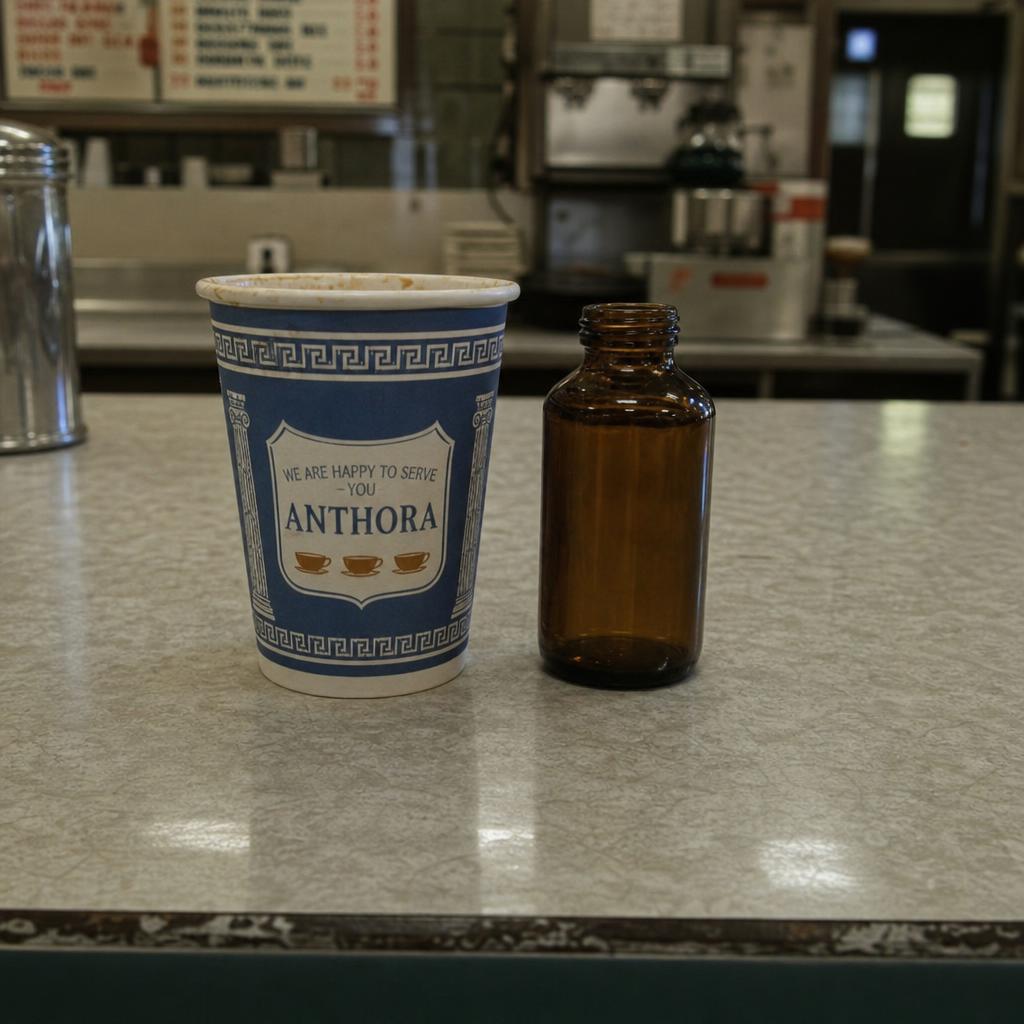
The stimulant the editorial floor actually ran on all day was legal, and no one on it counted it as a drug. Before the espresso bars arrived, New York ran on coffee poured from diner urns, sold at sidewalk carts, and brewed by the pot in every office. The cart coffee came, more often than not, in a blue-and-white paper cup stamped with a mock-Greek amphora and the words WE ARE HAPPY TO SERVE YOU — the Anthora, designed in 1963 by Leslie Buck, a survivor of Auschwitz and Buchenwald, for a paper-goods company chasing the city’s Greek-run coffee shops.7 In a diner the coffee came in a heavy ceramic mug with refills poured unasked; from a cart or a deli counter it came in the paper cup, handed over with a napkin folded around the hot side and a thin plastic stirrer. By 1994 the cup was selling around half a billion units a year,7 an object so ordinary it drew no notice at all, carried by the millions past every desk in the city.
The office ran on the same principle at higher volume. A commercial brewer held a pot against a warming plate all day; the pot was refilled, the mugs went unwashed, and the caffeine combined with the cigarettes at every desk and, after hours, with the alcohol at every dinner. Editors kept stained mugs at their desks and refilled them without counting; the pot emptied and was made again a dozen times between the morning and the close of the day. This was the working chemistry of the floor — legal, constant, unremarked — the fuel nobody described as a drug because everybody used it. A trip out for real coffee was a break, not a score.
None of it registered as consumption the way the illegal drugs did. A man smoking angel dust on a stoop was a drug user; an editor on her fourth cup before noon, a pack of cigarettes gone by six, was simply working late. What separated a habit from a drug was who kept the habit, and where.
The upscale tier came late. In April 1994 the Seattle chain Starbucks opened its first Manhattan store, on Broadway at 87th Street, then the largest of its 318 outlets and one of the largest coffee bars in the city.8 Espresso, latte, and a cup priced many times higher entered a market where the same jolt had cost small change at a cart, and coffee acquired a price gradient it had not carried before. The stimulant did not change. The packaging, the vocabulary, and the bill did.
The sorting was complete, and it ran on a single rule. The drugs the floor recognized as drugs were the ones other people used, in other neighborhoods, at other hours. The drug the floor used itself, all day, from the cart and the office pot, it did not recognize at all.
The pharmacology of a city is not one landscape but many, sorted less by the chemistry of the drugs than by the people who claimed them. These substances shared nothing in their effects — a psychedelic that ran for half a day, a dissociative snorted in a nightclub, a sedative already gone from the shelves, a cup of coffee — and everything in their social position: each was owned by a particular crowd, in a particular place, at a particular hour, and each was visible to the editorial floor in exact proportion to how near that crowd stood. What the floor could see it filed under someone else’s life. What it could not see was its own habit, the legal stimulant on every desk that no one thought to count. To read a decade by its drugs is to learn where a given set of eyes stopped looking — and to notice that the hardest thing for any vantage to see is the substance it is standing in.
The two datable facts this chapter turned up for Meridian would both have landed in the same corner of the book. Shulgin’s PIHKAL, published that year with its catalog of phenethylamines he had synthesized and tested on himself, would have made a plausible short item for The Back’s November close in 1991 — a paragraph on a chemist’s private taxonomy surfacing in the clubs under other names, not a review carrying the volume’s own argument, which would have belonged to a books critic with more space than a monthly’s back pages could spare. Jerry Garcia’s death that August, ending the Grateful Dead’s thirty-year touring run and with it the traveling market that had carried LSD across the country from parking lot to parking lot, would have reached The Back as well, in the issue closing that October: a few lines on what the death of a road show did to a psychedelic’s distribution, filed by whichever assistant on the articles desk would have had the column inches free that week.
Neither item would have troubled anyone above the desk. Both would have arrived already small, a fact about a book and a fact about an ending, and both would have been typeset once and not returned to.
Footnotes
-
Blair Jackson, Garcia: An American Life (New York: Viking, 1999). ↩ ↩2
-
“Schedules of Controlled Substances: Placement of Ketamine Into Schedule III,” Federal Register 64, no. 133 (July 13, 1999). ↩
-
Alexander Shulgin and Ann Shulgin, PIHKAL: A Chemical Love Story (Berkeley, CA: Transform Press, 1991). ↩
-
Steven P. Kurtz and James A. Inciardi, “Crystal Meth, Gay Men, and Circuit Parties,” Law Enforcement Executive Forum 3, no. 4 (2003): 97–113. ↩
-
Moby, “In the early ’80s my friends and I spent a lot of time in Washington Sq Park,” journal entry, moby.com, June 23, 2015. ↩
-
“Placement of Methaqualone in Schedule I,” Federal Register 49 (August 27, 1984): 33870. ↩
-
Margalit Fox, “Leslie Buck, Designer of Iconic Coffee Cup, Dies at 87,” New York Times, April 29, 2010. ↩ ↩2
-
Florence Fabricant, “Food Notes,” New York Times, April 27, 1994. ↩