The Visible City
Subscribe
https://meridian-archive.com/feed.xmlOpen in your app, or paste the link above into any other:
The Corner Count
Over the course of the 1990s, the New York Police Department made close to nine hundred thousand drug arrests citywide, and the enforcement fell overwhelmingly on the street-level crack trade rather than the powder cocaine consumed indoors by a different clientele.1 A patrol officer did not need to build a case beyond what a corner offered in plain sight: a hand-to-hand exchange performed on a sidewalk, in a park, at a stoop, was a sale conducted where a badge could see it happen. The arrest tally was not the residue of investigative work; it was a running count of how much of the trade a market had been forced to conduct in view of the street. Powder cocaine, bought and sold indoors, generated almost none of it — not because the volume moving through it was smaller, but because the transaction never crossed a sidewalk for an officer to witness.
The Market You Could See
The drug trade a Manhattan editor could see was the part arranged to be seen. In Washington Square Park, dealers worked the paths near the fountain in low continuous patter, pitching to anyone crossing toward New York University or south toward SoHo; the musician Moby, who spent teenage afternoons by the fountain, remembered the sound as a fixed background — “smoke, smoke, mescaline, smoke, smoke, weed, smoke, dust, smoke.”2 The park was a retail counter with no walls. So were parts of Tompkins Square Park and the numbered avenues east of it, where Avenue A, B, and C carried an open heroin and crack trade that thickened after dark. The visibility was the point of it and also the smallest part of it. What a passerby saw was the last three feet of a supply chain that ran back through the outer boroughs and up the interstates, and the three feet were the part built to move product to a stranger on foot. The rest of the market did not advertise. It ran in the interior courtyards and stairwells of the housing projects in Red Hook, in East New York, in the Harlem complexes — semi-enclosed rooms where a buyer had to be known, or brought.
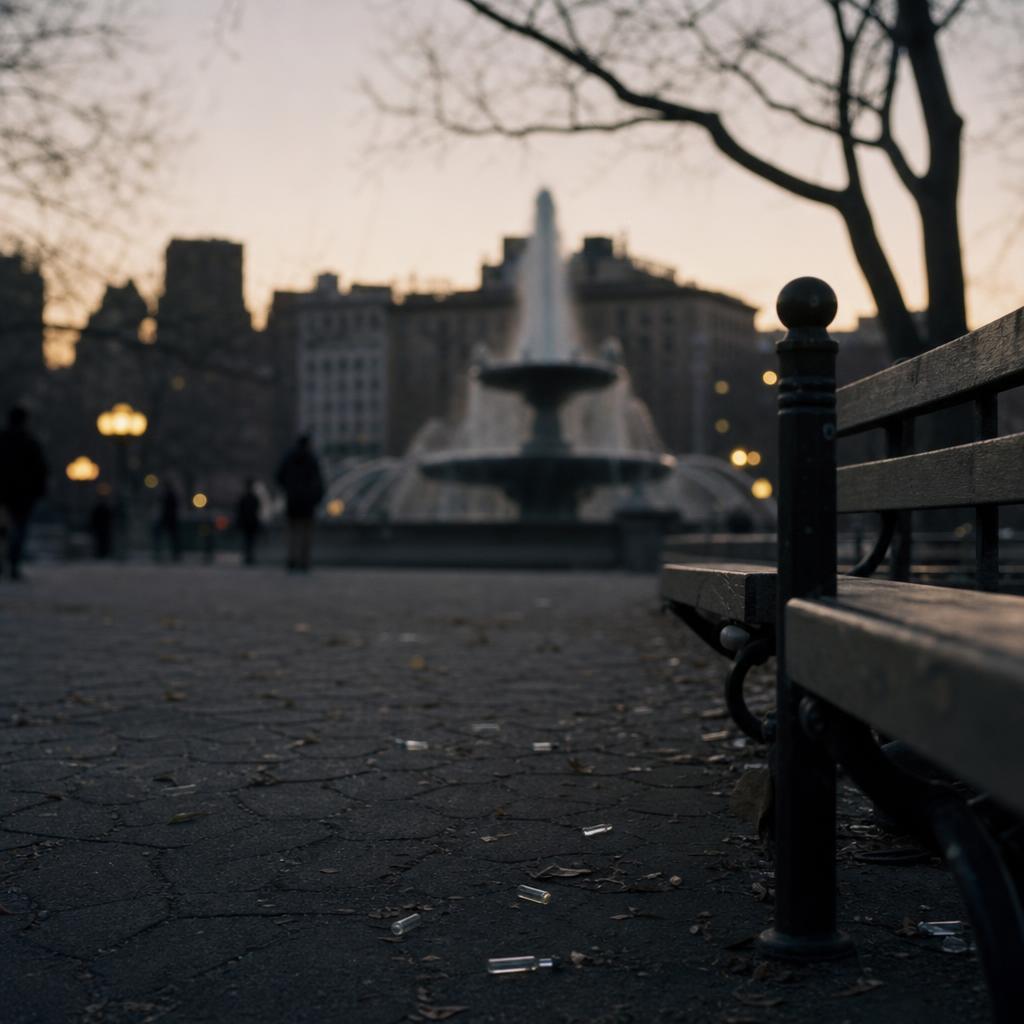
Visibility was not magnitude, but it was mistaken for magnitude, and the mistake was made at scale. In September 1986, CBS broadcast 48 Hours on Crack Street, a prime-time special anchored by Dan Rather and reported from the places the drug could be filmed.3 The camera needed an image, and the image it could get was the exchange on the corner, the pipe on the stoop, the vial in the gutter. A national audience learned the epidemic as a set of pictures taken where pictures were available. The sociologists Craig Reinarman and Harry Levine, tracking the coverage, found that the crack story hardened after 1986 into a fixed repertoire of scenes repeated across outlets — the demon drug rendered as a handful of photogenic tableaux, its scale asserted more often than counted.4 The counting, where it was done, lived in medical-examiner tallies and hospital-admission data that no camera could frame.
The Man on the Platform
For most people on a Meridian salary, daily contact with crack was a single recurring figure: the thin man on the subway platform muttering and working at something in his cupped hands, the used vials and glass stems in the gutter near the single-room-occupancy hotels on the West Side, a soft pitch from a bench while crossing a park. The figure was real. What it was not was representative, and the distance between the two was where the era’s central error lived. The visible user was, almost by selection, the user in visible trouble — the one whose life had narrowed to the street because the drug had taken everything with a door on it. The user still holding a job, an apartment, a family did not appear on the platform, because appearing on the platform was itself a late stage of the thing.
So the received portrait was of instant and total ruin: a person used crack and was destroyed, immediately and identically, the wreck the same in every case. The record underneath was slower and more various — a long middle passage of functioning use, of people who held employment for months or years, of a decline that came as a slope far more often than a cliff. Eugene Richards spent those years photographing the drug where it actually gathered, not in Washington Square but in East New York, in the Red Hook houses, in North Philadelphia, and the book he made, Cocaine True, Cocaine Blue, refused the single note of the television segment; it recorded addicts, dealers, sex workers, and police as a population with a range rather than a type.5
The same selection sorted the era’s picture of who used. The visible user was on a public sidewalk in a poor neighborhood, and so the crack user entered the general imagination as poor and Black, while the powder-cocaine user — the same molecule, taken indoors — stayed the white professional at the office or the dinner party. Both halves of the image were edited by where use could be seen. The white user who smoked crack, and there were such users from early in the wave, did it behind a door and stayed off the sidewalk and out of the frame; the powder user’s evidence was a bathroom stall at the office held shut a beat too long, not a vial in a gutter. So did the Black user who held a job and a lease and moved between worlds without announcing either. Privacy was the strongest camouflage the drug offered, and it was distributed by class. What could be photographed was one slice of the users, and the visible slice was taken for all of them.
The Map the Coverage Drew
The crack economy was rooted in particular neighborhoods, and they were not the ones the downtown reader lived in. It concentrated in Mott Haven and Hunts Point in the South Bronx, where the dealing corners and the sex-work strolls overlapped block for block; in the project courtyards of Red Hook, East New York, and Harlem; on uptown and outer-borough streets a Manhattan professional had no daily reason to enter. What that professional saw was the spillage — the park below Fourteenth Street, the SRO block in the West Fifties — and the coverage took the spillage for the source. The story was told as a phenomenon of Manhattan below Ninety-Sixth Street, a thing that had come downtown, when the ground truth was that downtown saw the thin outer edge of a market whose weight sat north and east.
The traffic between the two maps had a name: drug tourism. Buyers from the suburbs and from downtown drove into the uptown and outer-borough markets, bought, and left — some to use, some to look. The direction of that traffic was itself the correction the coverage declined to make. The drug did not spread from midtown; midtown drove to it. The neighborhoods that carried the market were the ones least able to command a reporter’s standing attention and most available to be entered, photographed, and left — which was the transaction the tourist and the news crew had in common.
The Neighborhood as Subject
A block with an open-air market was photographed as a place things happened to. The corner, the vials, the boarded building behind the corner: the image was of a neighborhood as a passive site of ruin, its residents present only as casualties or dealers. What the frame left out was everything the residents did about it. The same blocks ran tenant patrols and block associations, marched, kept watch, leaned on precincts, and carried the daily work of feeding children and walking them to school through a market their parents could not clear. Much of that work fell to older women — grandmothers raising the grandchildren of daughters who were dead, incarcerated, or in treatment — and it was labor, not weather, though it photographed as neither.
The erasure was not neutral. A neighborhood shown as a passive victim asked only to be acted upon; a neighborhood shown as an agent contending with a market asked to be reckoned with. The coverage that reached the downtown reader mostly chose the first, because the first was the available picture and the second required staying long enough to watch people do things that took months to accumulate and left nothing bright on the sidewalk. The resistance was continuous, and it went unrecorded for the same reason it was needed: it made no picture.
The Baby in the Photograph
The most durable image the era produced was of an infant. The “crack baby” — trembling, underweight, wired to a monitor in a neonatal unit — became the settled shorthand for a generation the drug was said to have ruined before birth. The science under the image was thinner than the image. It traced to a 1985 report in the New England Journal of Medicine by Ira Chasnoff and colleagues, based on twenty-three cocaine-using women, which found worse outcomes and was carried into the press as prophecy: a cohort of permanently damaged children declared, most of them sight unseen.6
The correction was available inside the period, and it was not obscure. In 1989, Gideon Koren and collaborators published in The Lancet an analysis of how the research itself was being filtered: reviewing abstracts submitted to a pediatric-research society, they found that studies reporting no adverse effect from prenatal cocaine exposure were accepted for presentation at a small fraction of the rate of studies reporting harm.7 The literature that reached print, and from print reached the news, had been selected for alarm before a single reporter touched it. The prophecy had been published in 1985 and amplified across the second half of the decade; the evidence that it stood on a bias in what got published sat in a major medical journal by 1989. The image kept its authority anyway, because the image was on television and the correction was in a footnote.
A city is not one thing evenly distributed; it is a set of sightlines, and what a person knows of it is bounded by where their body has standing to be. The crack years were known, by the readers and editors who set the terms of how they were known, through a narrow and particular aperture — the park below Fourteenth Street, the platform on the morning commute, the block a cab passed through with the doors locked. Through that aperture the drug looked like a Manhattan story of instant ruin visited on passive neighborhoods and confined to the poor and the Black, and every one of those impressions was an artifact of the vantage rather than a fact about the drug. The market was uptown and outer-borough; the ruin was slow and uneven; the neighborhoods were full of people doing the opposite of nothing; the users crossed every line the picture drew; the damaged generation was a projection the evidence, already, did not support. What was visible was taken for what was true, and the gap between them was exactly the width of the distance a downtown reader did not travel. The parts arranged never to be seen went on existing anyway, unphotographed and undiminished, and they are there still for anyone who comes to the decade from outside the window a downtown reader happened to be standing at.
A junior writer on the research side would have brought in the Koren analysis out of The Lancet in December 1989 — the finding that studies reporting no harm from prenatal cocaine exposure had been accepted for presentation at a fraction of the rate of studies reporting harm, the bias sitting inside the literature that had produced the “crack baby” prophecy. It would have been a corrective worth running, and it would have gone nowhere. The pitch would have landed on the desk of the senior editor who had put the original Chasnoff item into the magazine in 1985 as settled fact, and he would not have cared to be told, in his own pages, by someone junior to him, that he had been wrong. The piece would have died there, on that footing, and not on its merits. Whatever else would have been said about it on the floor would have been said after the decision, not before it.
Footnotes
-
New York Police Department drug-arrest totals, 1990s, cited in Torben Grünhaupt, “The War on Drugs in the Media: The Making of the Crack-Cocaine Epidemic,” documenting nearly 900,000 NYPD drug arrests during the decade concentrated in street-level crack enforcement over indoor powder-cocaine use. ↩
-
Moby, journal entry, “In the early 80’s my friends and I spent a lot of time in Washington Sq Park,” moby.com. ↩
-
48 Hours on Crack Street, CBS News, September 1986; anchored by Dan Rather. Vanderbilt Television News Archive, broadcast record. ↩
-
Craig Reinarman and Harry G. Levine, eds., Crack in America: Demon Drugs and Social Justice (University of California Press, 1997), esp. “Crack Attack: Politics and Media in the Crack Scare.” ↩
-
Eugene Richards, Cocaine True, Cocaine Blue (Aperture, 1994). The book’s fieldwork concentrated in East New York, the Red Hook Houses, and North Philadelphia. ↩
-
Ira J. Chasnoff et al., “Cocaine Use in Pregnancy,” New England Journal of Medicine 313, no. 11 (September 12, 1985): 666–669. ↩
-
Gideon Koren, Karen Graham, Heather Shear, and Tom Einarson, “Bias against the null hypothesis: the reproductive hazards of cocaine,” The Lancet 2, no. 8677 (1989): 1440–1442. ↩