Political Events as Class Ruptures, 1991–2001
Subscribe
https://meridian-archive.com/feed.xmlOpen in your app, or paste the link above into any other:
The Global City’s Small Print
A private citizen in Crown Heights had drawn a round-the-clock New York City police detail since 1966: two patrol cars parked outside a synagogue at 770 Eastern Parkway and outside a private home a few blocks away, on duty in shifts every hour of every year, budgeted and staffed like any other precinct assignment though the person they guarded held no public office and had never been the target of a specific, documented threat that the department disclosed. The city’s own 1978 attempt to withdraw the detail, prompted by a death in police custody and a vigilante beating the same year, met organized political resistance and failed; the cars stayed, and by 1991 the assignment had run unbroken for twenty-five years at an estimated lifetime cost of four million dollars — a routine line in a precinct budget that had simply never come up for a second vote.1 The mechanism doing the sorting was not a citizen’s income. New York’s income structure already showed the shape the sociologist Saskia Sassen called the “global city”: a metropolis whose economy had less use, each year, for the middle rungs that had once connected its very rich to its very poor, so that the two ends of the ladder drifted apart from each other and from the rungs in between.2 Robert Fitch’s 1993 argument that the city’s own planning and real-estate interests had deliberately hollowed out Manhattan’s manufacturing base to drive up land values gave a name to what a walk down any avenue already showed: a city built for two economies stacked at different elevations inside the same buildings.3
Two people earning identical salaries could occupy entirely different class positions depending on whether one had inherited a lease held by the family since the early 1960s and the other was renting the same address at the current market price — the distinction the sociologist Pierre Bourdieu called habitus, the internalized inventory of taste and certainty that no paycheck alone could purchase.4 Political access, like a lease, could be inherited and defended across a quarter-century without ever needing to be re-justified in public.1 The credentialing started earlier than any interview: Buckley or Chapin for day school, Groton or St. Paul’s for boarding school, the Ivy League after that — a sequence a family understood as inevitable long before the first tuition bill arrived, and one no scholarship fund could fully substitute for.
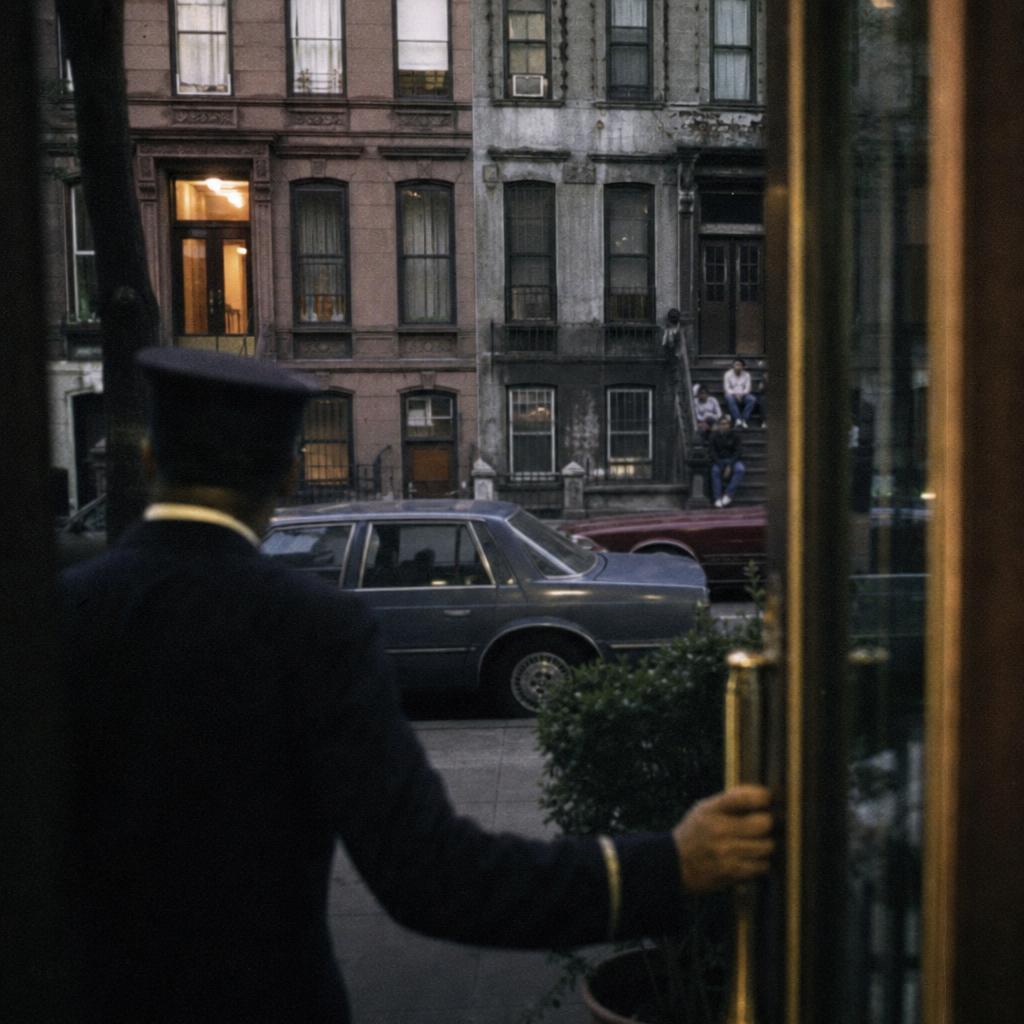
Beneath the credential of the address ran the arrangement that made it livable: the doorman, the building superintendent, the nanny, the delivery man — a domestic-labor economy that put people of sharply different class positions into daily physical proximity without asking either side to share a social reality. The relationship was formalized once a year, at the December holiday tip, and mostly unexamined the other fifty-one weeks. This was the city that spent the 1990s responding to a run of events — a bombing, a riot, a verdict, a law, a stock index, a second bombing — that did not set out to be about class and were reported, almost without exception, as being about something else entirely.
The Decade’s Ruptures
| Date | Event | What split |
|---|---|---|
| Aug. 19–21, 1991 | Crown Heights | Political access and police resources, inherited from a 1966 arrangement, decided whose safety was defended first.1 |
| Feb. 26, 1993 | World Trade Center bombing | The six dead all worked below street level; the tenants above were back at their desks within weeks.5 |
| Oct. 3, 1995 | O. J. Simpson verdict | A magazine masthead split along a line its senior staff had rarely had to name out loud.6 |
| Aug. 22, 1996 | Federal welfare-reform law signed | Benefit time limits pushed the city’s poorest households into the low-wage service jobs the decade’s boom depended on.7 |
| 1999–2000 | Dot-com peak and collapse | A twenty-something’s stock grant briefly outweighed three generations of inherited real estate, then didn’t.8 |
| Sept. 11, 2001 | World Trade Center attacks | Bereavement crossed every floor of the same two buildings, from trading desks on 101–105 to a restaurant’s kitchen two floors above them.9 |
Six Floors Below
At 12:17 in the afternoon on February 26, 1993, Ramzi Yousef and Eyad Ismoil parked a rented Ford Econoline van on the B-2 level of the World Trade Center’s underground garage and detonated a 1,336-pound urea nitrate bomb, built, in its designer’s own stated intention, to topple the North Tower into the South and kill as many of the fifty thousand people in the complex as the physics of the collision allowed. The towers swayed and held. The blast tore a crater nearly a hundred feet across through several sublevels of the garage, cut the main electrical line, and sent smoke up unpressurized stairwells as high as the ninety-third floor of both towers. Six people died, and every one of them had been working below the level where the visiting public ever went. Monica Rodriguez Smith, thirty-five and seven months pregnant, was a Port Authority secretary checking time sheets at a desk on the B-2 level. Robert Kirkpatrick, 61, Stephen Knapp, 47, and William Macko, 57, Port Authority maintenance supervisors, were eating lunch together in a break room down the corridor. Wilfredo Mercado, thirty-seven, was receiving a food delivery for Windows on the World, the restaurant on the 106th and 107th floors he supplied on weekdays and guarded on weekends. John DiGiovanni, forty-five, a dental-supply salesman with no office in the building at all, was parking his car.5 Between them, the six shared one thing the tens of thousands of lawyers, bankers, and trade officials on the floors above did not: their jobs required them to be underground.
Getting the survivors out took most of the afternoon and half the evening. With the power line severed, the stairwells ran dark from the basement to the ninety-third floor, and the smoke Yousef had designed the device to produce rose with them. Walter Philip Travers, a Cantor Fitzgerald broker on the 101st floor, spent more than five hours descending through the dark. Robert Small, evacuating that same morning, put words to what the descent required of everyone in it: “You had to keep your hand on the shoulder of the person in front of you and just rely on them to tell you that they hit a platform.” Travers reached a street already lined with soot-covered survivors and the emergency vehicles that had answered the call. The towers were not fully cleared until after five-thirty that evening. The South Tower reopened to tenants on March 18; the North Tower on April 1. Windows on the World, on the 106th and 107th floors, reopened within weeks and went back to serving the same clientele of financial-district regulars it always had.5
What the bombing exposed, and what its own swift resolution let the city set back down, was the seam running through its own office towers: the people whose names filled a partnership letterhead occupied the visible floors, filed insurance claims, and were back at their desks within a month; the people who kept the machinery running beneath them were the ones who died doing it, and their names needed a memorial plaque before most of the city could recite them. New York filed the case as solved — four convictions within thirteen months of the bombing,5 its architect arrested in Pakistan roughly two years after that, the physical damage repaired well ahead of any reckoning with what had caused it.9 What went unfiled, in 1993, was the fact that the six people who died for it were the ones who never had a choice about which floor to be on.
The Motorcade’s Escort
The car that killed Gavin Cato was not part of a public motorcade in the ordinary sense. It was a station wagon carrying three yeshiva students, trailing the unmarked police car and sedan that escorted the Lubavitcher Rebbe, Menachem Mendel Schneerson, on his frequent visits to his father-in-law’s grave in Queens. The Rebbe’s round-the-clock police protection — patrol cars stationed at his synagogue and his home since 1966, at a cost that ran into the millions of dollars over the years — had survived a 1978 department proposal to withdraw it. On the evening of August 19, 1991, the driver, twenty-two-year-old Yosef Lifsh, fell behind the lead cars, entered the intersection of President Street and Utica Avenue against a light that witnesses described as already changing, and struck another car; his station wagon veered onto the sidewalk and killed seven-year-old Gavin Cato, pinning his cousin Angela beside him. Gavin’s father, Carmel Cato, was steps away: “Angela she was on the ground but she was trying to move. Gavin was still. They was trying to pound him. I was trying to explain it was my kid!” That same night, police pulled Pierre Regis, a Haitian driver with no connection to the crash, from his car blocks away, claiming he had tried to run them over, and beat him; a jury later awarded him $3.1 million against the city. Three hours after the crash, a crowd surrounded Yankel Rosenbaum, a rabbinical student visiting from Melbourne who also had no connection to it. Charles Price, a local man in his late thirties who had been at the crash site, urged them on — “Let’s go get a Jew!” — and was later convicted of inciting the attack; sixteen-year-old Lemrick Nelson Jr. stabbed Rosenbaum to death. Seventeen days later, on September 5, Anthony Graziosi, an Italian-American salesman, was shot dead six blocks from the stabbing site by four Black men; his family and several elected officials believed his beard and dark suit had gotten him mistaken for a Hasid, though the city never classified the killing as a bias crime.1
The three nights of violence that followed exposed, block by block, an arrangement a Brooklyn residency map from 1991 already showed without a word of commentary: a Hasidic community numbering in the tens of thousands, a demographic minority tightly organized and politically connected enough to have kept a round-the-clock police detail at its spiritual headquarters for a quarter-century, embedded inside a much larger Black and Caribbean neighborhood that had absorbed a decade of recession, of the crack epidemic, and of a grievance voiced to reporters and oral historians for years afterward — that the city’s investment ran toward the community that could produce a congressional resolution for its rabbi’s birthday and away from the one that could not. Neither side’s account of the disparity was simply wrong. The Lubavitch could point to real threats as the reason for the escort; the Black families around them could point to a Sunday-service response that the state’s own 1993 investigation termed passive, as evidence that political access, not need, still governed which corner of Brooklyn a mayor answered fastest.
The riot’s political accounting arrived on schedule. Governor Mario Cuomo’s Girgenti Report, released in July 1993, cleared Mayor David Dinkins of ordering police to stand down but found him “passive and out of touch” through the worst of it, and singled out Police Commissioner Lee Brown by name.1 The Hasidic vote in Crown Heights, which had gone to Dinkins by an overwhelming margin in 1989, swung to Rudolph Giuliani in 1993; a state jury’s 1992 acquittal of Rosenbaum’s killer, and the outrage it produced — Norman Rosenbaum, the victim’s brother, made “Jewish blood is not cheap!” the line of the protest campaign that followed — was credited by at least one historian of the period with possibly costing Dinkins the fifty-three-thousand-vote margin by which he lost. Giuliani ran that fall on a slogan, “One City, One Standard,” built to answer Dinkins’s “gorgeous mosaic,” and won the first Republican mayoralty New York had elected since John Lindsay’s fusion ticket. What changed in Crown Heights afterward was measured in terms nobody at the time called class terms: a $1.1 million city settlement with Jewish residents in 1998, a federal civil-rights conviction against Rosenbaum’s killer in 1997 that was vacated on appeal and replaced, on retrial, with a narrower civil-rights verdict that stopped short of finding his actions had caused Rosenbaum’s death, and a neighborhood in which the underlying disparity in political access was managed, litigated, and eventually settled, without ever being closed.10
Anna Deavere Smith spent the following winter interviewing more than a hundred Crown Heights residents and reassembled twenty-six of their voices, verbatim, into Fires in the Mirror, which opened at the Public Theater in May 1992 and remains the most exact record of how differently the neighborhood’s two communities read the same three nights.11 Neither Smith’s subjects nor the Girgenti Report ever quite named, in so many words, the disparity visible at the intersection where the crash happened: a resource asymmetry inherited from a 1966 police assignment, not from anything either family had earned that August.
The Verdict in the Conference Room
At 1:07 in the afternoon on October 3, 1995, a Los Angeles County court clerk read a not-guilty verdict in the trial of O. J. Simpson to more than a hundred and fifty million television viewers — ninety-one percent of everyone watching television in America at that moment. The nine months before the verdict had already supplied the material for the divide the moment made visible: defense investigator Laura McKinny’s tape recordings of Detective Mark Fuhrman using a racial slur roughly forty-one times, two of which Judge Lance Ito admitted into evidence that summer after Fuhrman had denied under oath ever using the word; prosecutor Christopher Darden’s decision to have Simpson try on the recovered glove in front of the jury, which did not fit, handing Cochran the closing line — “If it doesn’t fit, you must acquit” — that outlasted the trial itself; and a Los Angeles Police Department whose credibility with Black jurors, and with much of Black America, had been shaped for years by the 1991 videotaped beating of Rodney King and the acquittal, the following spring, of the officers who administered it. A CNN poll taken within hours of the verdict found sixty-two percent of white respondents believed Simpson guilty of murder and sixty-eight percent of Black respondents believed him innocent — a split rooted less in the DNA evidence in front of the jury than in two starkly different institutional histories with the same police department.6
A magazine’s conference room, that Tuesday afternoon, could not resolve that disagreement, and the reason was structural before it was personal. A masthead at a prestige monthly in 1995 ran, at its senior levels, almost entirely white; the diversity that existed on the floor sat mostly in the support ranks, the editorial assistants and fact-checkers, where the pay was lowest and the path upward slowest. When the verdict was read, the senior editors in the room experienced something close to genuine shock: their confidence in the physical evidence, and in a criminal-justice system they had rarely had cause to distrust, had just been directly contradicted. A Black staff member watching the same screen from a chair more senior than most of her Black colleagues could expect to reach had, more often than not, arrived at the moment with a different set of priors already installed — not because she had followed the trial more closely, but because her own experience of the same institutions the trial was testing had never given her reason to expect the outcome her white colleagues had assumed. The gap in the room was not a gap in information. Both groups had watched the same nine months of testimony. It was a gap in what each group’s life, up to that point, had trained it to expect a jury and a police department to do.
What a magazine did with that gap became its own class story. Johnnie Cochran told a Harvard audience four weeks later that his closing argument “didn’t drive a wedge between the races, it simply revealed the chasm that already exists” — a formulation sharper than most of what ran in the mainstream press that fall, which mostly treated the racial split in reaction as a puzzle to explain to a white readership rather than a fact to report from inside a Black one.13 A magazine that had spent a decade describing itself as a serious venue for writing about race discovered, in the weeks after the verdict, whether that description was true — whether it had the editorial confidence to run a piece written from inside a Black staff member’s reaction rather than one that translated it, at a careful remove, for readers who did not share it. Some publications hired more Black editors in the years that followed, in numbers that mostly receded again within a few years.
The Decade’s Last Ruptures
Three more ruptures closed out the decade, each thinner in documentation than Crown Heights or the bombing but no less legible as class events once the frame was applied.
Police Commissioner William Bratton’s application, after 1994, of the “broken windows” theory the criminologists George Kelling and James Q. Wilson had proposed in 1982 — that visible disorder invited more serious crime, and that policing minor infractions could reverse a neighborhood’s trajectory — became, under Mayor Giuliani, “quality of life” enforcement: arrests and summonses for turnstile-jumping, unlicensed vending, public urination, and the windshield-washing of the squeegee men who had worked Manhattan’s bridge and tunnel approaches since the late 1980s.14 The theory targeted behavior, not income, but the behavior it targeted was concentrated almost entirely among the city’s poorest residents, and its declared purpose — a city safe enough for the capital returning to Manhattan real estate after the recession — was a class purpose stated in public-safety language.15
The federal welfare-reform law President Clinton signed on August 22, 1996, replaced Aid to Families with Dependent Children with time-limited benefits tied to work requirements, and moved a portion of the city’s poorest households — the population least visible in a decade of coverage devoted to Wall Street bonuses and dot-com valuations — into the low-wage service jobs that kept the boom’s kitchens, cleaning crews, and delivery routes running.7 The state’s 1997 revision of its rent-regulation law let an apartment leave rent stabilization once its legal rent crossed a set dollar threshold, working the other side of the same mechanism by giving landlords a direct financial incentive to move a long-term tenant out rather than keep her at a controlled rent.
The dot-com boom offered, for about eighteen months, the appearance that the whole arrangement might dissolve: a twenty-something with a Silicon Alley stock grant could sit, briefly, at the same table as money that had taken three generations to accumulate. The NASDAQ composite, trading near 750 at the start of 1995, closed above 5,000 in March 2000; by the end of 2001 it had given back most of the gain, and the Silicon Alley offices that had briefly rivaled the finance industry’s rents emptied out just as quickly.8
What closed the decade was not a rupture the city could resolve, forget, or settle in court. On September 11, 2001, the towers whose basement had killed six people in 1993 came down with everyone still inside them who had not gotten out in time — traders on floors 101 through 105 of the North Tower, where Cantor Fitzgerald’s offices sat, and the staff of Windows on the World two floors above them, who had no stairwell below the fire that morning at all.9 The class geography the 1993 bombing had briefly made visible, and that the city had chosen to read as solved, returned eight years later, this time with no plaque possible and no six people to name. Bereavement crossed every floor of both buildings that morning — traders and secretaries, cooks and executives, messengers and partners — in a way no city agency, real-estate report, or magazine feature had prepared anyone to expect from a symbol everyone had already decided was invulnerable.
None of these six events set out to be about class. A car crash, a bomb, a jury’s verdict, a president’s signature, a stock index, a second bomb: each had its own immediate cause and was reported, in real time, in the vocabulary its own occasion supplied — race, crime, technology, terrorism. What they held in common became visible only to a reader willing to ask the same question of all six: who was standing where, on what terms, when it happened. The six people who died underground in 1993 had not chosen to work underground any more than the Lubavitch escort, or a magazine’s assistant class, had chosen the terms of their own visibility. New York prided itself, across the decade, on having absorbed each rupture without the kind of citywide burning that reshaped other American cities in the same years, and rarely asked what the absorption had cost, or who had paid it more than once. What the reader carries out of these six events is not a verdict on any of them, but a way of re-reading everything the rest of the decade insisted was a private matter of taste, address, or opportunity — a co-op board’s interview, a nanny’s papers, an unpaid internship — as the same argument these six events conducted at full volume, and in public.
The bombing under the World Trade Center would have needed no internal argument: a villain with a stated intention, a body count, a garage torn open below street level, a recovery finished well ahead of any reckoning with its cause — material built for The Feature Well, timed against an April close.
The welfare-reform law signed that August would have landed on a different desk. Time limits tied to work requirements would have made a longer case than a reported feature could carry on its own, and The Essay would have been where a writer worked out, at length, what the new mechanics meant for a household living against a benefit clock — the kind of argument piece a monthly could still afford to run months after the signing, since the law’s real weight would only have shown up in the caseloads a year or two out.
The dot-com run and its collapse would have made the same section’s other kind of story: not a crime but an accounting, a twenty-something’s stock grant briefly outweighing three generations of inherited real estate, and then not — an obituary for a boom the magazine’s own advertising pages would have ridden as hard as any Silicon Alley client, headed again for The Feature Well.
September’s attacks would have reopened the question the desk had kept returning to all decade: assigned once more to The Feature Well, the September issue already gone to press by the eleventh, the piece held for November instead.
Footnotes
-
Richard H. Girgenti, A Report to the Governor on the Disturbances in Crown Heights (State of New York, 1993). ↩ ↩2 ↩3 ↩4 ↩5 ↩6
-
Saskia Sassen, The Global City: New York, London, Tokyo (Princeton University Press, 1991). ↩
-
Robert Fitch, The Assassination of New York (Verso, 1993). ↩
-
Pierre Bourdieu, Distinction: A Social Critique of the Judgement of Taste, trans. Richard Nice (Harvard University Press, 1984). ↩
-
Jim Dwyer, David Kocieniewski, Deidre Murphy, and Peg Tyre, Two Seconds Under the World: Terror Comes to America — The Conspiracy Behind the World Trade Center Bombing (Crown Publishers, 1994). ↩ ↩2 ↩3 ↩4
-
Jeffrey Toobin, The Run of His Life: The People v. O.J. Simpson (Random House, 1996). ↩ ↩2
-
Personal Responsibility and Work Opportunity Reconciliation Act, Pub. L. No. 104-193 (1996). ↩ ↩2
-
John Cassidy, Dot.con: The Greatest Story Ever Sold (HarperCollins, 2002). ↩ ↩2
-
Jim Dwyer and Kevin Flynn, 102 Minutes: The Untold Story of the Fight to Survive Inside the Twin Towers (Times Books, 2005). ↩ ↩2 ↩3
-
Edward S. Shapiro, Crown Heights: Blacks, Jews, and the 1991 Brooklyn Riot (Brandeis University Press, 2006). ↩
-
Anna Deavere Smith, Fires in the Mirror: Crown Heights, Brooklyn and Other Identities (Anchor Books, 1993). ↩
-
Fashion Institute of Technology, “1990–1999,” Fashion History Timeline. ↩
-
Harvard Crimson, “Cochran Discusses Race, Media,” October 30, 1995. ↩
-
George L. Kelling and James Q. Wilson, “Broken Windows,” The Atlantic, March 1982. ↩
-
William Bratton with Peter Knobler, Turnaround: How America’s Top Cop Reversed the Crime Epidemic (Random House, 1998). ↩
-
New York City Rent Guidelines Board, Housing NYC: Rents, Markets and Trends ‘98 (1998). ↩