Watches and Class Signals
Subscribe
https://meridian-archive.com/feed.xmlOpen in your app, or paste the link above into any other:
The Watch Nobody Priced
In March 1993, the Washington Post printed, as an ordinary line of column copy requiring no gloss for its readers, a physical description of the sitting president’s watch: “a plastic digital watch, thick as a brick and handsome as a hernia.”1 Omega, the Swiss watch company, ran its own advertisements the same season inviting the watch’s wearer to consider something the company actually made — a national newspaper and a rival manufacturer’s paid advertising both treating a public appraisal of a president’s forty-dollar Timex as a transaction so unremarkable it needed no setup. Neither the columnist nor the watchmaker had to explain the joke, because the appraisal itself was already universal: on Meridian’s own editorial floor in the same years, anyone fluent in it could price a colleague’s watch — and by extension a colleague’s family money or the size of a recent bonus — in the time it took an elevator door to close, a habit so routine that no one who performed it experienced it as judgment at all.
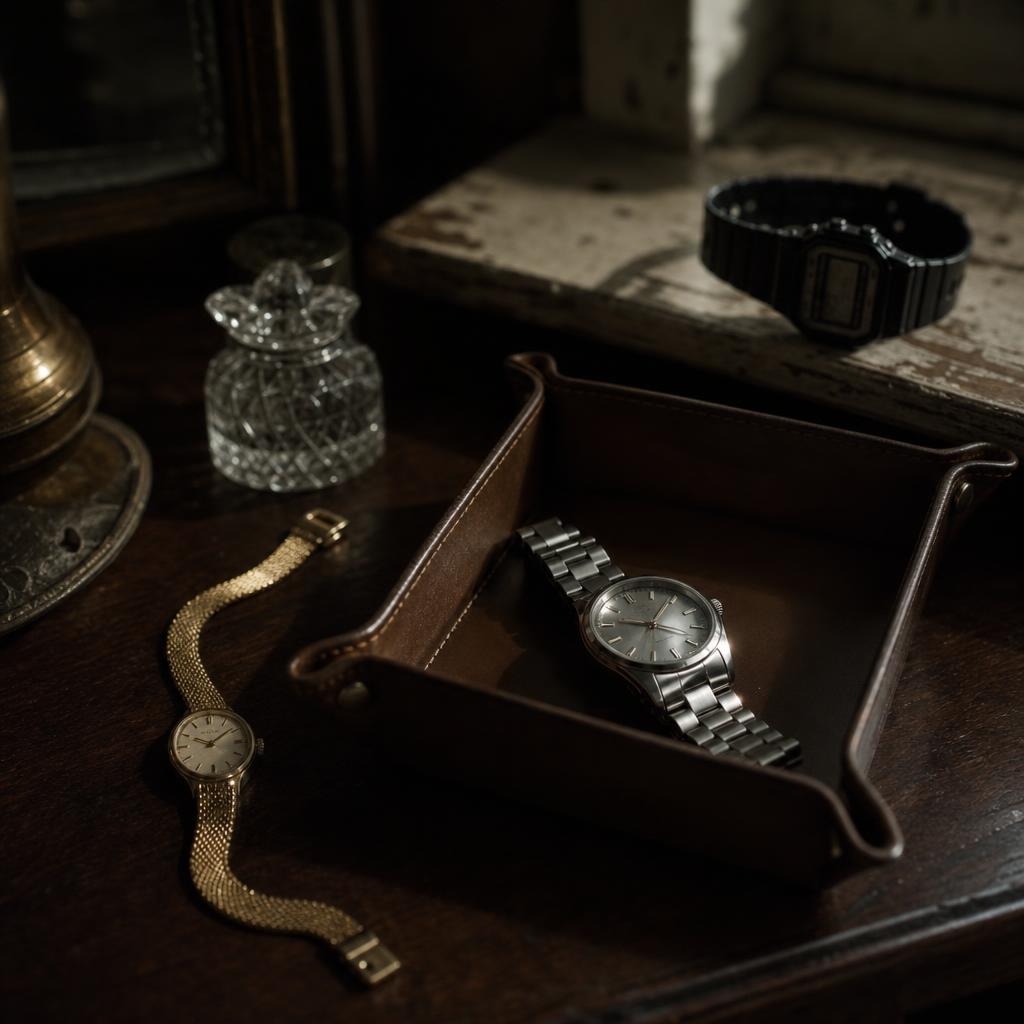
The objects doing that appraising, on the magazine’s own floor, were concrete. An inherited dress watch the width of a dime — its thin gold case worn smooth at the back from decades first on a father’s wrist and then on a daughter’s — drew no comment from anyone who saw it, and needed none. A heavier watch two desks over, a steel Rolex bought new within the year, its bracelet catching light every time its owner reached for a telephone, drew the private markdown described above. The watch that would actually have told a person the truth about a time zone she had just left belonged to neither reading. It sat on a foreign correspondent’s wrist a continent away: a rectangular block of black resin, bought for something under fifty dollars, built to survive conditions that ruin a thin gold dress watch or a steel bracelet within a week.
Which of the first two watches counted as pedigree and which counted as effort had already been settled by the same recession-era logic that scored an unlabeled sheath over a labeled one. What that reading left alone was the objects themselves: four watches, worn on the same masthead in the same years, built by four different logics to do four different jobs, only one of which had anything to do with being seen.
The Currency of Not Trying
Cartier’s Tank, a flat rectangular case on a leather strap designed in the years around the First World War, was old money’s default because it required no explanation. Its accessible line, Les Must de Cartier, entered the market in 1977 — a response to the same crisis that was flooding watch counters everywhere with cheap, accurate Japanese quartz movements — built in vermeil, silver gilded in gold, so that it looked, to any eye but a jeweler’s, identical to the solid-gold original it stood in for at a fraction of the cost.2 Worn without a box, without a receipt, without any gesture toward its own value, a Tank on an old-money wrist required no defense of its own worth; the absence of any defense was the point.
The Rolex — a Datejust with its cyclops-magnified date window, a Submariner with its diver’s bezel and oyster case — required the opposite. Both were built as instruments first, self-winding, water-resistant, engineered to a standard a wearer could point to and explain. That was precisely what read as wrong to the room: a watch a person could describe the merits of was a watch its owner had researched and then bought, and buying, on that floor in that decade, was the one transaction pedigree was supposed to make unnecessary. The distinction had nothing to do with the two watches’ actual prices, which could land at the same number. It had to do with which watch could explain itself and which could not, and did not need to. A Submariner’s deep-diving water resistance meant nothing to the wrist that wore it in an office on Madison Avenue, and that was itself part of the point: over-engineering as its own kind of pedigree, proof that the object, unlike the man wearing it, was built for depths he had no plans to visit.
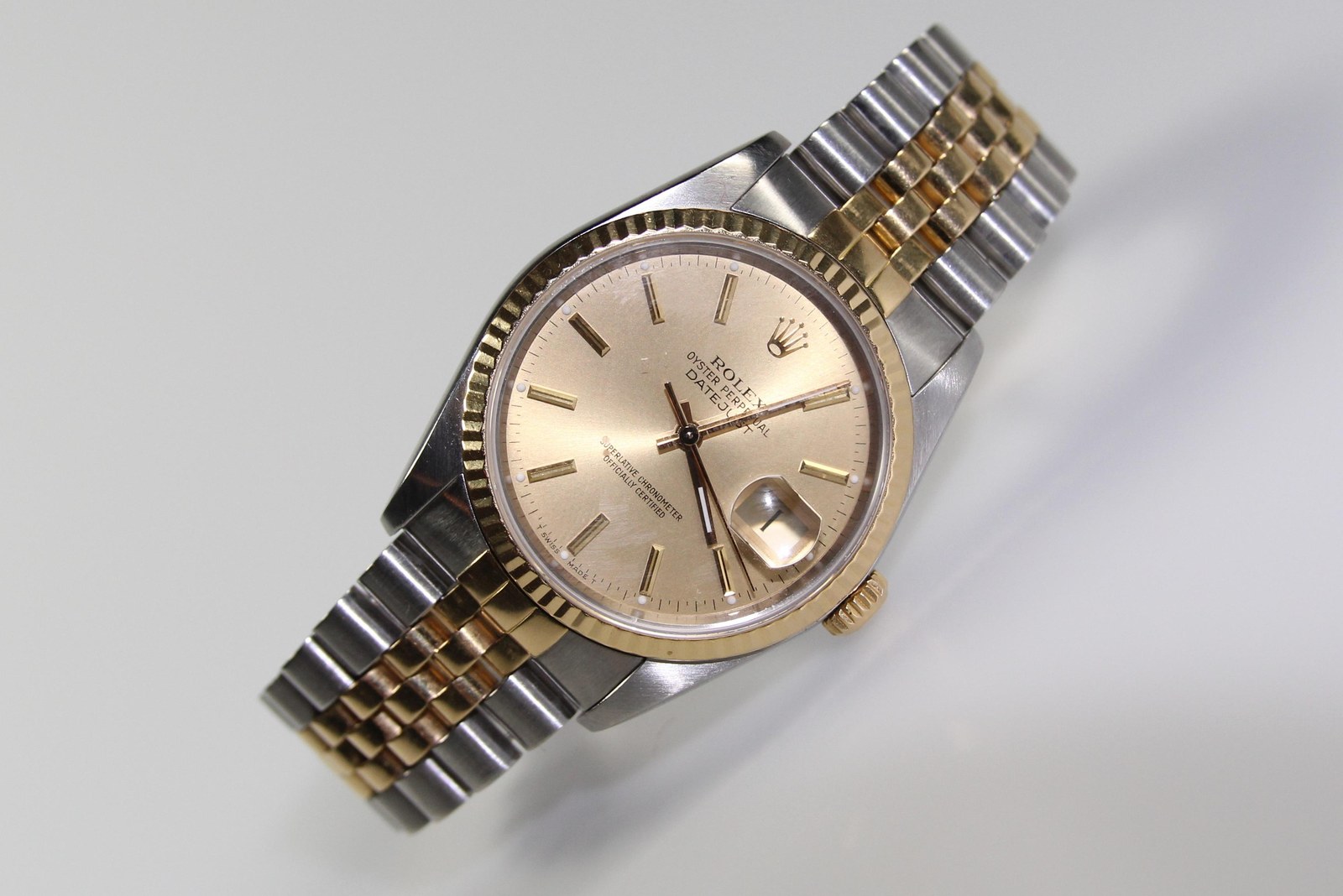
Three floors down and a few blocks over, on the finance side of the same recession, the same object told a third, faster story. New money ran on the December bonus check, the single date on the calendar that determined what got bought, renovated, or upgraded for the following twelve months, and a Rolex purchased in the flush weeks after the check cleared read as exactly what it was: this year’s money, spent on this year’s object, timed to a cycle the old-money wrist never had to observe. The magazine’s own senior editors moved in the same buildings as that money without belonging to it, which was part of what let them read it so precisely — they could price a January Rolex to the week without ever having received a bonus themselves.
The Watch Built to Cost Nothing
A third watch on the same floor answered to neither logic. Founded in Switzerland in 1983 by Ernst Thomke, Elmar Mock, and Jacques Müller, Swatch built its case and movement as a single sealed plastic unit, requiring a fraction of the parts and the assembly labor a conventional mechanical watch needed, and sold the result as exactly what its name proposed: a second watch, casual and replaceable, worn alongside a real watch rather than instead of one.3 Owning three or four, in different colors, for different moods, was not carelessness. It was the entire point — a Swatch that cracked or fell out of a season’s favor cost too little to mourn, which made it, to the small number of readers positioned to notice, its own kind of unconcern. The Tank achieved indifference to money by never having had to think about it. The Swatch achieved the identical appearance by being cheap enough that the question never arose.
A vintage Omega, bought secondhand from a dealer or an estate sale rather than a boutique, worked the same inversion from the opposite direction. Decades old, its dial faded and its case already scuffed by a stranger’s years of wear before it reached a new owner’s wrist, it was not under warranty and told no one what it had cost — only that its owner had known where to look for it. On a floor that traded, above everything else, in the claim to know a thing before the general public did, that particular knowledge outranked whatever a Rolex bracelet could announce merely by catching the light.
What a Watch Was Actually For
None of this reading reached the fourth watch, because the fourth watch was never on the floor to be read. A foreign correspondent filing from a checkpoint, a border crossing, or a hotel running on generator power needed an object built to keep working through conditions no editorial floor’s climate control ever tested, and by November 1989 the object that did that reliably and without ceremony was the Casio G-Shock DW-5600C-1, in production since June 1987.
An automatic Seiko 5 offered the same reliability dressed for a meeting rather than a filing queue: caliber 7009, a slim thirty-six-millimeter case, and a day-date window whose day wheel could be set to alternate in and out of English depending on the market a given watch had been sold into — a small mechanical bilingualism useful to a correspondent working copy between two languages.5 The Timex Ironman Triathlon, on the market since 1986, was the third plausible choice and the most American of the three: an unglamorous, mass-produced sports watch, round-cased and grey, cheap enough that an Arkansas governor wore his into the presidency and kept wearing it through the start of a first term.
The comparison to the watch world the Rolex belonged to had already been made explicitly, and in print, within the period — the Washington Post line and the Omega advertisements of March 1993, cited above. The joke worked only because both sides of it were legible to the same reader: a hundred-dollar difference in retail price produced no punchline; a difference in what the watch was for did.
A correspondent’s kit committed to neither the floor’s old-money logic nor its inverse. The Swatch, built to be seen and replaced, was wrong for the same reason a Rolex was wrong: a body pinned down in a filing queue had no use for a watch designed to say anything about its owner at all, and a bought steel case belonged on a wrist that was trying to be read, not on one trying to survive.
None of the three, that November, was the cheapest digital Casio made. The F-91W, a slim plastic model, had entered production earlier the same year and, at introduction, sold for about twenty dollars — less even than the G-Shock.6 A watch’s standing in a filing queue was built the same way a stringer’s was: by a record, not a release date. In November 1989 the F-91W was still new enough that most watch counters carried little or no stock of it, while the G-Shock, two years into production, was already carried by correspondents who trusted it.
A watch told two different kinds of truth depending on who was reading it. On an editorial floor sorting itself by the object on a wrist, a watch’s truth was about its owner — whether money had arrived recently or long ago, whether its owner needed the room to notice or could afford for the room not to. A few floors and a few thousand miles apart, in a filing queue with an unreliable line and no time to spare, a watch’s truth was about the hour itself, plainly, and nothing else. Both truths were real, and neither watch was wrong for the job it was actually doing. What changed, wrist to wrist across the same masthead, was never the truth a watch told. It was only what the truth was for.
The correspondent’s watch would have reached Meridian’s pages as gear well before it would have reached them, if ever, as an argument. A Foreign File dispatch filed from a hotel running on generator power would have carried, in the reporter’s own notebook if nowhere else, an inventory of what would have gotten him through six weeks away: the boots, the make of notebook, the resin watch that would never once have needed a repair. An editor assembling a sidebar around a correspondent’s kit would have found the watch a natural, minor item on that list, named once and passed over.
A sharper assignment would have tried something else: laying the correspondent’s cheap, indestructible watch beside the fashion desk’s Cartier-and-Rolex material and asking what the two facts, set side by side, would have said about the newsroom that produced both. It would have died at the level of a hallway remark. The foreign desk would have owned the correspondent’s copy; the fashion desk would have owned the status-object material; and neither editor would have thought to walk the idea down the corridor to the other, because the two desks would never have traded in each other’s material, and no one on either side would have been assigned to notice that they should. The watch would never have become a signals piece of its own, not for any shortage of a connection between the two desks but because the two people positioned to draw it would never have sat in the same meeting.
He would have checked the time on his wrist in a filing queue outside a gutted post office, the black resin catching the glare of a single working bulb, while, at the same hour, a senior editor riding an elevator on Madison Avenue would have read a colleague’s wrist in under a second and would have filed the judgment without a word. Neither would have known the other’s watch existed. Neither would have thought to ask. The elevator would have closed. The queue would have moved forward one place. Both men would have known, to the minute, what time it was, and neither would have known what keeping the other’s watch running would have cost him.
Footnotes
-
“U.S. Presidents and Timepieces, The Last 40 Years,” Watches of Espionage, September 19, 2023, citing Gene Weingarten, “Noted With Disdain,” Washington Post, March 7, 1993. ↩
-
“The Cartier Tank Must de Cartier: A Story of Accessible Luxury,” Bezel, February 11, 2025. ↩
-
“40 Years of Swatch: A Look Back at the Plastic Watch That Changed Everything,” Fratello Watches, February 24, 2023. ↩
-
Shockbase, G-Shock Database, model entry “DW-5600C-1 [691],” shockbase.org. ↩
-
“Seiko Caliber 7009 — Beginner’s Guide,” Vintage Watch Studio, October 5, 2025. ↩
-
“The Consumer Electronics Hall of Fame: Casio F-91W Wristwatch,” IEEE Spectrum, November 7, 2019. ↩