Recession Minimalism, 1989–1993
Subscribe
https://meridian-archive.com/feed.xmlOpen in your app, or paste the link above into any other:
The Store That Cut the Labels Out
At Loehmann’s on Fordham Road, a garment reached the sales floor with its manufacturer’s tag already gone — slashed, snipped, or cut down to a stub at the register before the item was ever hung on a rack. The practice was chain-wide policy, not an isolated clerk’s habit, standing procedure at every Loehmann’s location since well before 1989 and continuing until about 1992; store staff performed it on Calvin Klein, Donna Karan, Ralph Lauren, Anne Klein, Giorgio Armani, Bill Blass, and Oscar de la Renta pieces alike, sorted into broken lots and marked down 65 to 75 percent from department-store retail, in the Back Room at the rear of the store.1 A customer who flipped back a blazer’s collar looking for a name found a cut thread or nothing. The store’s own clientele treated the missing label as a condition of the merchandise rather than a defect in it: “Who makes that?” functioned on the floor as ordinary conversational currency, a question asked lightly and answered from the weight of a seam or the fall of a lapel rather than from a tag, because in most cases there was no label left to read.1
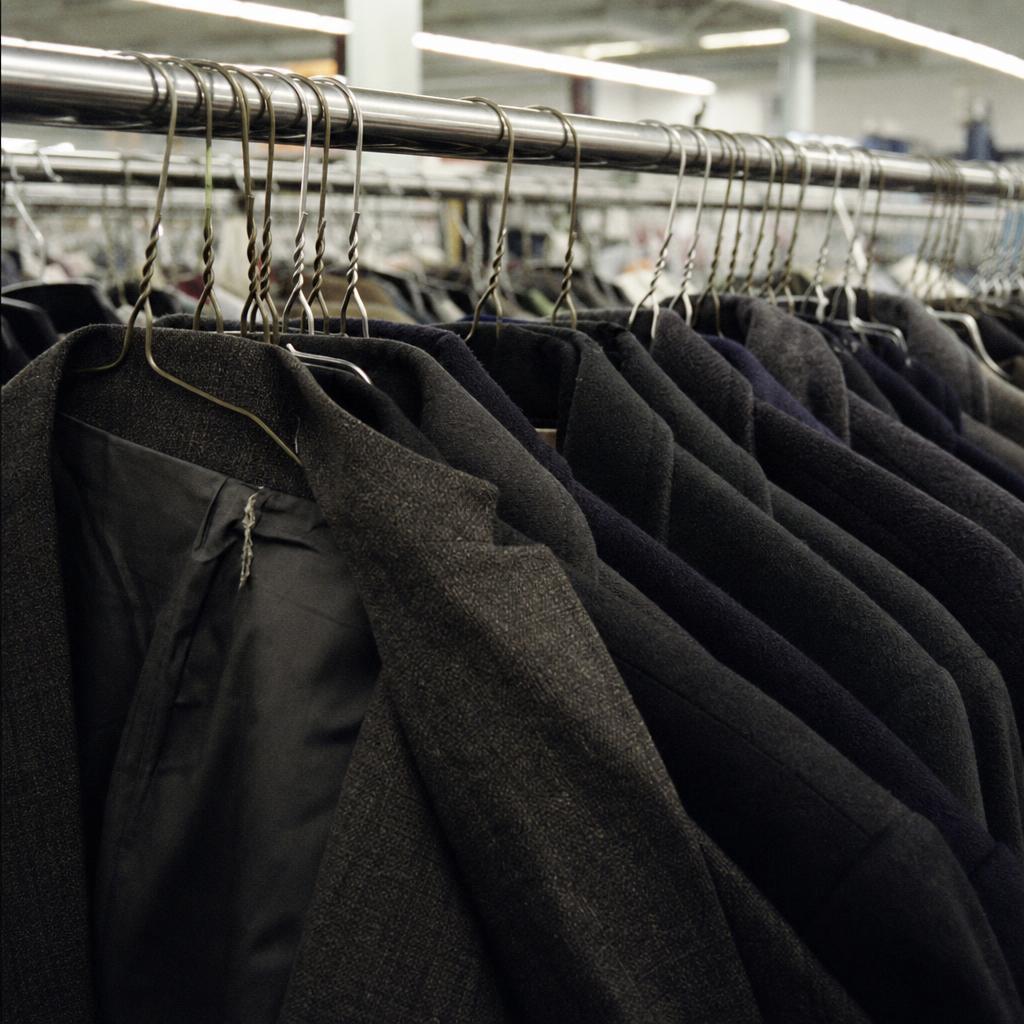
The same trained eye that read a Back Room blazer for its maker without a label read every other garment on the Fordham Road corridor the same way, coat included. The best coat a Bronx editorial assistant owned in her first winter at a Midtown magazine came off a sale rack on the same strip for sixty dollars: a single-breasted, knee-length coat in a wool-and-polyester blend rather than pure wool, its buttons a good-quality plastic shaped and tinted to pass for horn. On the terrazzo of the office lobby, under the doorman’s eye, the coat announced itself before its wearer said a word. Pure wool held its own weight and broke at the shoulder in a soft, continuous line; a fifty-fifty wool-poly blend carried a faint synthetic sheen under the lobby’s fluorescent tubes, resisted the body’s movement by a fraction most people could not have named, and hung a half-inch stiffer at the hem. None of it was a flaw exactly. It was arithmetic wearing a collar.
Fordham Road ran east–west through the central Bronx, from Jerome Avenue past the Grand Concourse to Webster Avenue, and by the end of the 1980s it carried the largest concentration of retail in the borough and the third-busiest commercial strip in the city — nearly three hundred stores, chain and independent, stacked along a corridor a few blocks long.2 Two other stores on that stretch supplied a coat like the assistant’s. Alexander’s, founded in the Bronx in 1928 by George Farkas and operating from Fordham Road and the Grand Concourse since 1933, built its business on discounted name-brand and private-label clothing pitched at a comfortable, non-wealthy customer.3 Burlington Coat Factory, farther east on the same corridor near Webster Avenue, did what its name promised: coats, at volume, well under department-store price. A coat from either store, in the wool-poly blend that both carried in quantity because it was what a sixty-to-eighty-dollar price point could hold, was warm, presentable, and legible on sight to anyone trained to read it.
The coat rarely came from the assistant’s own paycheck. More often it arrived as a gift — bought, in a case like this one, by a mother whose wages as a registered nurse at Lincoln Hospital, the public hospital in the South Bronx, ran several multiples of her daughter’s own starting salary and still fell short of a coat cut from finished wool. The gap between what a good salary bought and what a great one bought was not large in absolute dollars. It showed up instead in a button, a lining, a seam allowance — in the difference between a coat built to be replaced next season and one built to be let out at the shoulder a decade later.
The tells sat below the level anyone would name aloud. A department-store coat’s lining was silk or a silk-weight acetate that slid cool against a wrist; the wool-poly coat’s lining was a plainer, warmer-feeling acetate that caught faintly instead. Its interfacing — the buried structure that gives a lapel its roll — was fusible, glued rather than sewn in, which held its shape at first and then, after a season or two of dry cleaning, went slightly boardy at the collar in a way a canvas-interfaced coat never did. The seam allowances ran narrow, sized for a garment expected to be worn out rather than let out, where a coat cut to be altered across a decade left an inch of spare cloth folded invisibly inside every seam. None of it showed in a photograph. All of it showed on a body, over years, to the small number of people already trained to look. An editorial assistant crossing a lobby in November had already been read, by the time she reached the elevator, by people who could not have said what exactly they had noticed.
The Back Room Economy
Loehmann’s, on the same Fordham Road corridor, ran on a different logic than Alexander’s or Burlington: not name-brand at a discount, but designer merchandise at the deepest markdown the trade allowed, sorted by a customer’s own eye rather than by a label. The main floor carried the era’s bridge-designer names in current sizes — Kasper, Evan Picone, Jones New York, Liz Claiborne, Ellen Tracy — the working wardrobe of the professional woman who could not afford full retail but needed to look as though she had not needed to ask. The Back Room, at the far end of the store, held the broken lots and off-season overstock described above, at the same 65-to-75-percent markdowns.4 What the Back Room did not offer was certainty about a garment’s origin — the customer who wanted to know what she was buying had to know it from the cloth itself, the weight, the drape, the finish of a seam, rather than from a name sewn into the collar.
That was the calculus an editorial assistant on a starting salary worked through on a Saturday afternoon. Meridian’s own entry tier paid in the high teens to the low twenties of thousands of dollars a year, a figure well known on the floor because everyone on it had once been paid the same. A blazer off the main floor, sixty to a hundred dollars; a matching skirt, twenty-five to forty-five; a blouse in a poly-silk charmeuse that read, from three feet away, like the real thing, twenty to thirty-five — a complete first-day outfit for something under two hundred dollars, a sum that still represented a real fraction of a month’s take-home pay. The purchase was not a failure of taste. It was a demonstration of exactly how much literacy a limited budget could buy: dark, clean-lined, unfussy, correct in every register a stranger could name and off by a set of details only the room’s most practiced readers would register at all — the plastic standing in for horn, the rayon lining that caught faintly against the skin where silk would have slid.
The Sound on the Terrazzo
The coat was only the first test. A woman commuting from the Bronx by subway in 1989 did not ride in the shoes she planned to wear at her desk — she rode in sneakers and carried the real pair in a bag, a practice with a specific origin in the 1980 transit strike, when professional women who had to walk to work discovered that heels and pavement did not mix, and that survived the decade as both a practical habit and an unmistakable class signal.5 The sneaker of choice for a woman commuting to an office job was the Reebok Freestyle, introduced in 1982 as the first athletic shoe designed and marketed specifically for women and, within two years, the shoe responsible for more than half of Reebok’s sales.6 She changed in the ladies’ room before nine.
What she changed into sorted the floor as precisely as the coat had. At the top of the tier sat Salvatore Ferragamo’s Vara pump, designed by the house’s Fiamma Ferragamo and introduced in 1978 — Italian calfskin, a grosgrain bow, a low stacked heel, and a leather sole that struck the terrazzo with a clean, solid report.7 Joan & David, whose flagship stood on West Fifty-eighth Street, ran a comparable register: the house had reached $100 million in revenue by 1986 and taken a Golden Shoe industry award in 1989, and its more accessible “Too” line brought a version of the same construction within closer reach.8 An assistant on a starting salary bought neither. She bought Nine West — a company that had opened for business in 1978, took its name from a Manhattan showroom address, and by 1989 was the default shoe of the career woman on a budget, its own “9 to 5” pump line named for exactly that customer.9 Nine West uppers were genuine leather, thin and corrected-grain rather than full-grain, over synthetic soles and linings; from three feet away the shoe read as correct, at forty-five to sixty dollars a pair. Underfoot it made a slightly hollower, more plasticky sound against stone than a Ferragamo did, a difference most people in a lobby would never consciously register and everyone in a lobby unconsciously heard. Beneath Nine West sat Payless ShoeSource, at twelve to twenty dollars a pair, and Fayva, the self-service chain whose parent company closed all 357 of its stores in October 1995 — both built from vinyl and polyurethane “man-made materials,” glued rather than stitched to a composite sole, a construction that could approximate a heel’s shape in molded plastic but could not approximate its sound.10 Leather aged by wearing softer, taking a patina at the toe and heel that read, to a trained eye, as evidence of money spent some time ago rather than money spent that month; vinyl aged by cracking, a network of fine white lines at the flex points that no amount of polish disguised. A floor that had never discussed the matter aloud could nonetheless place almost anyone on it by the click, or the clack, of her own arrival.
The Uniform That Announced Nothing
Set against all of this was the wardrobe worn by the senior women a few years and several pay grades further up the same floor: a uniform of matte wool crepe in navy, oatmeal, and black, cut close and left bare of ornament, hardware, or a visible label — Calvin Klein at home, Jil Sander arriving from Hamburg, Helmut Lang from Vienna, all working the same austere register at roughly the same moment.11 The recession that settled over the city’s ad pages and hiring lines by 1990 made visible spending bad manners on an editorial floor watching its own well shrink; a loud wardrobe read as ostentation at a moment of hiring freezes. The epidemic sitting under the whole decade did comparable work from a different direction: a mood that had produced shoulder pads and sequins in the middle 1980s no longer suited a floor that had, by 1989, been losing colleagues to it for years, and severity read, in that light, less like fashion than like an appropriate quiet. Between the two pressures, austerity became the era’s most expensive proposition — a wardrobe that announced nothing cost as much as one that announced everything, and the ability to read the difference sorted the room as surely as any label.
None of it was cheap. A Jil Sander or Helmut Lang piece ran to the same four-figure sums as the loudest thing it was replacing — not because the cloth itself cost dramatically more than a good wool-poly blend, but because the cut depended on hand-finishing a machine could not approximate, an economics as exact, in its own register, as anything working out of a Back Room. The austerity was a taste that had to be bought, not merely adopted, and a senior editor’s salary — several multiples of an assistant’s — was the price of admission to a look that cost nothing to describe and a great deal to wear. An editorial assistant on Fordham Road prices and a senior editor in unmarked wool crepe were, from across a conference room, dressed in something like the same idea: dark, quiet, unornamented. The idea cost each of them a different fraction of a different income — a small share of the senior editor’s salary, most of a week’s pay for the assistant.
The Imported Difference
A third register arrived on the same floor from a different direction entirely. A British-Iranian photographer working the same corridors in the same years dressed by a set of rules that owed nothing to Fordham Road’s economics or to Sander’s austerity, because they had been formed somewhere else. Where the American office ran to a single, matched garment — one blazer, one dress, chosen to cohere — British creative dressing of the period ran to layers that did not match on purpose: a T-shirt under a button-down under a cardigan, a scarf added or left off as the day’s weather required, the whole effect deliberately unfinished in a way that read as sloppy to an American editor and correct to a London one. On her feet, in place of a pump, she wore Doc Martens — the eight-hole 1460 boot, first produced in April 1960 and still, in a Manhattan magazine office in 1989, an instant marker of somewhere else; American mass adoption of the boot was still several years off.12 Over it all, in place of a blazer, she wore a Barbour Beaufort, the waxed-cotton field jacket the house’s chairman had designed in 1983, its corduroy collar and tartan lining showing at the throat where an American colleague wore a peacoat or a North Face shell instead.13
Her trousers, in high-waisted wool or dark denim, came closer to Margaret Howell’s clean, natural-fabric tailoring than to anything sold on a Midtown floor, and her working bag was as likely to be a Billingham — a British firm that had built fishing bags before 1978, when a New York photographer’s steady orders turned its production over almost entirely to camera bags — as a leather satchel.14 The single most legible marker sat closer to her throat: a small gold Faravahar, the winged disk of pre-Islamic Zoroastrian Iran, worn as an assertion of heritage that carried no religious content and needed none — a form of identification the Iranian diaspora in Britain had made into its own quiet vocabulary of belonging, worn daily and without explanation.15 Beside it, on a good day, a single oval of turquoise from the mines at Nishapur, in a setting of gold warmer in tone than the fourteen-karat American standard; around her eyes, kohl rather than the precise liquid line an American colleague wore, and eyebrows shaped rather than plucked thin. No single piece alone drew a second look. Together, on one body, walking past desks dressed in Sander’s austerity or Loehmann’s approximation of Armani, they read at a glance as an import — a set of choices formed by a design culture the American floor was watching from outside — the same culture that had named a Turkish-born, London-trained designer, Rifat Ozbek, its British Designer of the Year in 1988, evidence that the culture producing her wardrobe was, on its own ground, in no way peripheral.16 None of it answered the same question the coat and the crepe answered. A colleague could price the assistant’s blazer and admire the senior editor’s restraint by the same local grammar of cost and literacy, and still have no comparable way to read the boots, the wax jacket, or the pendant — objects formed by a different country’s grammar entirely, arriving on the floor with no locally agreed price.
None of these three wardrobes cost the same amount, and none of the women wearing them earned the same salary, but each was fluent in the same test: what a garment’s surface admitted and withheld about the income and the education behind it. The sixty-dollar coat and the four-figure wool crepe answered the same question in opposite currencies — one converting a small budget into the maximum legibility it could buy, the other converting a large one into the appearance of having spent nothing at all — while a wardrobe built somewhere outside either economy sailed past the test’s terms entirely, legible as difference before it was legible as class. A magazine floor that prided itself on reading the world closely was, every morning, reading itself first, in a language written in stitching most of its readers would never be shown.
The closing of a chain like Fayva — all 357 of its stores shuttered at once in the fall of 1995 — would have arrived on the articles desk as a clean, well-sourced item and would have gone nowhere past it. The facts would have checked out easily enough: a parent company folding a discount shoe division in a single stroke, a floor at the bottom of a ladder that ran, above it, through Payless, then Nine West, then the department-store tier proper. What the item would have lacked was a reader anyone on the floor could have named. A bankruptcy filing that far down the retail chain would have read as a trade-press matter — the kind of story that belonged, if it belonged anywhere, to a shoe-industry newsletter rather than to a general-interest monthly with a well to fill and a readership that had never set foot in a Fayva. An editor turning the item over would have found no fault in the reporting and no obvious way to make a reader who shopped several tiers above Fayva care where its stores had gone. It would have been set aside rather than argued over, the kind of kill that would have needed no meeting and produced no memo, and by the following week’s stand-up no one would have raised it again.
Footnotes
-
The label-cutting practice at Loehmann’s, standard by the 1980s and continuing into the early 1990s, is documented in period retrospectives of the chain’s Back Room culture, including Tablet Magazine’s “Dress for Less: The Golden Age of Discount Fashion.” ↩ ↩2 ↩3
-
“Fordham, the Bronx: What to Do, See and More in the Borough’s Largest Shopping District,” amNewYork, 2019. ↩
-
“Alexander’s, Inc.,” International Directory of Company Histories, vol. 45 (St. James Press, 2002). ↩
-
“Loehmann’s Inc.,” International Directory of Company Histories, vol. 24 (St. James Press, 1999) — 1988 sale of 77 stores at $334 million in annual sales; the 1988 leveraged buyout by an affiliate of Entrecanales y Tavora S.A. and a Donaldson, Lufkin & Jenrette venture-capital arm for $170 million; 82 stores operating by year’s end; the Fordham Road store’s 1988 conversion of a former roller-skating rink into a 35,000-square-foot flagship, the chain’s largest. ↩ ↩2
-
The subway-sneaker, office-pump commuting practice, traceable to the 1980 New York City transit strike, is dramatized in the opening of Working Girl (1988, dir. Mike Nichols, costumes by Ann Roth). ↩
-
“From Aerobics to Hip-Hop Lyrics: How the Reebok Freestyle Became the 5411,” Highsnobiety, 2020 — introduced 1982 as the first athletic shoe marketed specifically to women; more than half of Reebok’s sales by 1984. ↩
-
“Vara Bow Pump Shoe,” Salvatore Ferragamo company archive, ferragamo.com — the Vara, designed by Fiamma Ferragamo, introduced 1978. ↩
-
“Joan & David,” Encyclopedia of Fashion (Fashion Encyclopedia, Advameg, Inc.) — $100 million in annual revenue by 1986; Golden Shoe industry award, 1989; flagship store, West 58th Street, New York. ↩
-
“History of Nine West Group, Inc.,” International Directory of Company Histories (FundingUniverse) — Fisher Camuto Corporation incorporated 1977–78, named for a showroom at 9 West 57th Street, Manhattan; the “9 to 5” pump line. ↩
-
“Fayva Family Shoes to Close All Its Stores,” Tampa Bay Times (formerly St. Petersburg Times), October 27, 1995 — parent company J. Baker Inc. closed 357 Fayva stores. ↩
-
Teri Agins, The End of Fashion: How Marketing Changed the Clothing Business Forever (William Morrow, 1999), on the recession-era rise of Calvin Klein, Jil Sander, and Helmut Lang’s minimalist register. ↩
-
“The History of Dr. Martens,” Dr. Martens company archive, drmartens.com — the 1460 eight-hole boot, launched April 1, 1960. ↩
-
“A Look at the Iconic Barbour Beaufort Jacket,” Barbour company archive, barbour.com — designed by chairman Dame Margaret Barbour, 1983. ↩
-
“50 Years of Billingham Bags: The Story,” Amateur Photographer, reproduced at billingham.co.uk — founded 1973 in Cradley Heath, England, as a maker of fishing bags; production turned over almost entirely to camera bags after 1978 following sustained orders from a New York photographer. ↩
-
On the Faravahar as a secular emblem of pre-Islamic Iranian identity widely adopted in the post-1979 diaspora, see “Faravahar,” Wikipedia. ↩
-
British Fashion Council, British Fashion Awards winners archive — Rifat Ozbek, Turkish-born and trained at Central Saint Martins, named British Designer of the Year, 1988. ↩