The Korean Greengrocer and the Red Apple Boycott, 1990
Subscribe
https://meridian-archive.com/feed.xmlOpen in your app, or paste the link above into any other:
The Collateral
At four in the morning, at the Hunts Point produce terminal in the South Bronx, infants slept in the cabs of parked pickup trucks while their fathers moved through the warehouse aisles under sodium-vapor light, checking the underside of berry flats for rot. No institution in New York City had built child care for that hour, so the children came to the terminal instead, in the truck, in the cold, and slept through it.1 The men doing the buying — by 1990, an estimated ninety-five percent of the immigrants who came to own a Korean greengrocery in the city — held a four-year degree from a Korean university.2 They had been engineers, foresters, bank tellers, teachers. None of it transferred. Kyung T. Sohn had graduated in forestry from a Korean university in 1968 and could not find forestry work in the United States; in 1975 he took $5,000 borrowed from his brother and bought out a retiring Italian grocer in the northern Bronx, among the first Korean greengrocers in the city.2 The store did not ask to see his diploma.
The $5,000 did not come from a bank. Mainstream banks would not lend to immigrants with no American credit history and no English fluency, so the capital moved instead through the kye, a rotating credit circle centuries older than the storefronts it now financed: members paid a fixed sum into a common pot on a fixed schedule, and each, once per cycle, took the entire pot home. No promissory note. No interest rate. Nothing the Internal Revenue Service or an American bank could read. The instrument that financed a produce store on a New York City corner in 1990 was enforced exactly as it had been enforced in pre-modern Korean villages: a member who defaulted was not sent to collections. He was expelled from the circle of people who had trusted him, and the expulsion, not any court, was the whole of the penalty.2
The Korean government progressively relaxed export-capital restrictions as the decade advanced — the South Korean government understood that its emigrants were generating remittances and creating value abroad. The $1,000 limit that had held through the 1970s was raised to $3,000 in 1979; by the mid-1980s, $100,000 was permitted; by 1990, $200,000.2 The Immigration and Nationality Act of 1965 — Hart-Celler — had dismantled the national-origin quota system that, for the previous forty years, had in practice capped Korean entry to the United States at a few hundred persons a year; the wave that followed crested through the late 1970s and into the early 1990s, and by 1990 approximately one hundred thousand Korean immigrants lived in the New York metropolitan area, a population that had not existed in measurable numbers a generation earlier.2 The equation closed: $5,000 to $25,000 in startup capital, financing through kye, government permission to export that capital, and a market of neighborhood storefronts in New York that had been empty for five years. The niche that opened, by economic logic rather than any plan, was the one where capital was smallest, English was not required for the transaction, and no credential validation occurred at the point of entry: the neighborhood grocery in the kind of neighborhood the supermarket chains had walked out of by the late 1970s.
The Niche
The American supermarket chain — A&P, Key Food, Associated, PathMark — operated on economics that made low-income neighborhoods unprofitable by the late 1970s. High theft rates, insurance costs, union labor obligations, and per-square-foot income too thin to support the overhead made them untenable. The chains withdrew, store by store, across the 1960s and 1970s, from Harlem, Flatbush, Brownsville, and the South Bronx. What they abandoned was the sole source of fresh produce for millions of New Yorkers. The Italian, Jewish, and Puerto Rican shopkeepers who had held neighborhood retail through the 1950s and 1960s — the independent grocers and bodegas — departed with the chains. They had held onto the storefronts through the early 1970s, absorbed the rising crime and the rising insurance, and eventually exhausted their tolerance for sixteen-hour days for thin margins. By 1980, the storefronts were empty.
The Korean merchant’s entry cost was negligible by grocery standards. A lease, a truck, first stock, salvaged shelving: $5,000 in the poorest neighborhoods (the Bronx), $15,000 in a corridor like Church Avenue in Flatbush, $25,000 in a more competitive area. No franchise fees. No licensing exam. No English required at the Hunts Point wholesale market where the owner purchased twice a week. The neighborhood calibration was economically rational. The owner did not plan to know his customer; he learned by attrition. In Flatbush in 1990, the customer base was Haitian, Jamaican, and Caribbean; within a month the owner carried plantains, yuca, Scotch bonnet peppers, ackee, the items the customer base purchased. In Washington Heights it was Dominican ingredients — sofrito components, cilantro, ajicito. In Harlem a different set. The owner often could not name what he was selling in English or Spanish. He knew what moved and what did not. The store configured itself to its geography. This was not benevolence — it was the only viable business model.3
The Store
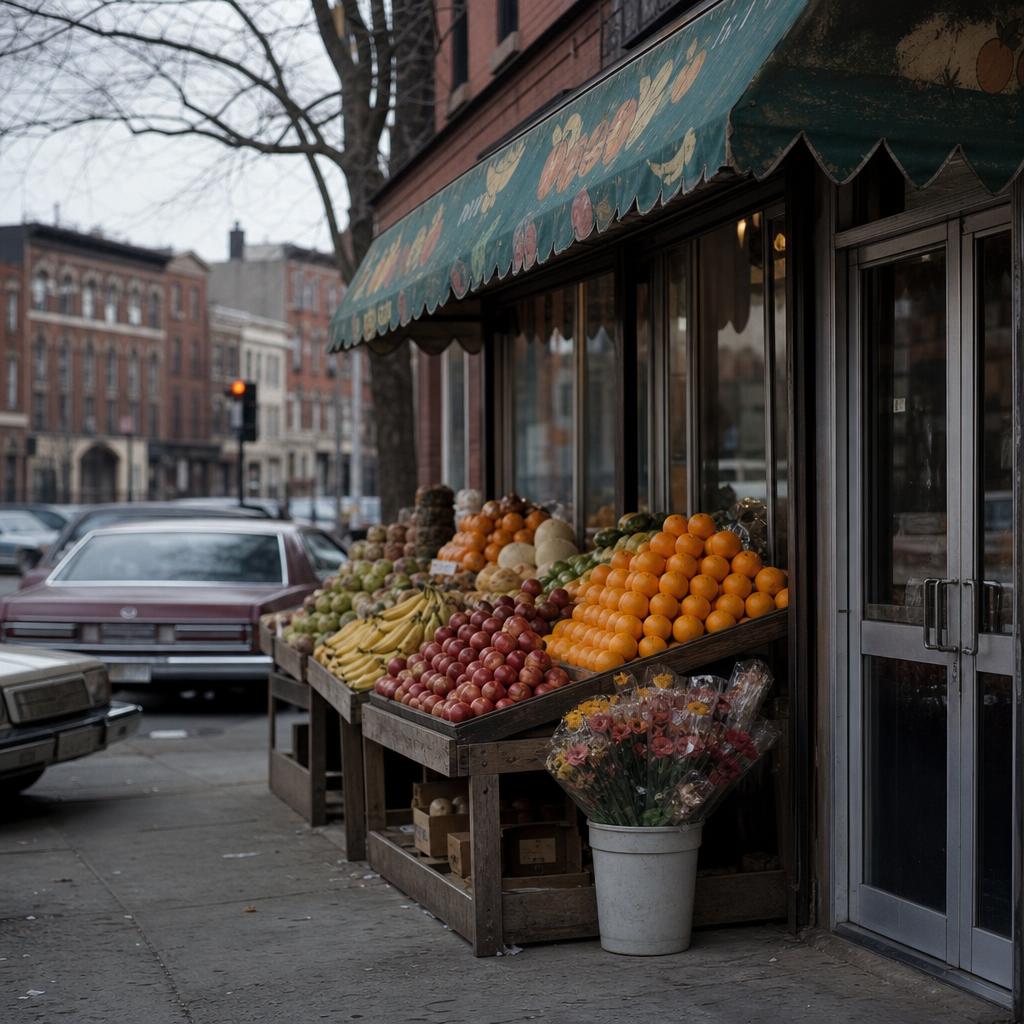
The physical grammar of the Korean greengrocer was instantly legible by 1985 and remained stable through the decade. Sidewalk: produce pyramids on sloped wooden display tables extending to the curb — apples, oranges, bananas, whatever was in season or on promotional — and standing buckets of cut flowers. A hand-lettered price board. The sidewalk display announced the store a block away and served as advertisement and commercial presence simultaneously. Interior: refrigerated cases along the back wall for dairy and eggs; produce in wooden bins and tiered shelving, often improvised from salvage; fluorescent lighting; a scale at the counter; the register staffed continuously, usually by the owner’s wife. The hours were 7 AM to midnight at minimum; many stores operated 24 hours. The owner — usually the husband — was on the floor for all or most of that time, or absent during the Hunts Point run, leaving the store to his wife and children.
The Hunts Point run was the physical anchor of the store’s supply chain. The owner woke at 2 or 3 AM to drive to the produce terminal in the South Bronx. He selected and loaded stock for two to three hours — moving through the warehouse, checking the bottom layer of flats for soft fruit, stacking what was good, setting the rest back — then returned to open the store by 7. He did this every day. Not most days. Every day, Sundays included, Christmas included.1 The family labor model that made the store viable operated at total-immersion scale. The wife at the register. The husband at Hunts Point, then on the floor. Children after school, on weekends, in the summer. A single employee outside the family was a luxury; two was unusual in a small store. No payroll taxes. No health insurance beyond the family. Margins on fresh produce ran approximately 20–30% on high-turnover items, supplemented by flowers (higher margin), and increasingly by the mid-1980s by deli counters and hot food bars — self-service salad bars, steam tables with rice and beans. The store was essentially a machine for converting time and labor into enough income to service the lease, the truck payments, and the household expenses. By 1990, the Korean Produce Association reported approximately 3,000 member stores in the New York–New Jersey metropolitan area. The institution was dominant.
The Configuration
The Korean merchant occupied a specific structural position: he operated in Black and Caribbean neighborhoods, employed almost exclusively family members (no neighborhood residents), and remitted profits to Korean households in Queens, Flushing, or elsewhere. The money extracted from the neighborhood largely did not stay in it. This structural position was not unique to Korean merchants — Jewish-owned stores had occupied the same position in Harlem and Bedford-Stuyvesant through the 1960s, Italian bodegas before them. The Korean succession was economic succession, not deliberate displacement. The Koreans did not displace the Italians and Jews. They inherited the leases after the chains departed and the previous owners exhausted their tolerance.4
From the customer’s perspective, the catalog of grievances was legible and documented. Prices perceived as higher than in white neighborhoods. Perceived rudeness: owners who did not look customers in the eye when making change, who did not speak conversational English, who did not chat. The owner visibly watching Black customers closely, a form of suspicion. No credit for regulars, compared to the old neighborhood relationships with Italian or Jewish storekeepers who sometimes knew customers by name and extended informal credit. No hiring of neighborhood residents — the family labor model was read as deliberate exclusion. From the merchant’s perspective, the reality was equally legible and equally documented: high theft rates in the neighborhoods where stores were located, physical danger to the owner and the family, robbery and assault at significant rates. Cultural unfamiliarity: the Korean custom of placing change on the counter rather than in the customer’s hand was read as disrespect; it was in fact a Korean custom about not touching strangers. The store was operating in a business environment entirely unlike what family members had known in Seoul or Pusan. Customer and merchant both legitimate. Both untranslatable. The situation was one that no quantity of politeness or education could resolve.5
Family Red Apple
On January 18, 1990, a Haitian immigrant woman named Giselaine Felissaint entered Family Red Apple Market at 1823 Church Avenue in Flatbush, Brooklyn, to purchase produce. The accounts of what occurred next diverged. Felissaint’s version: she was physically searched, then struck by three employees. The store manager, Bong Ok, offered a different sequence: Felissaint bought $3 worth of merchandise — plantains and limes — and gave his cashier wife only $2. When asked to pay the full amount, Felissaint spat in his wife’s face, threw peppers at her, and cursed. Store employees moved to restrain her; merchandise was thrown. The NYPD’s Deputy Inspector Robert Noonan, arriving from the 70th Precinct, documented that Felissaint had received no serious physical injury — only a scratch on her face. What was not disputed: there was a physical altercation, Felissaint left injured enough to seek medical attention, police were called, no arrests were made on January 18. The incident might have ended there, as neighborhood conflicts often did.
Instead, within days, picket lines formed outside Family Red Apple. The organizing was initially spontaneous, then rapidly formalized under Robert “Sonny” Carson and the December 12th Movement, a coalition of Black activists organized around direct action. The friction had a decade of documented history in the city’s Black press — in 1981 the Amsterdam News ran a piece headlined “Koreans Dash for Harlem Cash”6 — and Carson had run previous anti-Korean-merchant campaigns: 1982 on Harlem’s 125th Street, 1984 a yearlong boycott of West 125th Street Asian-owned stores, 1988 the Korean-owned Tropic Market in Bedford-Stuyvesant. Church Avenue was a reprise. The December 12th Movement had earned its name from December 12, 1988, when demonstrators stormed the Brooklyn Bridge, the “Day of Outrage,” leaving 44 police officers injured. The movement specialized in sustained, high-visibility direct action.
The boycott line at Family Red Apple was not a mob — perhaps eight to twelve protesters daily, a bullhorn, handwritten signs, chants that repeated with the rhythm of routine, “Koreans go home” among them. The store visible through the window, gradually darkening, income collapsing. Before the boycott, the store did approximately $1,500/day in sales. By mid-May 1990 — four months in — daily sales had fallen to as low as $10.7 The store was economically closed. The boycott extended almost immediately to Church Fruit and Vegetable across the street at 1820 Church Avenue. The demands were arrests of store employees, an apology from store management, and compensation to Felissaint — and in broader framing, Korean merchants leaving the community entirely. Community control of neighborhood commerce. This last was not a demand that could be met or negotiated. It was a structural claim about who should control the economic life of a neighborhood.8 The Korean Produce Association contributed approximately $8,000/month to keep the targeted stores economically viable while the boycott continued.7 They could not offset the lost revenue, but they could keep the stores from immediate bankruptcy. This support continued for the duration.
The friction had spilled past the picket line by then: that spring, a boycott participant had struck a Vietnamese man with a claw hammer.9 By August 1990, eight months into the boycott, the NYPD discovered 18 Molotov cocktails on rooftops near the store.10 Carson had publicly stated, in language reported in the newspapers, “In the future, there will be funerals not boycotts.”9 Judge Gerald S. Held issued a court order in August barring demonstrators from picketing within 50 feet of the Korean stores. The NYPD declined to enforce it, calling it a civil matter, not a criminal one. Mayor David Dinkins did not override this decision. Dinkins had been elected in 1989 with overwhelming Black support, a coalition of Black, Latino, and liberal white voters. The boycott was organized by Black activists representing a Black and Caribbean constituency. To intervene against the boycott was to act against his political base. Dinkins stated, years later in his memoir: “I was criticized for not crossing the picket line and ending the boycott by example. I was prepared to mediate the dispute, but I suspected my presence would not have helped at that juncture. In this instance I believed that my participation would do more harm than good.”11 The court order sat unenforced. September passed. October passed.
On September 21, 1990 — eight months after the boycott began — Dinkins personally visited Family Red Apple and made a purchase, crossing the boycott line. Boycotters met him with curses. The Korean storeowner welcomed him. The New York Times editorial board, writing in late August about a separate Korean-merchant boycott in Brownsville, observed approvingly that the mayor had acted quickly on that one. The comparison was pointed. Dinkins had not acted quickly in January. The mayor’s delay had been noted. By May 1991, the original owner had relinquished the lease. A new Korean-American owner took over. A steady stream of customers resumed. The boycott had run for sixteen months.
No one designed this. The Korean grocer behind the register and the Haitian woman in front of it had not been put in the same room by anyone’s plan. The supermarket chains had pulled out of low-income Brooklyn a decade earlier on a calculation about insurance and theft, leaving a neighborhood with no other store within walking distance that sold plantains. The Italian and Jewish shopkeepers before the chains had worn out their tolerance for sixteen-hour days. The Korean families who came after them had arrived with credentials American employers would not recognize and capital raised through a savings circle American banks did not know existed. A court order had been issued and was not enforced. A mayor presided over a city whose two halves had both voted for him. The whole arrangement, by January 1990, was the product of perhaps a dozen separate decisions made in a dozen different rooms over thirty years — none made with the others in mind, none reversible by anyone now in any one of the rooms. It was nobody’s idea. It was, instead, one of the things the 1990s had inherited, accepted as given, and then required its sharpest observers to walk past.
The City would have carried the boycott by the calendar Dinkins himself supplied: eight months of a mayor declining to cross a picket line his own coalition had put him on, and then, in September, crossing it. A piece built on that arithmetic would have needed nothing the dailies hadn’t already established — Carson’s rhetoric, the arithmetic of the Church Avenue vote, the awkwardness of a court order nobody would enforce. It would have gone into the November close clean and defensible, and it would have been accurate about every fact it chose to include.
What it would have left out was argued over, more than once, without ever being closed. Somewhere in the building the case would have been made for the other version: what stood behind the counter and why, the kye that had financed it, the 3 a.m. drive to Hunts Point that no reporter on staff would ever have made. Nobody would have opposed the pitch outright. The trouble was narrower and more ordinary than opposition — no writer in the stable would have spent time on Church Avenue, and no freelancer in rotation would have either, and the gap would not have closed itself over a single editorial meeting or a second one. The conversation would have kept surfacing through the spring without anyone assigning it, and by the time the boycott ended in May of 1991 it would still not have been assigned.
Footnotes
-
The pre-dawn run and the family’s total-immersion hours, including the infants left in parked trucks at Hunts Point, are documented in the fieldwork of Kyeyoung Park, The Korean American Dream: Immigrants and Small Business in New York City (Cornell University Press, 1997); Park could reach owners for interviews only at ten at night. ↩ ↩2
-
Pyong Gap Min, Ethnic Solidarity for Economic Survival: Korean Greengrocers in New York City (Russell Sage Foundation, 2008). ↩ ↩2 ↩3 ↩4 ↩5
-
City Journal, “Where Did the Korean Greengrocers Go?” ↩
-
The political scientist Claire Jean Kim named this position “racial triangulation”: the Korean merchant was economically valorized as a model minority and civically ostracized at the same time — praised and excluded in one motion, held between the Black neighborhoods he served and the white economy he supplied. Claire Jean Kim, Bitter Fruit: The Politics of Black-Korean Conflict in New York City (Yale University Press, 2000). ↩
-
Christian Science Monitor, “New York’s Korean Grocery Turmoil Rooted in Cultural and Economic Conditions,” May 31, 1990. ↩
-
New York Amsterdam News, “Koreans Dash for Harlem Cash,” 1981; the paper’s own later characterization of the organized response it described was “anti-Korean hysteria.” ↩
-
Washington Post, “Embattled Korean Grocers Wait Out Racially Charged Boycott,” May 15, 1990. ↩ ↩2
-
UMB Trotter Review, “No Justice, No Peace: The Politics of Black-Korean Conflict.” ↩
-
Washington Post, “Blacks Continue Grocery Boycott,” October 1, 1990. ↩
-
David N. Dinkins, A Mayor’s Life: Governing New York’s Gorgeous Mosaic (Public Affairs, 2013). ↩