Transit: The MetroCard Transition, 1994–2001
Subscribe
https://meridian-archive.com/feed.xmlOpen in your app, or paste the link above into any other:
The Two Fares
For nearly a decade the system administered two currencies at once and called it routine. The MetroCard entered service on June 1, 1993, a test run of three thousand cards good only at the turnstiles of the Wall Street and Whitehall Street stations, and the Transit Authority did not retire the brass token to make room for it.1 It kept minting, banking, and reconciling both: the card spread turnstile bank by turnstile bank until the entire system accepted it on May 14, 1997, and the token remained on sale at every booth for six more years after that, sold and swiped and counted alongside the card until the Authority stopped selling it on April 13, 2003 and shut off the last reader that would still take one three weeks later.1 A rider approaching the same bank of turnstiles in 1994 chose which fare to spend that day — a coin dropped through a slot on the left, or a magnetic stripe drawn through a reader on the right — and either choice opened the same gate and closed the same books, two instruments of payment carried side by side for as long as it took to phase one of them out.
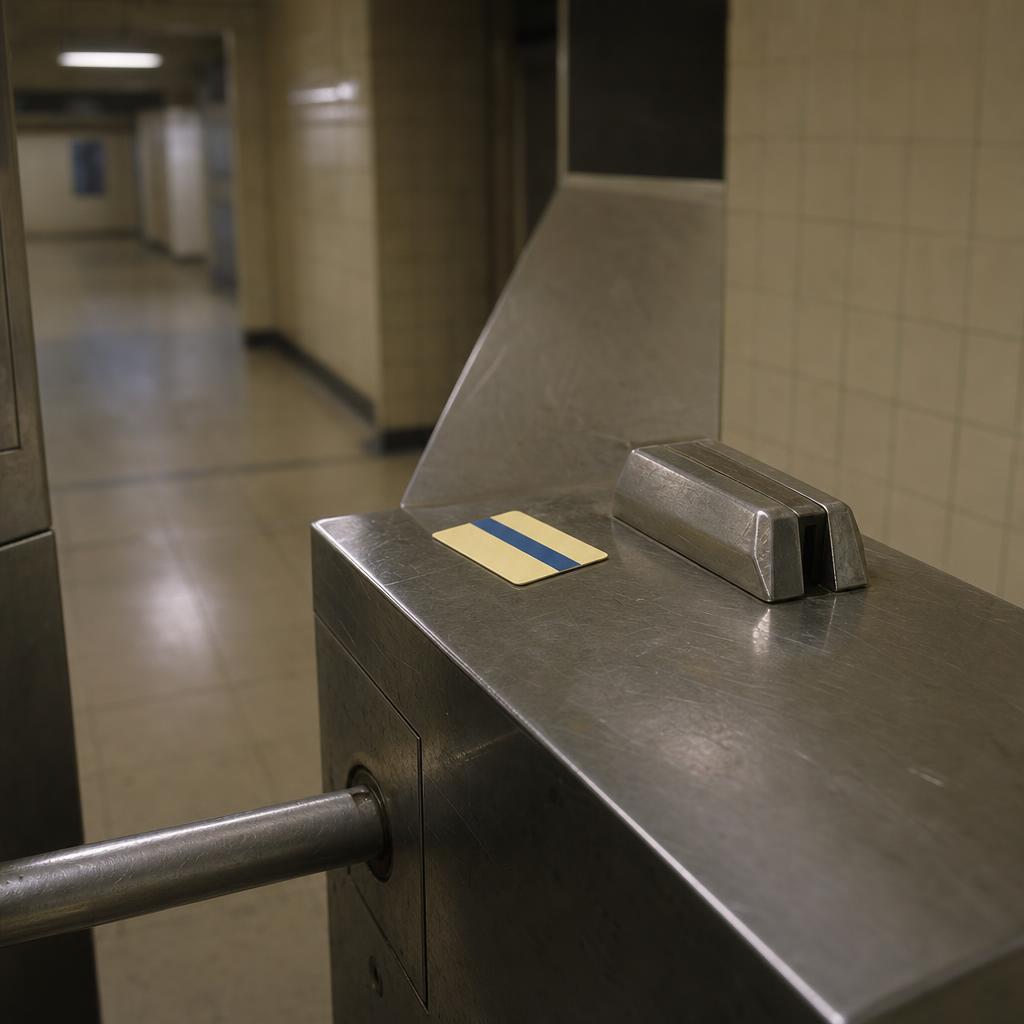
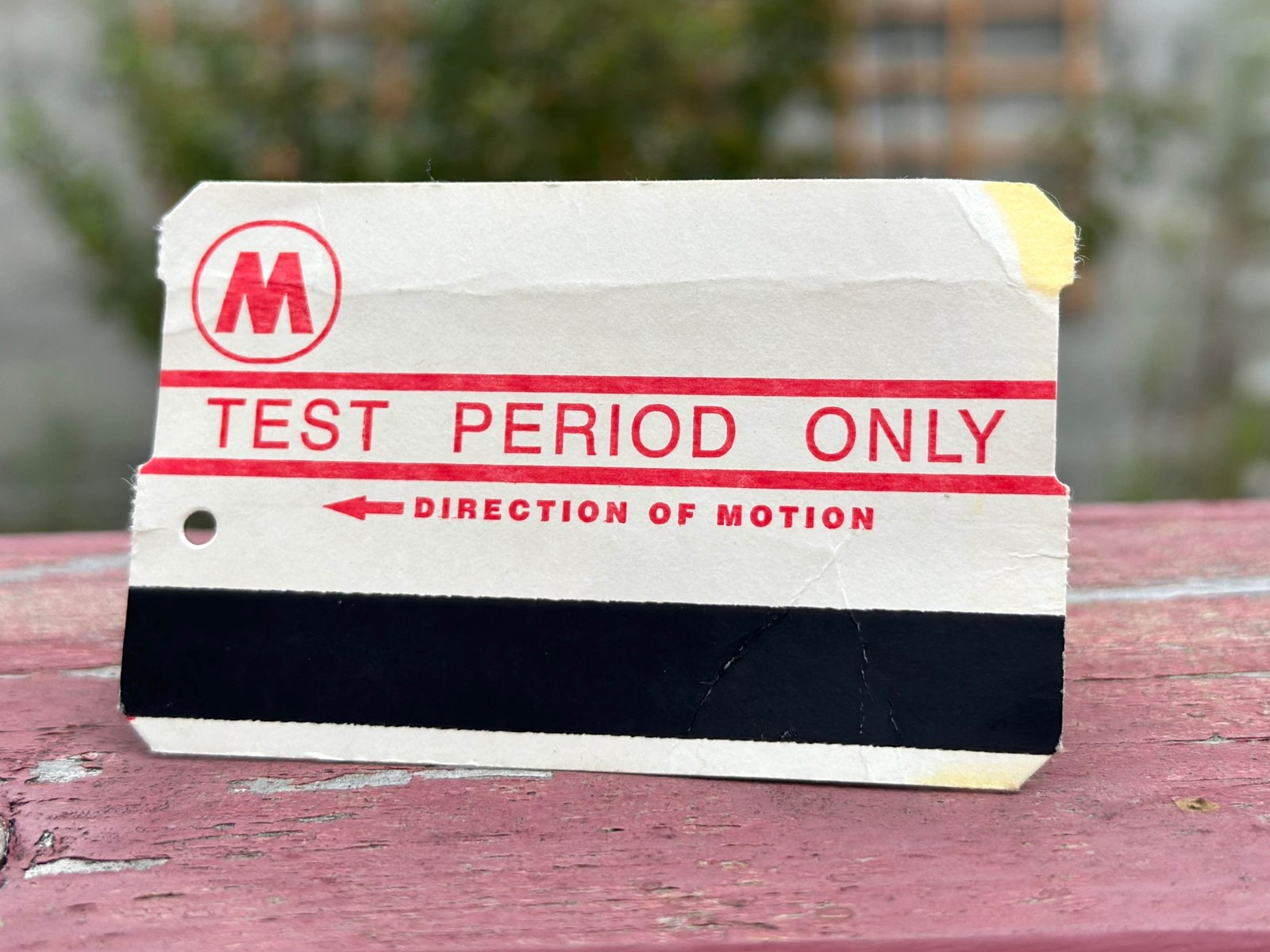
The token could not be performed incorrectly. It was dropped through a slot; it fell; the turnstile released. The MetroCard could be performed incorrectly, and through the second half of the 1990s most riders performed it incorrectly on a regular basis. The card was a plastic rectangle with a magnetic stripe across the back, and to pay a fare a rider drew it through a slot cut into the right side of the turnstile head at a speed the reader could parse — not too fast, not too slow, the stripe held flat against the housing, the dark band facing in. Too fast and the reader caught nothing. Too slow and it caught the same nothing. A card tilted in the hand read as a corrupted stripe. The turnstile answered on a small liquid-crystal panel — SWIPE AGAIN AT THIS TURNSTILE — and the rider swiped again, and behind him the line compressed. New Yorkers came to remember the whole business by a phrase the machines never quite displayed, please re-swipe: the card drawn through again, and again, the panel unchanged, the riders behind waiting.
The gesture had to be learned, and the learning was public. A New Yorker who had dropped a token into a slot ten thousand times held no transferable skill; the wrist that had mastered the drop had to master the draw, and it mastered the draw by failing at a turnstile during the morning rush with a dozen people waiting to pass. The failure fell unevenly. It fell on the riders whose hands were older and less certain; on riders newly arrived in the city, who were learning the machine in a second language alongside everything else they were learning; on anyone carrying a child or a bag or a coffee in the hand that the swipe needed free and level. The panel had a vocabulary for each way of getting it wrong — TOO FAST, SWIPE AGAIN, and, for a card already used, JUST USED — and the vocabulary was legible to everyone standing behind the person reading it. The token had asked nothing of the body but the willingness to let go. The card asked for competence and graded the answer in front of the line.
The transaction also went quiet. The token had made a sound — the brass falling on the brass in the collection box, the rotor’s ratchet dropping back — and the sound had been audible to the whole platform, a public register of a fare paid among everyone else paying it. The swipe made almost nothing: the friction of a stripe against a slot, a soft electronic tick from the reader, the arm giving way. A bank of turnstiles at rush hour had once been audible across the platform; now it worked in near silence. The clerk in the token booth, whose job had been to sell the brass and make the change and watch the station, gradually became the person who stood beside the vending machine explaining to a confused rider why the card had not read, until the day the booth stayed dark and the machine did the selling alone. When the card failed to read, no one behind the glass was left to help, and the rider who could not make it work had no one at the station to ask.
The Variable Fare
The token had one virtue the card spent years working around: a single legible price. A brass disc bought one ride and announced its cost by existing. The card carried stored value instead — a rider loaded several dollars onto the stripe and drew the balance down swipe by swipe — and from that one capacity a new fare structure followed. Beginning January 1, 1998, a purchase of fifteen dollars or more earned a bonus of ten percent, added to the card as extra fare.2 It was the first time in the system’s history that the price of a ride depended on how many rides a rider bought at once. The base fare, fixed at a dollar-fifty since November 12, 1995, stopped being a single number and became the top of a small schedule of discounts available to anyone able to pay in advance.2
The Unlimited Ride cards that arrived the following summer carried the logic to its end: a flat sum bought a fixed span of unmetered travel, and the fare per ride fell toward nothing as the rides accumulated.2 A rider who had counted every trip her whole life now swiped without counting, rode one stop, rode back, spent a marginal fare of zero. But the unlimited card had an entry price, and the entry price sorted its riders. The thirty-day card paid for itself after forty-two rides — a threshold a twice-daily commuter crossed before the third week of any month — and then ran free for the balance.2 It also demanded its full sum on the first day. A rider paid twice a month by direct deposit cleared that sum without watching it leave. A rider paid weekly in cash, at the end of a shift, could not always assemble it on a single day, and so kept paying by the ride — buying fares in the small amounts a thin week allowed, forgoing the bonus that rewarded buying in bulk, paying the higher per-ride price precisely because the lower one required capital up front. The free bus-to-subway transfer introduced with the card on July 4, 1997 had abolished the decades-old penalty on outer-borough commuters, the two-fare zone, and the card’s fare structure quietly installed a subtler one in its place.2 The instrument that discounted volume charged the least to those who could prepay and the most to those who could not.
The vending machine that spread through the stations at the end of the decade widened the gap it was meant to close. A machine took a credit card and loaded any amount instantly, so a rider with a card in a wallet bought a month of travel in ten seconds at the wall and walked to the platform. The card itself was finicky — the stripe wore with handling and demagnetized against the other cards in a wallet, and reloading value onto a worn card at a machine could take several passes before it took. A rider paying cash still counted bills into the machine’s slot for the fare a thin week allowed, and a rider without a bank card at all — a substantial share of the cash economy the magazine floor rarely priced — could reach only the fares that cash in hand could reach that day. The card had made buying in bulk cheaper and buying in bulk easier for exactly the riders who had never needed the discount, and had left the discount furthest from the reach of the riders who needed it most. The behavior changed accordingly. The prepaid rider swiped for a single stop without a thought, because the marginal cost was nothing; the pay-per-ride rider still weighed the stop against the dollar-fifty, because for her a dollar-fifty was money.
The Record
The token was anonymous. A dropped fare told the collection box only that a fare had been paid; the brass carried no memory and named no one. The card was not anonymous. Each MetroCard was assigned a unique serial number when it was manufactured, and each swipe wrote a line to a central database — which card, which turnstile, which station, what minute.3 The fare-collection system was built and run by Cubic Transportation Systems, a San Diego contractor that had won the work with the low bid of roughly one hundred million dollars and encoded the card’s data in a format proprietary enough that the Transit Authority could not fully read its own fares without the vendor.3 The token had told the system that someone had entered. The card told the system who, where, and when.
The memory had immediate operational uses. The unlimited card enforced a discipline the token never could: a card swiped once could not be swiped again at the same station or bus route for roughly eighteen minutes, the turnstile refusing the second attempt with JUST USED.3 The interval existed to stop one rider from passing an unlimited card back over the stiles to a companion; it worked by remembering the previous swipe and declining the next. A fare medium that could remember an entry could refuse an entry, and the same record that priced the ride could reconstruct, from the database, where a given card had been and at what time it had been there. The token economy had run on a coin the authority could not trace and could barely count. The card ran on a record the authority held in full, retained, and searched. The capacity was present in the system from its first swipe, encoded in the same magnetic stripe that carried the fare.3
None of this was the reason the card replaced the token. The card replaced the token because a magnetic stripe was cheaper to issue than brass, because a vending machine was cheaper than a clerk, and because a card that carried variable fares closed the workarounds a fixed coin had left open. The record was a byproduct — a thing the new instrument produced whether or not anyone had set out to produce it, held in a database whether or not anyone read it. The New Yorker learning to swipe in 1998 was learning a gesture. The gesture also wrote its line to the record.
The transition that mattered was not brass to plastic. It was the drop to the swipe — a fare a rider could get wrong, a fare that priced itself by how much a rider could pay in advance, a fare that remembered where it had been. The token had been a small anonymous coin at a single public price, and a whole platform had paid it the same way, in the open, with the same two-beat sound. The card asked each rider for a private competence, charged each rider a price set by the state of a bank account, and kept a copy of every entry. What replaced the coin was not simply a faster coin. It was an instrument that sorted the people who used it — by the steadiness of a hand, by the timing of a paycheck — and quietly filed what it learned. The city that came out the far side of the decade moved through its turnstiles a little faster than the city that went in, and it left behind it, rider by rider, the first thin record of its own passage.
Meridian’s City section would have found the fare-collection story reachable in its safer version: the Cubic bid, the vending machines arriving to do a clerk’s work, a public authority that could not fully read the format its own contractor had encoded. That version would have run in The City for the March close, sourced and clean.
The piece that would not have survived the room was the one about who the swipe cost most — the rider paying weekly in cash who could never front the thirty-day card’s sixty-three dollars on the first, and so would have kept paying the higher per-ride fare for lacking the capital that bought the lower one. An editor would have raised it and set it down again, for a reason nobody at the meeting would have named aloud. That spring’s well would have carried Citibank and Chase, whose branch machines the MTA’s own card readers stood beside at the turnstile bank, and a piece pricing the cash economy out of a discount those very banks made frictionless for anyone with a card in a wallet would have read, next to their spread, as an insult the meeting would not have set out to file. The granular arithmetic would have gone the way the safer version would already have claimed the assignment — folded into the story of a contractor and a vending machine — and the discount’s harder cost would have stayed off the page that spring.
Footnotes
-
“Subway as Social Equalizer” dossier, §5, MetroCard rollout timeline (Wikipedia, “MetroCard”; 6sqft.com, “History of the New York City MetroCard”; Gothamist, “Brief History of Subway Fares”). On the June 1, 1993 pilot at Wall Street/Whitehall Street, the May 14, 1997 systemwide acceptance date, and the April 13, 2003 / May 3, 2003 dates on which token sales and token use were discontinued. ↩ ↩2
-
Andrew J. Sparberg, From a Nickel to a Token: The Journey from Board of Transportation to MTA (Empire State Editions / Fordham University Press, 2014). Covers the MetroCard rollout, the pay-per-ride bonus, the free transfer of July 4, 1997, and the Unlimited Ride cards of July 4, 1998 ($17 and $63). ↩ ↩2 ↩3 ↩4 ↩5
-
Noah McClain, “Caught inside the black box: Criminalization, opaque technology, and the New York subway MetroCard,” The Information Society 35, no. 5 (2019): 260–277. On Cubic Transportation Systems’ proprietary fare-collection format, the per-swipe transaction record, and the anti-passback interval that the stored-value stripe made possible. ↩ ↩2 ↩3 ↩4