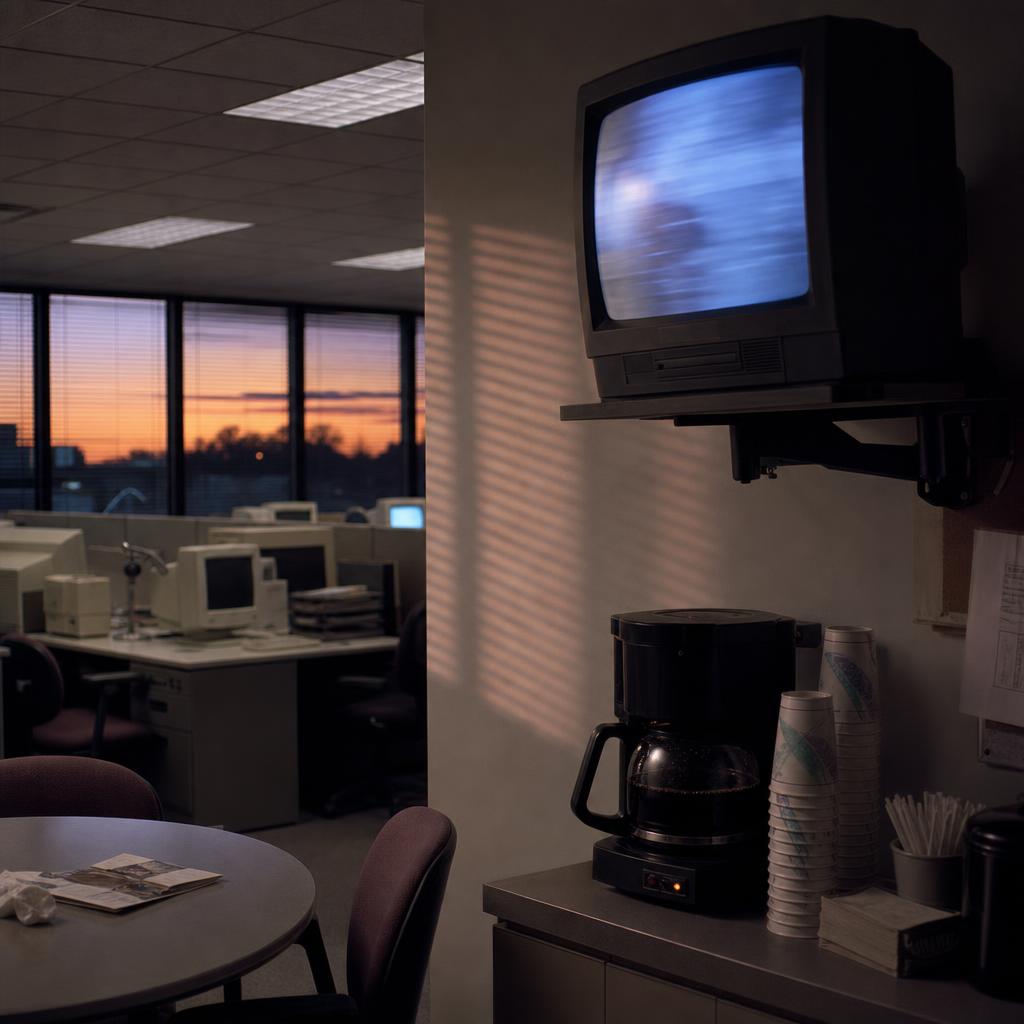
The Water Cooler, 1990–2001
Subscribe
https://meridian-archive.com/feed.xmlOpen in your app, or paste the link above into any other:
The Trial in the Time Slot
By 1995 an American murder trial could occupy a soap opera’s afternoon time slot as a matter of ordinary scheduling rather than special event: the broadcast networks broke into afternoon programming for testimony, the daytime dramas that normally held the hour were pre-empted outright, and a cable channel built for exactly this purpose ran the trial feed for hours a day to an audience that treated the witnesses and lawyers as a returning cast.1 That channel, Court TV, had gone on the air July 1, 1991, founded by the legal publisher Steven Brill and reaching roughly three million cable households at the start; within two years of the trial that made it, the same Nielsen count that ranked soap operas and game shows against one another ranked Court TV fourth among daytime cable audiences — a standing built substantially on a single defendant.1 The defendant was O. J. Simpson, and the trial that filled the slot followed a chase four months earlier that the medium had handled with a different, equally routine piece of broadcast machinery.
On the evening of June 17, 1994, NBC interrupted the fifth game of the NBA Finals to broadcast a white Ford Bronco traveling the speed limit up a Los Angeles freeway. The network cut away from the Houston Rockets and the New York Knicks with six minutes and thirty-nine seconds left in the first half, shrank the game into a box in the corner of the screen, muted the courtside commentary of Marv Albert and Matt Guokas, and handed the hour to the news division and Tom Brokaw.2 O. J. Simpson, wanted that afternoon in the murder of his former wife and her friend, sat in the back of the Bronco with a passport, a disguise, and a gun while a friend drove and the Los Angeles police followed at a distance rather than force the car to stop. The pursuit never exceeded ordinary highway speed. Simpson had been an NBC sideline reporter, which was part of why the network already had his face on file and part of why it treated the drive as its own story rather than a sports interruption.2
The audience assembled for it was later put near ninety-five million across the networks that carried it — a larger simultaneous audience than any scripted program of the year had drawn, gathered to watch a man do nothing but ride in a car that obeyed the traffic laws.2 What the chase demonstrated, before the trial or the verdict or the years of argument, was the plainest possible version of a fact the decade kept proving: at certain hours the whole country could still be found in front of the same screen at the same moment, and would still arrive at work the next day having watched the same thing.
The Morning After
The mechanism behind that simultaneity was not mysterious. Three broadcast networks reached most of American households through the first half of the period, and they organized the week into fixed and named hours, so that the country largely watched the same handful of programs and arrived at work the next day having watched them. The conversation that followed — at the coffee machine, in the elevator, across the desks of an office the first thing on a Monday — was the predictable product of a schedule that left few alternatives. A program that produced enough of that conversation was worth more to the network than its raw rating alone, because the talk recruited the next week’s audience for free.
The news side had demonstrated the principle before any finale did. On the night of January 16, 1991, the United Nations deadline for Iraq’s withdrawal from Kuwait having passed the day before, the bombing of Baghdad began in the middle of the American evening, and the country watched a war start on live television. The three broadcast networks lost their links out of the city in the first hours; CNN kept a working audio line, and its three correspondents in the Al-Rashid Hotel — Bernard Shaw, Peter Arnett, and John Holliman — described the anti-aircraft fire over the city, hour after hour, to what was reported as the largest audience the ten-year-old cable channel had ever held.3 The president’s address that night, and the raid coverage surrounding it, drew one of the largest simultaneous audiences of the period across all the channels that carried them. The next morning’s conversation was the same at every coffee machine in the country, and a cable channel that a decade earlier had been an Atlanta curiosity had supplied the pictures — the first entry in the decade’s ledger of hours when the whole country could be assumed to be watching the same thing, three years before the white Bronco.
The form reached its height at the finales. The last half hour of the decade’s most-watched bar comedy, broadcast May 20, 1993, drew a Nielsen audience near eighty million and closed out a Boston set on a night the trade press treated as a civic occasion.4 The two-part farewell to the decade’s most-watched comedy about nothing, on May 14, 1998, drew seventy-six million, a number no scripted program approached again before the century ended.5 Individual episodes could do it too, when the writing gave the audience a phrase to carry: the same comedy’s 1992 wager over abstinence, built entirely around a word its own network censors refused to clear, drew eighteen and a half million viewers and put a euphemism into every office by Thursday morning.6 The number was the currency the whole arrangement traded in, but the number was also a headcount of a shared experience, and the people who sold magazines against those same evenings understood both halves of it — a magazine competed with television for a reader’s attention and an advertiser’s budget, and it also depended, for its own morning-after relevance, on the reader having watched.
The Largest Shared Broadcasts, 1991–1998
Each audience below is Nielsen- or network-reported and sourced where its broadcast is discussed in the body.
| Broadcast | Date | Audience |
|---|---|---|
| Opening air raids on Baghdad, live coverage | Jan. 16–17, 1991 | tens of millions (all networks) |
| Cheers finale, “One for the Road” | May 20, 1993 | ~80 million |
| O. J. Simpson Bronco pursuit | June 17, 1994 | ~95 million (est., all networks) |
| O. J. Simpson trial verdict | October 3, 1995 | 150+ million |
| Ellen, “The Puppy Episode” | April 30, 1997 | ~42 million |
| Seinfeld finale | May 14, 1998 | 76 million |
The Courtroom on Cable
The trial that followed the chase turned a courtroom into a channel on the wager that Americans would watch a trial the way they watched a game, carrying civil and criminal proceedings live, gavel to gavel.1 Court TV had drawn its first real audience from the 1993 Menendez brothers’ trial in the same Los Angeles courthouse; the Simpson case, which opened in January 1995 and ran nearly nine months, made it.
For those nine months the arrangement described in the previous section held without exception. When the verdict was read at ten in the morning, Pacific time, on October 3, 1995, a reported audience above a hundred and fifty million was watching or listening, and much of the country’s ordinary business paused for the minutes of the reading.7 The racial fault line the verdict exposed belonged to a reckoning the news pages carried and the culture pages did not; what the television carried was the simpler and stranger fact that the same tens of millions had spent nine months watching the identical hearing, and had all stopped, on the same morning, to watch it end.
The Night on the Calendar
Some broadcasts became shared events by appointment rather than by accident, their dates known weeks ahead and the country’s tuning-in an argument in itself. On April 30, 1997, the lead character of the ABC comedy Ellen realized and announced that she was a lesbian, in an hour built around the same recognition its star, Ellen DeGeneres, had made in her own life; roughly forty-two million people watched, the largest audience the program ever drew.8 The convergence had been organized in advance — the storyline reported for months, the airdate a fixed point everyone could plan around — and the reaction arrived through the machinery advertisers and affiliates controlled. Wendy’s pulled its advertising from the program entirely; Chrysler and J. C. Penney declined to buy time in the episode itself; at least one ABC affiliate refused to carry it.8 The televangelist Jerry Falwell called DeGeneres “Ellen Degenerate,” and she answered that she had been getting the line since the fourth grade and was glad to have given him the work.8
The scheduled event and the accidental one worked on the same principle from opposite ends. The chase and the verdict gathered their audiences because no one could look away; the announced broadcast gathered its audience because everyone had known for weeks it was coming, and because a national audience arriving at a fixed hour to watch one thing was, by 1997, itself the event — the appointment kept, the sides taken by Monday, the size of the crowd a fact the broadcast could not have manufactured and could not repeat.
The Last One
By the end of the decade the shared hour had thinned. Six broadcast networks and dozens of cable channels split an audience that three networks had once held nearly whole, and no single channel commanded the share any one network had commanded in 1989. The finale that drew seventy-six million in 1998 was already understood, by the people who sold the advertising against it, as the kind of number the arrangement no longer reliably produced. The morning-after conversation continued, but it fractured across more programs and smaller audiences, and the odds that any two people at the same office had watched the same thing the night before fell year over year.
Then, in the window’s final months, the medium did its oldest work one more time. After the attacks of September 11, 2001, the country returned to television all at once — not for any program but for the news, and then, gradually, for the resumption of ordinary programming as a signal that ordinary life might resume. The networks ran days of coverage without commercials before entertainment came back at all; the late-night hosts returned within the week to studios blocks from the site, and their first nights were watched less for jokes than for the fact of their return.9 The broadcast that gathered the whole country at a single hour was, by then, a rarer thing than it had been when the decade opened. It could still be summoned by catastrophe, and in the last autumn of the period, it was.
The water cooler was never really about water, and the conversation around it was never only about television. It was the daily proof that a national audience existed — that millions of separate evenings had, the night before, briefly converged on the same handful of images, and that a person could walk into work and assume a stranger had seen what he had seen. That assumption held through the finales and the interruptions and the trials that ran for months on live cable, and it weakened, quietly, as the channels multiplied and the evenings scattered. What the decade recorded, in its ratings and its Monday mornings, was the last stretch in which a country could still be counted on to look at the same thing at the same time without being told to. The habit did not end on a date. It thinned steadily, until the moments that could still gather everyone stood out as exceptions rather than as the ordinary shape of a Tuesday night — and the rooms that had made their living speaking to a whole country at once began, without quite saying so, to wonder who was still on the other side of the page.
Court TV’s launch, on the first of July 1991, would have reached the floor as a business story before a legal one: a channel built to carry trials live and gavel to gavel, a subscriber base near three million cable households, a wager on an audience nobody could yet measure. The Front would have carried a September item on the launch — the format, the founder, the household count — filed the way any new cable venture would have been filed, as a fact about the industry rather than the courtroom it proposed to televise.
Three years later an essay editor would have claimed a different kind of fact for The Essay: not the pursuit up the freeway, which broke no law and resolved nothing on its own, but the ninety-five million who would have arranged to be in front of a set for it. The August 1994 issue would have argued the size of the audience as its subject, the car and the basketball game it interrupted only the occasion for counting it.
The Ellen broadcast three years further on would have needed less argument to justify itself: the date fixed weeks ahead, the storyline reported in advance, forty-two million viewers gathering by appointment rather than accident. The June 1997 issue would have had its piece reported before the hour aired, the sponsor withdrawals and the one affiliate’s refusal to carry it folded into copy closed days ahead of the broadcast itself.
Footnotes
-
“Courtroom Television Network,” Encyclopedia.com; Wikipedia, “Court TV,” https://en.wikipedia.org/wiki/Court_TV (launched July 1, 1991 by Steven Brill; ~3 million cable households at start; audience rose with the 1993 Menendez trial and the 1995 Simpson trial; ranked fourth in daytime cable ratings within two years). ↩ ↩2 ↩3
-
“On This Day in 1994, O.J. Simpson’s Infamous Bronco Chase Changed American Television Forever,” Vice, June 17, 2019. NBC cut from Game 5 of the 1994 NBA Finals (Houston Rockets vs. New York Knicks) to the pursuit, running the game in a corner box; Simpson had been an NBC sports commentator. ↩ ↩2 ↩3
-
Wikipedia, “Gulf War,” https://en.wikipedia.org/wiki/Gulf_War_air_campaign (air campaign opened the night of January 16–17, 1991; CNN’s Bernard Shaw, Peter Arnett, and John Holliman reported live from the Al-Rashid Hotel in Baghdad by audio line after the broadcast networks’ links failed). CNN’s Baghdad coverage drew the largest audience a basic cable network had held in prime time to that date — an estimated 11 million households, roughly sixteen times the channel’s typical draw — though the three broadcast networks’ own Gulf War coverage that night drew larger individual audiences (ABC around 18 million households, NBC 14 million, CBS 10.5 million); the chapter’s claim is narrowed accordingly to CNN’s own largest-ever standing rather than a claim of leading the night outright. ↩
-
UPI, “Cheers’ finale watched by nearly 100 million,” May 21, 1993 (Nielsen audience near 80 million; NBC’s own survey closer to 100 million). ↩
-
“28 Years Ago Today, ‘Seinfeld’ Aired Its Final Episode and Drew 76 Million Viewers,” Yahoo Entertainment, May 14, 2026. ↩
-
“Remembering the Edgy ‘Seinfeld’ Episode ‘The Contest,’ 30 Years Later,” TV Insider, November 18, 2022 (“The Contest,” NBC, November 18, 1992; approximately 18.5 million viewers). ↩
-
“How the O.J. Simpson Verdict Changed the Way We All Watch TV,” Time, October 2, 2015 (verdict read October 3, 1995; audience above 150 million). ↩
-
Wikipedia, “The Puppy Episode,” https://en.wikipedia.org/wiki/The_Puppy_Episode (ABC, April 30, 1997; ~42 million viewers; Wendy’s, Chrysler, and J. C. Penney advertising withdrawals; Jerry Falwell “Ellen Degenerate” and DeGeneres’s reply). ↩ ↩2 ↩3
-
“Looking Back At David Letterman’s First Broadcast After 9/11,” CBS News New York, September 2016 (late-night’s return to air the week of September 17, 2001, after days of commercial-free network news coverage). ↩