The Borrowed Grammar: Formal Innovation, 1989–2001
Subscribe
https://meridian-archive.com/feed.xmlOpen in your app, or paste the link above into any other:
The Split Payment
A network drama that wanted a finished pop recording playing under a scene owed money to two separate parties for the same three minutes of sound: one fee to the song’s publisher, for the composition, and a second fee, negotiated apart from the first, to whoever owned the actual recording — the master. The trade called the practice a needle-drop, a name carried over from the era of setting a phonograph needle into a chosen groove, and by the 1990s a production’s music budget routinely carried both payments as a single line item, two checks against one three-minute cue, without the arrangement striking anyone who processed it as unusual. It was one small, standing mechanism inside a much larger habit: American network and cable television spent the years between 1989 and 2001 borrowing whatever finished tool film, theater, the recording studio, and the silent era already owned, and running each import through the ordinary channels — a licensing desk, a standards department, a budget line — until it stopped reading as imported at all.
The one time the borrowing arrived loud, in public, importing an entire foreign grammar intact rather than a single device at a time, it failed within a season. On September 26, 1990, ABC broadcast an hour of prime-time police drama in which the detectives, the suspects, an arraignment judge, and a jury of twelve stopped the investigation at intervals to sing.1 Cop Rock was Steven Bochco’s, built on the same instinct for ensemble density that had carried Hill Street Blues and, by then, L.A. Law, and it fused a straight-faced crime procedural to the full apparatus of the Broadway book musical — original numbers, choreography, a jury delivering its verdict in four-part harmony. ABC spent somewhere between thirteen and twenty-two million dollars on eleven hours of it, cancelled the show that November over its ratings, and burned off the last of the produced episodes by December 26, three months after it began.1 The following spring the same eleven hours won two Emmy Awards: one for editing, and one for Randy Newman, who wrote the theme, in the category of Outstanding Achievement in Music and Lyrics.1 The most expensive formal gamble American network television made in the period was also, by the industry’s own award, among its best-made, and it was gone inside a season.
What followed across the next decade borrowed the same way Cop Rock had, from film and theater and the recording studio and the silent era, but quietly, one technique at a time, on shows that survived long enough to make the borrowing look native. By 2001 the medium’s own default look and sound had been assembled almost entirely out of imports, most of them small enough that no boycott, no budget line, and no Emmy citation ever marked their arrival.
The Darkened Image
Television had been lit, for most of its history, bright and flat and even, on the working assumption that a small screen in a lit room would lose anything left in shadow. The shows that broke that assumption did it by lighting for the image rather than for the viewer, and the first to do it in the period did it in the spring of 1990, when ABC aired David Lynch and Mark Frost’s Twin Peaks in saturated color and long static holds that let a composition sit on screen well past the point a network drama usually cut away — feature-film framing inside a broadcast box built for something plainer.
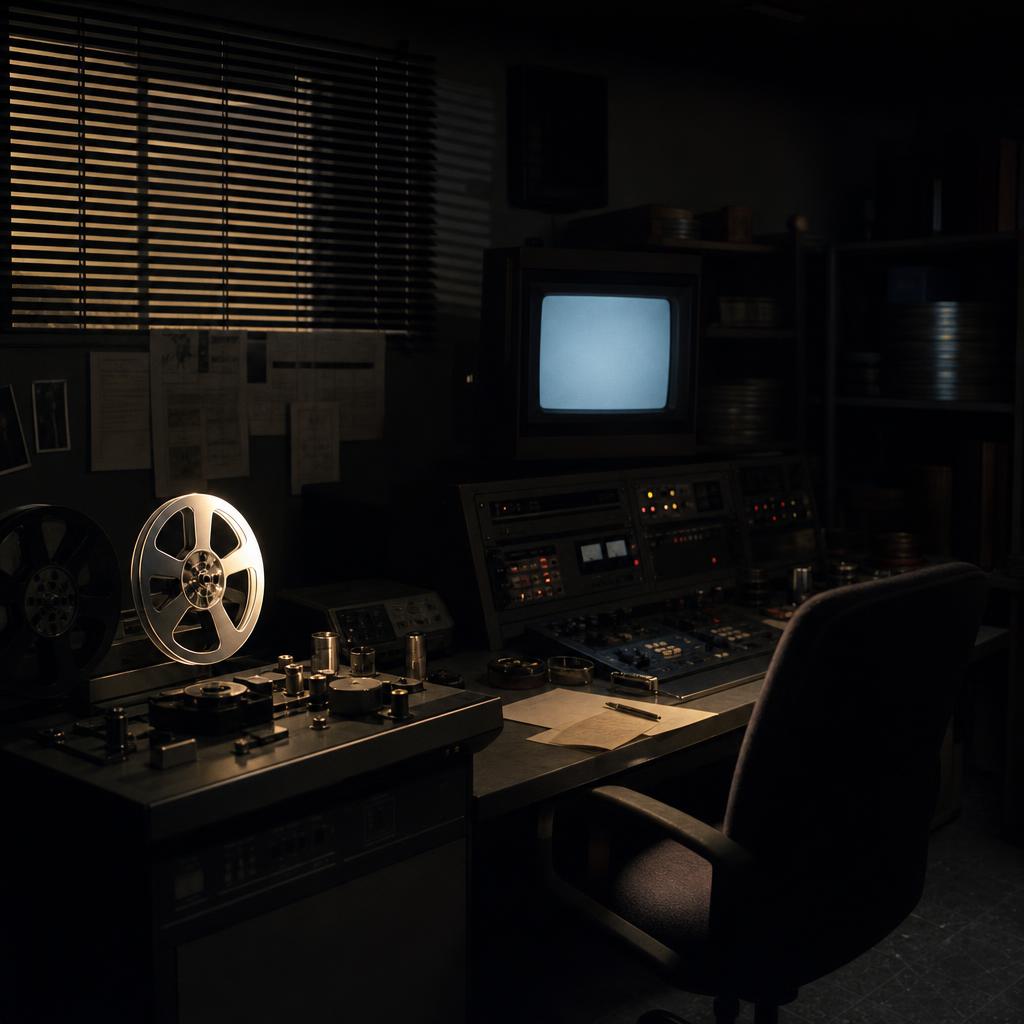
Chris Carter took the same principle toward darkness. Carter chose, from the start of The X-Files in 1993, to eschew the bright even light of the era’s science-fiction television and to shoot in as much natural darkness as the story allowed; his Vancouver cinematographer, John Bartley, lit a jail sequence with fluorescent tubes so saturated that, in Bartley’s own account, “these tubes are so blue, you can’t even read them on a colour meter.”2 The complaint that followed — that the show was, at times, literally too dark to make out — was the exact cost of the choice, paid deliberately. By the decade’s end the darkening had migrated to one of the medium’s most expensive dramas: the cinematographer Alik Sakharov shot the early hours of The Sopranos on Zeiss variable prime lenses, wider than television convention, with deliberately less coverage and longer takes, closer to how a feature was photographed than how an hour of series television had ever been.3 The picture had stopped being lit so that nothing would be missed on a dim set in a bright room, and started being lit on the film’s assumption of a dark room and a viewer paying attention.
The Sound Before the Scene
The image’s imports arrived alongside the ear’s. In the fall of 1989 the composer Angelo Badalamenti sat at a keyboard while Lynch described, in words, the images in his head, and the two built the theme for Twin Peaks in roughly twenty minutes, on Lynch’s standing instruction that music grew more beautiful the slower it was played.4 The theme, “Falling,” carried a vocal by Julee Cruise that had already appeared on her 1989 debut album, and the soundtrack Warner Bros. released on September 11, 1990, established a register — ambient, slow, unresolved — that scored dread rather than action.4
The X-Files’ signature was stranger in origin. Its composer, Mark Snow, had worked through revision after revision of a main theme without satisfying Carter, and produced the final one by accident: dropping his forearm across the keyboard in frustration triggered an echo effect already loaded in the instrument, and the whistling figure over it came from a stock sample called “Whistl’n Joe” layered with the whistling of Snow’s own wife.5 A theme assembled from a manufacturer’s preset and a household whistle became, within two seasons, one of the most recognizable pieces of music on American television. The last of the period’s sonic imports came not from a composer at all. David Chase, casting for the opening of The Sopranos, remembered a track he had heard on the radio driving the New Jersey freeway that ran under his own title sequence, and used it — “Woke Up This Morning,” by the British band Alabama 3, off a 1997 album most of the show’s American audience had never encountered — a finished commercial recording dropped whole into the place a composed cue would have gone.6
The Silent Hour
A series stable enough could spend a single hour breaking its own rules, and the period’s most confident ones did. On December 14, 1999, the fourth season of Buffy the Vampire Slayer, on the WB, ran an hour in which, for roughly twenty-seven minutes, no character spoke: a supernatural affliction stole every voice in town, and the show played the stretch as a deliberate tribute to silent film, its score carrying the narrative weight the dialogue had dropped.7 “Hush” earned the series the only writing Emmy nomination of its run, which it lost.7 Buffy ran the opposite experiment a season later, on February 27, 2001, staging a mother’s death and its aftermath across an hour that used no music at all — no score anywhere in it, the silence doing what a score would ordinarily have softened.8 Then, on November 6, 2001, it aired an hour told almost entirely in song, written, directed, and composed by its creator, Joss Whedon, in which a summoned demon compelled a California town to break into musical numbers.9
The musical episode was the exact form that had killed a network drama eleven years earlier, and here it drew some of the most affectionate notice a single hour of the period’s television received. The difference was quarantine. Cop Rock had asked an audience to accept a singing police force as the permanent condition of the show, week after week; the later experiment asked for one hour, framed inside a series whose rules the audience already trusted, and returned to speech the following week. The formal risk that had to carry a whole series in 1990 had become, by 2001, a thing a confident show could do once and survive.
The Broken Frame
The other imports worked on the frame itself, on the small permanent signals that told a viewer he was watching television. On July 12, 1997, HBO premiered Tom Fontana’s Oz, a prison drama that built its narration on a device borrowed from the stage: the inmate Augustus Hill, played by Harold Perrineau, addressed the camera directly from inside a rotating glass box, commenting between scenes on the brutality around him. Fontana’s stated reason was practical to the setting — “in prison, guys aren’t that forthcoming about what they think” — and the aside gave the show a voice its own characters would not supply.10 The direct address, television’s oldest taboo outside of news and comedy monologue, became a dramatic instrument.
The comedies dismantled a different tell. The multi-camera situation comedy had been built for decades around a studio audience and the laugh track its reactions fed, a signal as old as the televised stage show. Single-camera comedy removed both: shot like a film, one camera, no audience, no laughter cued for the viewer. The convention that had normalized it on cable earlier in the decade reached broadcast on January 9, 2000, when Fox premiered Malcolm in the Middle, a single-camera comedy about a working-class family with a gifted middle son, played without a studio audience or a laugh track anywhere in it.11 The oldest instruction television gave its audience — when to laugh — had been switched off, and the joke was left to land on its own.
Underneath the visible devices ran a structural one. The story that resolved inside a single hour, self-contained so a viewer could miss a week and lose nothing, gave way across the period to the season-long arc — the mystery held open for months, the villain who spanned a year, the plot that assumed the audience had been present all along. It was the serialized structure of the soap opera and the nineteenth-century magazine novel, moved into prime time and treated as ambition rather than as the daytime form it had been. The X-Files split the difference formally, alternating self-contained cases with hours that advanced a years-long conspiracy — training an audience, without announcement, to carry a story between weeks.
None of this arrived as a plan for what television should become. A producer dropped a Broadway musical onto a police beat and lost the bet in a season; a director let a shot hold until it turned strange; a composer kept an accident because it sounded right; a showrunner used a song he had caught on the radio; a series spent one hour in silence because it had earned the room to try. Each was solving a narrow problem in front of it, reaching into film or the stage or the record store or the silent era for a tool television had not owned, and keeping whatever worked. What the borrowings had in common was only that they came from somewhere else, and that the quiet ones outlasted the loud one. By the end of the period the medium looked and sounded assembled — a darker light, a licensed song, a held silence, a switched-off laugh — out of parts it had gone looking for in every neighboring art, and had begun, one quiet import at a time, to ask of the people in front of it the kind of attention those older arts had always been granted.
The Back would have carried the singing police drama’s collapse in the issue closing that February — a legible flop, with a budget easy to quote and a cancellation date to hang a piece on, the sort of failure the desk would not have needed persuading to run.
A pitch arguing that the medium’s own grammar had quietly been rebuilt — a prison drama’s inmate breaking the fourth wall from inside a rotating glass box — would have died in the room itself: the writer proposing it would have had no way into HBO’s closed production circle, nothing the checking desk could verify past what the network’s own press office supplied, and the piece would have gone unassigned. A companion pitch on a network comedy stripped of its studio audience and laugh track would have died, years later, for an unrelated reason: Fox’s own advertising desk, still selling against the network’s family-hour block, would not have wanted a story framed as a sitcom in crisis running anywhere near its own client list.
None of the three hours a WB vampire drama built around a formal stunt would have reached the room at all. A twenty-seven-minute stretch without dialogue would have stayed trade-press business, beneath a national readership’s notice. An hour scored with no music at all, the following winter, would have carried no news peg a monthly could have hung lead time on: a network hour would have aired and vanished before a monthly could have caught up to it. The musical hour that closed out the run would have read, to the floor, as an item for a television column or a fan newsletter, not a monthly’s argument at any length.
Footnotes
-
Wikipedia, “Cop Rock,” https://en.wikipedia.org/wiki/Cop_Rock; “‘Cop Rock’ Canceled,” The Baltimore Sun, November 13, 1990. ABC announced the cancellation in mid-November 1990 on poor ratings; the last of the eleven produced episodes aired December 26, 1990. Its 1991 Emmy Awards were for Outstanding Editing for a Series (the pilot) and Outstanding Achievement in Music and Lyrics (Randy Newman, “Under the Gun”). ↩ ↩2 ↩3
-
“In Camera: John Bartley Shoots The X-Files on the Edge of Darkness,” EatTheCorn.com (interview reprint), eatthecorn.com; Chris Carter’s dark-lighting choice is documented in the same source. ↩
-
“Cinematographer Alik Sakharov Breaks Down His Work on ‘The Sopranos,’” No Film School, September 19, 2021; “The Cinematography of The Sopranos: Alik Sakharov, ASC,” Cooke Optics interview, cookeoptics.com. ↩
-
“The Making of the Twin Peaks Theme,” Uncut, June 2017; Wikipedia, “Soundtrack from Twin Peaks,” https://en.wikipedia.org/wiki/Soundtrack_from_Twin_Peaks. The soundtrack was released by Warner Bros. Records on September 11, 1990; “Falling” had appeared on Julee Cruise’s 1989 album Floating into the Night. ↩ ↩2
-
“As ‘X-Files’ Returns, Meet the Man Behind the Theme Song,” NPR, January 22, 2016; “How the ‘X-Files’ Composer Made TV’s Creepiest Theme Song, Partly by Accident,” Vice/Motherboard. ↩
-
“Alabama 3 on How Their Song ‘Woke Up This Morning’ Became the Theme Tune for The Sopranos,” Louder, April 28, 2024; Wikipedia, “Woke Up This Morning,” https://en.wikipedia.org/wiki/Woke_Up_This_Morning. The track appeared on Alabama 3’s 1997 album Exile on Coldharbour Lane. ↩
-
Wikipedia, “Hush (Buffy the Vampire Slayer),” https://en.wikipedia.org/wiki/Hush_(Buffy_the_Vampire_Slayer). The episode aired December 14, 1999, on the WB; roughly twenty-seven minutes are without dialogue; it received the series’ only nomination for Outstanding Writing for a Drama Series, which it did not win. ↩ ↩2
-
Wikipedia, “The Body (Buffy the Vampire Slayer),” https://en.wikipedia.org/wiki/The_Body_(Buffy_the_Vampire_Slayer). The episode aired February 27, 2001, and uses no non-diegetic music. ↩
-
Wikipedia, “Once More, with Feeling (Buffy the Vampire Slayer),” https://en.wikipedia.org/wiki/Once_More,_with_Feeling_(Buffy_the_Vampire_Slayer). Broadcast November 6, 2001, on UPN; written, directed, and scored by Joss Whedon. ↩
-
Wikipedia, “Augustus Hill,” https://en.wikipedia.org/wiki/Augustus_Hill; “Oz” premiered on HBO July 12, 1997. Fontana’s remark on the character’s narration is quoted in Ethan Alter, “‘Are These People F***ing Crazy?’: A 25th Anniversary Oral History of HBO’s Pioneering Prison Drama ‘Oz,’” Yahoo Entertainment, July 2022. ↩
-
Wikipedia, “Malcolm in the Middle,” https://en.wikipedia.org/wiki/Malcolm_in_the_Middle. The single-camera comedy premiered on Fox January 9, 2000, without a studio audience or laugh track. ↩