Status Markers: How Class Was Read, 1989–2001
Subscribe
https://meridian-archive.com/feed.xmlOpen in your app, or paste the link above into any other:
The Quiet Years
At the co-op boards governing addresses like 740 Park, 820 Fifth, and 834 Fifth Avenue, an all-cash offer for the apartment was a condition of being considered, not a guarantee of anything after. The board convened a personal interview, and the interview could end in rejection with no reason given, a routine enough outcome that the standard the boards were applying without writing it down had a settled name among brokers and in the press: “good character,” understood by everyone on both sides of the table to mean discretion and the correct lineage rather than money in hand.1 Barbra Streisand was turned away by more than one board, including 1107 Fifth Avenue, on the calculation that her presence would bring parties and the photographers who followed her into lobbies that prized their quiet; Madonna’s 1985 rejection from the San Remo stood, through the rest of the decade, as the settled proof that fame did not purchase what “good character” required.2 A fortune large enough to buy the building outright bought, at these addresses, only the right to be interviewed.
The clothing worn to such interviews, and to the floors above them, ran on the identical logic. In the autumn of 1990, the most expensive way to signal rank on a Manhattan editorial floor was to wear nothing anyone could name. The senior women at the prestige monthlies and the Condé Nast titles dressed, by preference, in matte wool crepe cut close to the body — a Geoffrey Beene sheath in navy or oatmeal, a Calvin Klein column in the same austere palette — with no visible label, no hardware, and no color that announced itself across a room. The garment was expensive and the expense was invisible, which was the point. A person who could read the cut knew what it cost; a person who could not was not the audience. The clothing sorted the room into those two categories before anyone spoke, and it did so without a single mark a camera could resolve.
The austerity had reasons, and they arrived together. The recession that had settled over the city by 1990 made visible spending a social miscalculation; a woman who dressed loud in a year of hiring freezes and shrinking well space read as someone who had not understood the room. The epidemic running underneath the decade had made a certain baroque exuberance — the sequined, shoulder-padded excess of the middle 1980s — feel like a costume from a party that had ended. And the fashion itself had turned: the designers the editorial class watched, Jil Sander in Hamburg and Helmut Lang out of Vienna, were building a vocabulary of severe, unadorned, expensively plain clothes, and their work was on the bodies of the senior fashion editors well before either designer kept a New York store.3 Minimalism was not only a look. It was austerity offered as honesty, at a moment when honesty was the fashionable virtue and money was the thing one did not discuss.
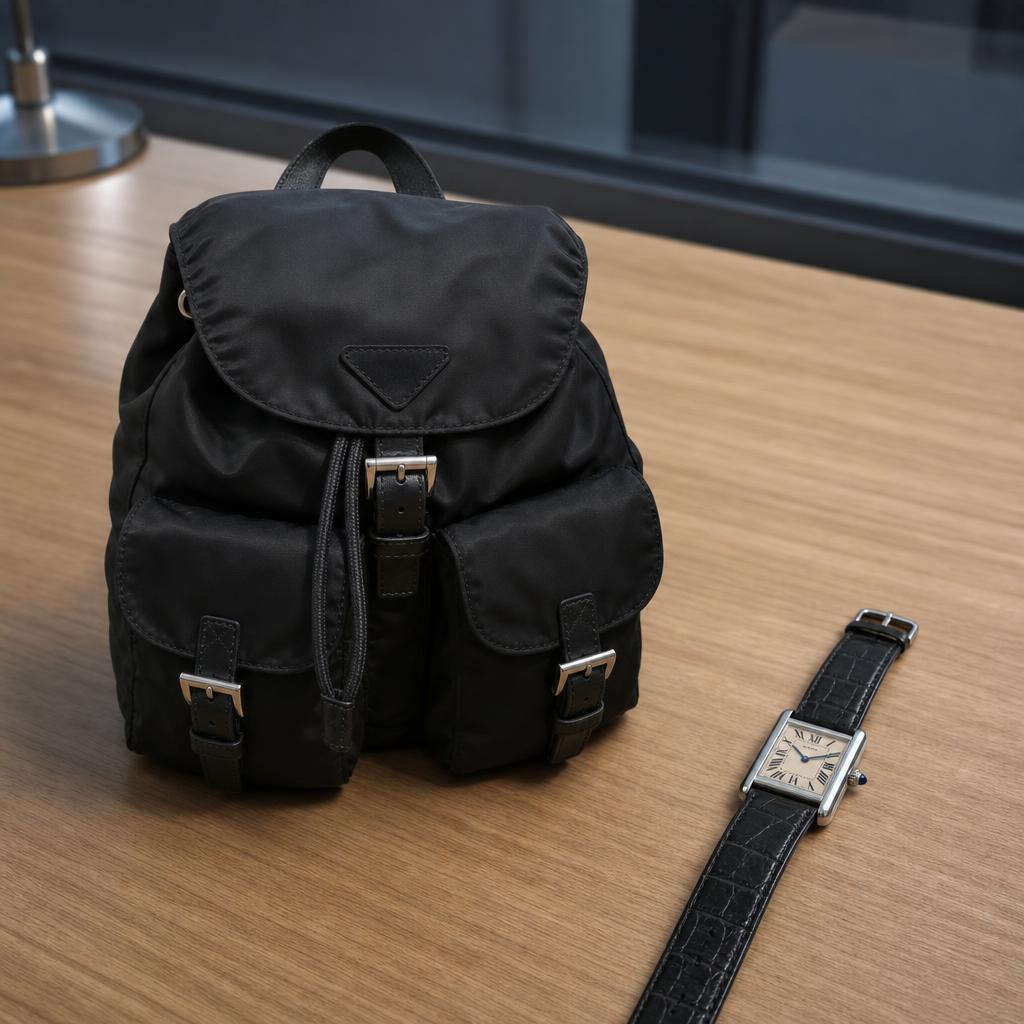
The watch performed the same discretion. Old money wore a Cartier Tank — the slim Louis Cartier on a leather strap, or the steel Tank Must that had been the house’s accessible model since the late 1970s — or a thin dress Patek Philippe inherited from a father, worn without comment. New money wore a Rolex, the Datejust or the Submariner, heavier and more legible and read, on the editorial floor, as the watch of someone who had bought it rather than been given it. The distinction was not price; a good Rolex and an old Patek could cost the same. The distinction was whether the object announced itself, and the room’s most literate readers scored announcement as a deduction. What a woman wore on her feet worked the reverse of loud: a flat handsewn Belgian loafer for the day, worn without socks, a low pump for the evening, nothing that clattered.
The code moved fast enough that its violations were datable to the year. By 1992 a set of objects that had signified money in the middle 1980s had hardened into evidence that their wearer had stopped paying attention: the padded shoulder, the navy blazer with gold buttons, the quilted Chanel bag carried on its gold chain, pantyhose worn with open sandals. Each had been correct within recent memory; each now read simply as behind. What replaced them was studied and small — a pair of Manolo Blahnik pumps kept low at the heel, pearl-and-gold earrings that did not swing, a handbag carried rather than displayed. The speed of the obsolescence was itself a barrier to entry. Staying current required either the income to refresh a wardrobe on the fashion calendar or the eye to know, unprompted, which of last year’s certainties had quietly expired, and the second was harder to acquire than the first.
The old-money version of the code was older than the recession and indifferent to it. Its uniform was deliberately worn: soft chinos gone pale at the seam, a shirt from Brooks Brothers with the collar just beginning to fray, no logo anywhere on the body, needlepoint where a stranger might have expected a brand. The point of the frayed collar was that it could not be bought that season; it had to have been acquired over years, which was the one thing money in a hurry could not do. The resort-preppy signaling of the country-club coast — the bright printed cottons associated with designers like Lilly Pulitzer, the grande-dame formality of a Carolyne Roehm — belonged to a related grammar, worn in the same summer geographies, legible to the same readers. Against all of it, the new-money instinct to buy the best and show it registered as a kind of illiteracy, a failure to grasp that the code being read was not the price of the object but the length of time its owner had known to want it.
The Anti-Status Object
The object that named the decade’s first half was a backpack. Miuccia Prada had begun making bags from Pocono — a black industrial nylon woven for military tents and parachutes — in the middle 1980s, and the plain nylon backpack she built from it carried no ornament and, at first, no obvious logo.5 By the early 1990s it had become the single most legible marker of belonging inside the Condé Nast building. It cost several hundred dollars, a sum out of all proportion to the humbleness of the material, and the disproportion was the entire content of the signal. Anyone could buy leather that looked expensive. Only a person schooled in the code would pay a leather price for nylon that looked like a camera bag, and would do it precisely because the nylon refused to look like money. The backpack was an argument that the wearer had enough cultural capital to find the vulgarity of an obvious luxury bag embarrassing — an argument made, expensively, in the register of not making it.
The bag had begun as a practical object, and the practicality was part of the alibi. The nylon was light, water-shedding, and close to indestructible; a bag made from it could be thrown under a desk, carried between shows on a wet afternoon, and slung on both shoulders while its owner’s hands stayed free — a working object for a person who moved through a day rather than posed at the center of one. That it also cost a fortune was the second layer of the joke, available only to a reader who knew the price and could see that the object had been built to deny it. The utility gave the wearer something to say if asked. The price was the thing that could not be said, and was the whole point.
This was the logic the whole first half of the decade ran on, and it had a name in the trade press that covered the business: the anti-status status object, the thing whose value lay in being unreadable to the people it was not for.3 It was a code built for a small literate audience and hostile to a large one, which suited a media class that lived on precisely that distinction — a class whose whole professional worth was the claim to know, before the general public did, what was good. An editorial assistant earning the low twenties could carry the same nylon backpack as the editor three tiers above her, and frequently did, on a salary the bag’s price mocked; the apartment behind the assistant was often subsidized by a family that did not appear on the masthead. The bag did not lie about income. It reported literacy, which in that building was the more valuable of the two.
The downtown edge of the same aesthetic went further and darker. The look the fashion press came to call heroin chic — the pallor, the visible clavicle, the deliberately depleted body photographed in flat gray light — was, read as a class signal, the performance of destitution by people structurally incapable of experiencing it. Grunge as a runway proposition — Marc Jacobs’s thrift-store flannel reproduced in expensive fabric — ran on the same inversion as the nylon backpack: the surface said poverty and the price said the opposite, and the gap between them was legible only to those positioned to read it. Uptown, the old-guard women in their bright resort prints and their pearls were performing continuity; downtown, the young were performing collapse; and both performances were affordable only to people whose actual position was secure enough to dress as something they were not.
The Turn
The turn had a date and a place, and neither was New York. Tom Ford had joined Gucci in 1990 as a designer of women’s ready-to-wear, taken over as design director in 1992, and been made the house’s creative director in 1994, arriving at full authority over a label that had spent the 1980s drowning in licensing and losing money.6 In March 1995, in Milan, he sent out a Fall collection that reversed, deliberately and at once, every premise the minimalist half-decade had been built on: jewel-toned satin shirts unbuttoned to the sternum, velvet hipster trousers in aubergine and chocolate, patent Horsebit loafers, a body dressed to be looked at rather than to disappear. Where Sander and Lang had proposed that austerity was honest, Ford proposed that money was good, that sex was good, and that the body was there to be seen — and he proposed it to an editorial class that had spent five years dressed in penance.
The commercial answer was immediate and enormous. The trade paper of the clothing business reported Gucci’s sales leaping by nearly ninety percent in a single half-year as the collection reached the stores, a rebound that restored a fading licensing house to the front rank of the luxury business.7 Within months the fashion establishment registered that the direction of influence had reversed: where the runway had spent the early 1990s chasing the street’s thrift-store austerity, the street was now chasing the runway again, a flip the New York Times fashion pages named directly that September.8 The change reached the editorial floor as clothing and as vocabulary at the same time. By the spring of 1997 the Gucci Horsebit loafer, the oversized G-buckle belt, and the unbuttoned satin shirt had become an editorial uniform as recognizable as the plain nylon backpack had been three years earlier, and considerably louder. The magazine that had dressed to be unreadable was learning, again, to dress to be seen.
The fashion titles did not receive the turn as one voice. Vogue, under Anna Wintour, embraced the new sensuality openly; the reconstituted Harper’s Bazaar, which Liz Tilberis had taken over in 1992 after arriving from British Vogue and set to a severe black-and-white elegance, held to the minimalist line for several more seasons.3 The serious general-interest press treated Ford less as a designer than as a social event — evidence that a whole culture’s relation to money and the body had turned over. The men’s code turned with the women’s: the slim black three-button suit, the white shirt open at the throat, no tie, a silhouette cut to read as expensive and available in the same glance.
What made the reversal legible as a class event, rather than merely a change in taste, was that the code did not loosen — it only changed its terms. The austere years had rewarded the reader who could recognize expensive plainness; the loud years rewarded the reader who could tell a current logo from a dated one, a Ford-era Gucci from the tourist-shop Gucci of a decade before. The literacy test remained. Its content had simply flipped from the ability to see value in the absence of a mark to the ability to place a mark in its exact season. A visible logo, forbidden in 1992 as the surest sign of not understanding, had by 1997 become — if it was the correct logo, from the correct year — the thing understanding required.
The Loud Years
By the end of the decade the marks were everywhere and the point of them was to be seen. Fendi’s Baguette, the small shoulder bag Silvia Venturini Fendi introduced in 1997 and carried through the following years into television saturation, was built to be recognized on sight and named aloud; the Dior saddle bag that John Galliano sent out for spring of 2000 worked the same way, a shape so distinctive it did not need a label to be named. The Prada backpack itself had by then acquired the small enameled triangle it had once done without, the logo restored to the object whose original argument had been the logo’s absence. “Dressing up,” on the editorial floor of 1999, meant the marks were visible; the woman who still dressed to disappear read, to the newest readers, as someone who had stopped keeping current.
The money underneath the change had grown to match it. The magazines’ fashion departments, which had spent the recession begging for sample budgets, now moved sums through their closets that a senior editor of 1990 would have found not merely large but categorically strange — clothes bought at a scale that assumed the clothes were the story. The dot-com fortunes briefly loosened the code further still, putting current luxury on the bodies of very young people whose money was a year old and whose literacy in it was thinner, a mismatch the older readers noted and the market, for a season or two, did not punish. The frontier of who could buy in kept moving outward. What did not move was the underlying transaction: the object read the owner, and the owner was paying to be read.
By 2001 the arc had closed on itself. The senior woman who in 1990 had signaled the top of the masthead by wearing nothing a stranger could name now signaled the same rank by carrying a bag whose entire value was the name across the front. Nothing about her position had changed, and nothing about the mechanism had changed; only the vocabulary had inverted, from a code that concealed to a code that announced, both of them exclusionary, both of them read instantly by the small number of people the clothing was addressed to and missed entirely by everyone else.
The Same Money, Read Three Ways
A single decade’s status vocabulary sorted less by wealth than by fraction: the old guard, the finance new money, and the creative class could spend comparable sums and still be told apart at a glance, because each read a different object as proof.
| Category | Old money | New money | Creative class |
|---|---|---|---|
| Watch | Inherited Cartier Tank | Rolex or new Patek | Swatch, or a vintage Omega |
| Child’s party | At home, pizza and a clown | A museum hall rented out | The park |
| Nanny | English, as a statement | Eastern European au pair | Caribbean, as the norm |
| Groceries | Zabar’s | Dean & DeLuca | Fairway |
| Evening drink | A martini | Single-malt Scotch | A cosmopolitan, after 1998 |
The surface of class in New York across these years was not a fixed set of objects but a test of reading, and the test stayed the same while its answers reversed. In 1990 the correct answer was a garment with no name on it, expensive in a way only the right eyes could price; by 2001 the correct answer was a name worn openly, in the right season, on the right bag. Both answers excluded the same people and rewarded the same people, because the thing being measured was never the money — a bond trader’s bonus and an old family’s frayed chinos could sit at the same number — but the fluency, the years of knowing what to want before the wanting became general. A city learning to read itself by its surfaces was a city in which the surface had become, quietly, the most honest document a person carried, more honest than a salary and harder to fake than a title. The clothes told the truth about who had been taught, and being taught was the one asset that could not be bought in the season it was needed.
A piece proposing to price the code rather than read it — naming the houses, printing the margins, saying plainly what the markup on a monogrammed canvas bag bought and from whom — would have gone no further than a memo. Counsel would have called it libel exposure, the naming of margins by house too exposed to clear at the speed the story needed; nobody at the table would have believed the reason, and nobody would have said the truer one aloud. The houses the piece would have named would have sat, every season, at the front of the same issues, buying the pages the piece proposed to explain, and the memo would have come back from the publisher’s floor without a mark on it, which would have been mark enough.
Tom Ford’s reversal at Gucci would have posed no such difficulty. The Back would have taken the collapse of minimalism into open luxury as sociology rather than fashion note, money recovering its nerve argued at length, and the piece would have run without much argument at the table.
Two years earlier, the Prada backpack would have gone into The City, read plainly as what it was: an anti-status object, several hundred dollars for plain black nylon.
Footnotes
-
Michael Gross, 740 Park: The Story of the World’s Richest Apartment Building (Broadway Books, 2005); “The Cooperative Model,” Cooperator News. ↩
-
“Celebrity Rejects,” Observer, 2016. ↩
-
Teri Agins, The End of Fashion: How Marketing Changed the Clothing Business Forever (William Morrow, 1999). ↩ ↩2 ↩3
-
Michael Gross, 740 Park: The Story of the World’s Richest Apartment Building (Broadway Books, 2005). ↩
-
Miuccia Prada, “Backpack” (designed 1984), The Museum of Modern Art, New York, Architecture and Design collection (object no. 91.2018). ↩
-
Sara Gay Forden, The House of Gucci: A Sensational Story of Murder, Madness, Glamour, and Greed (William Morrow, 2000). ↩
-
“Gucci Profits Rocket 165% as Sales Leap 89.2% in Half,” Women’s Wear Daily, 1996. ↩
-
Amy Spindler, “Flip-Flop: The Runway Leads the Street,” New York Times, September 1995. ↩