Sports as Cultural Force, 1989–2001
Subscribe
https://meridian-archive.com/feed.xmlOpen in your app, or paste the link above into any other:
The State’s Percentage
Nevada law capped what its athletic commission could fine a licensed boxer for a foul inside the ring at three percent of his purse, a ceiling fixed in statute regardless of what the foul was. The number did not move for the offense; it moved only with the size of the check the fighter had been due. Every disqualification the commission had ever ruled on had been processed against that same flat percentage, a fine sized to the fighter’s earnings rather than to what he had done, and the sum the state fined Mike Tyson after he bit a piece from Evander Holyfield’s ear in June 1997 — three million dollars — was not a punishment calibrated to the act; it was simply the ceiling the law allowed, hit in full because the purse behind it was large enough to make three percent a number worth printing.1 The same logic of formal, numeric rule-setting governed the city’s arenas as thoroughly as its boxing commissions, and nowhere more visibly than at the building where New York’s other winter sport was sold by the seat.
A Knicks ticket in the media world of the early 1990s was rarely bought. It was had, or owed, or sent up in an envelope by a public-relations contact who wanted something and knew that a pair of seats at the Garden said it better than a letter could. Madison Square Garden sat at Seventh Avenue and Thirty-third Street, a short cab ride south and west of the Midtown magazine offices, and the giving and receiving of its tickets ran on a grammar of obligation more precise, and more legible to the people inside it, than any restaurant reservation. An editor who wanted to flatter a difficult writer took him to a game; the offer carried its own message — that the thing being given was valuable — and the two hours supplied a social context a dinner could not. The two men sat side by side, reacted with their bodies, argued a call, and came away having shared something. The tickets were hierarchy. The game was not.
The seating sorted the room by rank with a precision the editorial floor’s own furniture could not match. The first rows of courtside belonged to celebrities and the top tier of New York media; the film director Spike Lee had held a baseline seat since the late 1980s and was recognizable enough to be a recurring story in his own right, the most visible fan in the building. The lower bowl was corporate and upper-media country. The upper deck, two hundred feet up, was where the working-class and outer-borough fan who had been the Garden’s historical base watched from altitude. The bars along Thirty-first through Thirty-fourth Streets — McFadden’s, Mustang Harry’s — filled before and after with the lower-bowl professional, not the suite-holder, who ate inside, and not the upper-deck fan, who went home on the train, but a loud, male, class-flattened crowd that the editorial floor, for all its range, never quite produced.
The Renovation
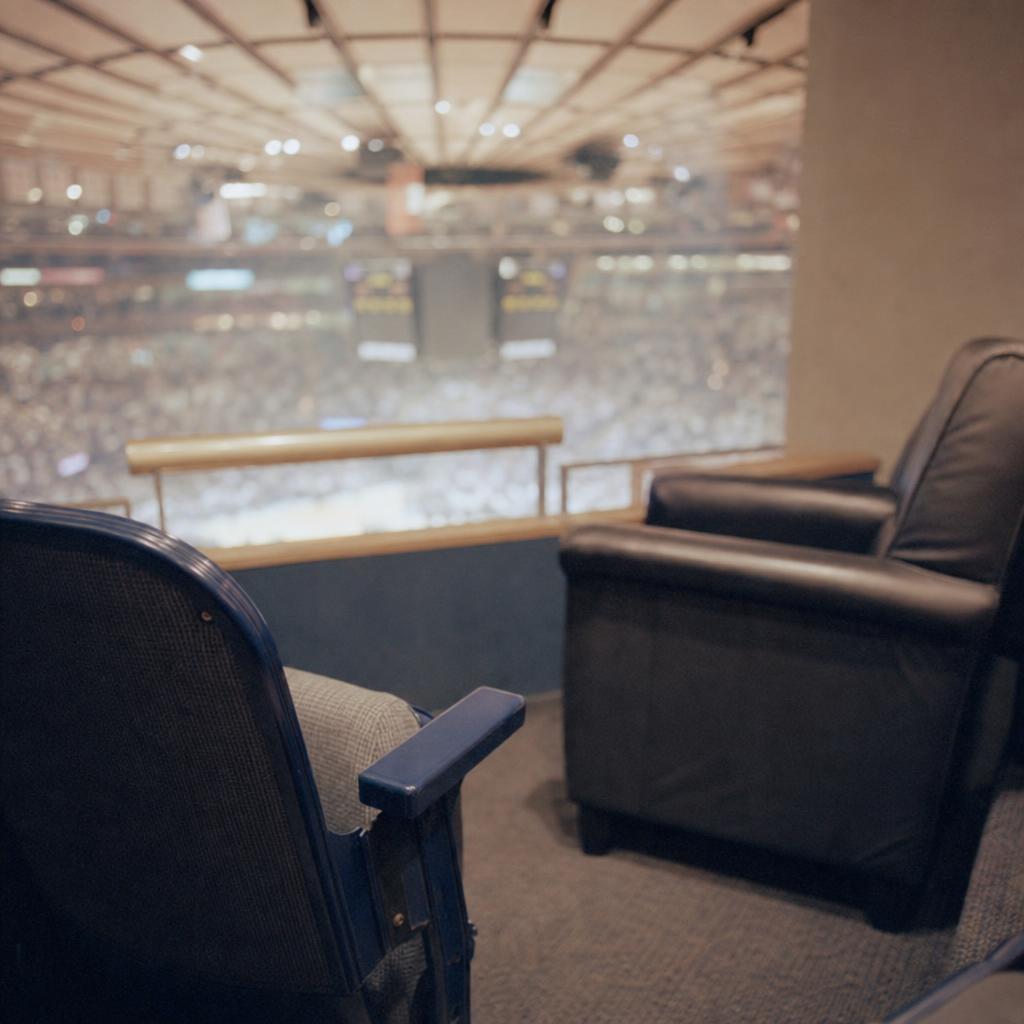
The economic transformation of the Garden had a start date. In 1991 its owners spent two hundred million dollars to rebuild the arena, and the central move of the rebuild was to remove hundreds of upper-tier seats and put in their place eighty-nine luxury suites, leased to corporations on multi-year terms.2 The old seats came out and cushioned teal and violet ones went in; the ventilation and the restrooms improved; the building grew more comfortable and more expensive at the same stroke. The most exclusive of the new rooms, known as Suite 200, became an invitation-only club under the Knicks president Dave Checketts, a place where the business and media worlds gathered at halftime to drink and conduct the informal commerce the game made possible.2
The renovation made explicit what the ticket economy had been doing quietly. A suite holder was not a fan in the inherited sense; he was a host, a man who had not necessarily followed the championship teams of 1970 and 1973, or the drafting of Patrick Ewing with the first pick in 1985, and for whom the Garden was a hospitality venue and the game a backdrop to the client he had brought. Lower-bowl seats that had cost forty or fifty dollars at the start of the decade were approaching three figures by its end, and the best floor seats ran to several hundred; the corporate lease put team access in a bracket only a major company could reach. The fan who had driven Knicks culture in the Patrick Ewing years was being priced upward and out, and the entertainment client who came a few times a winter because it was a perk was filling the reconfigured bowl. The building kept two populations after that, and their relation to each other was the relation of the city that had been to the city that was arriving — the upper deck cheaper, louder, quicker to boo; the suites quiet during play and loud at the break, when the real transaction happened. By the time the Knicks made their improbable run from the eighth seed to the Finals in 1999 — the first team ever to reach it from a berth that low — a ticket to a meaningful game at the Garden cost more than a night’s wage for the fan whose investment in the outcome ran deepest.
One Spring, Two Endings
The spring of 1994 arrived at a temperature the rest of the decade never matched. Two championship runs ran at once — one that ended in triumph, one that ended six points short — and put into a single month both a long-awaited victory and a bitter defeat.
The hockey half came first, and it came with a promise. The New York Rangers, down three games to two to the New Jersey Devils in the Eastern Conference final, faced elimination in Game 6 on May 25. The day before, their captain Mark Messier promised the assembled press that the Rangers would “go in and win Game 6” and bring the series back to the Garden for a seventh.3 He then scored three goals in the third period of a 4–2 win, the last of them shot the length of the ice into an empty net, and made the promise true.3 The Rangers took Game 7 in double overtime and went on to win the Stanley Cup against the Vancouver Canucks in seven, Messier’s goal in the deciding game standing as the winner. The drought behind them ran to 1940 — fifty-four years, long enough that the franchise had become known for losing well and often. Grown men who had gone to Rangers games their whole lives wept on Seventh Avenue, and the parade up the Canyon of Heroes drew a crowd counted in the millions.
Then the basketball half turned. The Knicks reached Game 7 of the NBA Finals in Houston on June 22, a week after Messier had carried the Stanley Cup onto the Garden floor at halftime of a Finals game. John Starks — the shooting guard the city had adopted, undrafted, a bagger at a supermarket a few years before, one of the most ferocious players in the league — went cold at the worst hour. He shot two for eighteen from the floor and missed all eleven of his three-point attempts; the Knicks lost 90–84, and Houston won its first title.4 The city that had been a hockey town celebrating a Cup and a basketball town fighting for a title was left holding one and not the other. Both teams were the city’s; both runs had happened at the Garden; and the triumph and the loss were felt at once, with no attempt to reconcile the two.
And then, in August, the baseball stopped. The players’ strike that began on the twelfth shut the year down and, for the first time since 1904, canceled the World Series. Baseball was still the American game, the thing fathers had handed sons, and its disappearance was felt as a real loss even in a city whose own two teams were going nowhere that year.
The Body from Brownsville
Mike Tyson came out of Brownsville, in Brooklyn, a geography of poverty and violence he carried in his body long after he left it. He became the youngest heavyweight champion in history in November 1986, at twenty, with a second-round stoppage of Trevor Berbick, and by the following summer had unified the three major titles into a single undisputed championship; he appeared to be unbeatable. In February 1990, in Tokyo, a forty-two-to-one underdog named James “Buster” Douglas knocked him out in the tenth round — the biggest upset in the history of boxing, and possibly of any sport.5 The fight ran on pay-per-view in America; the shock was immediate and physical, and the man who had seemed inhuman was revealed to be a man.
Then the fall kept going. In February 1992 a jury in Indianapolis convicted Tyson of raping Desiree Washington, a contestant at the Miss Black America pageant the previous summer; he was sentenced to six years and entered prison that March.6 The conviction drew a complicated response, particularly among Black audiences, where the sight of a Black man convicted on a Black woman’s testimony inside a justice system with its own long record produced no single reaction; Tyson’s promoter Don King and the rest of his camp mounted a loud reasonable-doubt campaign, and none of it moved the verdict. He served three years and was released in March 1995. The comeback was fast and lucrative: a knockout of Peter McNeeley in under ninety seconds that August, well over a million homes paying to watch; the WBC title back from Frank Bruno in 1996; then, in November of that year, a loss to Evander Holyfield, who dominated and stopped him in the eleventh.
The rematch, in June 1997, produced the act that outran the sport. Frustrated by what he called Holyfield’s headbutts, Tyson bit a piece of cartilage from Holyfield’s right ear in the third round and spat it onto the canvas; he bit the other ear before the round ended; the fight was stopped and he was disqualified.1 The Nevada commission revoked his license and fined him three million dollars. The act read two ways at once — as calculation, a disqualification chosen over a second clean loss on the record, and as breakdown, the performance of invincibility giving way at last. Something that happened at ten o’clock on a Saturday night was in every paper by Sunday morning and stayed in conversation for weeks. The office knew about Tyson, but the knowing came differently than a Knicks game did: a fight was not something a person watched in real time because he had a good seat. It was something a person paid forty dollars to see on a small television in a friend’s apartment, a handful of people around it, and then carried to work on Monday as a thing he could not quite believe had happened.
The Dynasty
Between 1981 and 1995 the Yankees reached one World Series. They had been good in stretches — the 1994 team may have been the best in baseball when the strike ended the year in August — but they had not been a dynasty. The dynasty began in 1996 out of a specific set of parts: Joe Torre, hired to manage after more than four thousand games as player and manager without once reaching a World Series; a twenty-one-year-old shortstop named Derek Jeter, who played with the ease of someone who had always assumed he would be there; and an older core — Bernie Williams, Paul O’Neill, David Cone — that had learned how to lose and was ready to stop. That October the Yankees dropped the first two games of the World Series at home to the Atlanta Braves, then won four straight and clinched in the Bronx, and the city’s response was proportional to the drought behind it.
Then came the year that stood as the decade’s high sports achievement. In 1998 the Yankees won a hundred and fourteen regular-season games, more than any American League team before them, and lost only two more across the whole postseason, sweeping the San Diego Padres for the title.7 The roster was a collective object with no single star of the Michael Jordan kind — Jeter, Williams, O’Neill, Tino Martinez, Scott Brosius, Andy Pettitte and David Wells starting, the closer Mariano Rivera breaking bats with a single pitch, and Orlando Hernández, “El Duque,” a Cuban defector whose arrival was itself a story — and the distributed, unshowy excellence of it was exactly what the city found satisfying. They won again in 1999 and in 2000, the second title over the Mets in the first Subway Series since 1956.
The Mets were a Queens team by origin and by temperament. They had been founded in 1962 to give the National League fans the city had lost — abandoned when the Dodgers left Brooklyn and the Giants left Manhattan for California in 1958 — a team of their own, and they played at Shea Stadium, a concrete multi-purpose bowl thrown up in Flushing in 1964, directly beneath the LaGuardia approach and loud in ways that had nothing to do with the crowd. The team spent six straight losing years in the early 1990s, its 1986 championship dissolved into drugs, trades, and decline, and began to climb again only as the Yankees reached their most imperious.
The baseball split ran along the city’s own seams. Yankees country was the Bronx, Manhattan, Staten Island, and the northern suburbs; Mets country was Queens, Brooklyn, and Long Island. The division ran close to even, but its class texture was real: the Yankees fan in Manhattan was, in the stereotype, the person who had arrived, and the Mets fan in Queens was the person still in the neighborhood, rooting for a team out of the borough’s own image. And the Yankees’ rise tracked something larger than a roster — it ran alongside the crime decline, the recovering real-estate market, the dot-com money beginning to land — so that the team became the correlative of the city’s renewal, the same forces pricing the outer-borough fan out of the ballpark producing the victories the renewal celebrated. Success as a form of gentrification.
The Dynasty’s Ledger, 1996–2000
Four titles in five years, over three National League opponents and, in 2000, the crosstown Mets.
| Year | Opponent | Result | Note |
|---|---|---|---|
| 1996 | Atlanta Braves | Won, 4–2 | First title since 1978; clinched in the Bronx |
| 1998 | San Diego Padres | Won, 4–0 | 114 regular-season wins, an American League record7 |
| 1999 | Atlanta Braves | Won, 4–0 | Second straight sweep |
| 2000 | New York Mets | Won, 4–1 | First Subway Series since 1956 |
The Ambient Argument
A literary magazine at Meridian’s altitude had a vexed relationship to sports. Not to follow them was itself a class signal at the high end of the business — a sign of being too serious, too occupied with things that mattered. Sports entered the serious magazine only in permitted forms: as Roger Angell’s baseball essays, admitted because they were literary before they were athletic, meditations on time and loss that earned their place by being about more than a game;8 as the athlete profile that was really a piece of sociology; or as a figure so culturally total — Michael Jordan from about 1991 on — that declining to have an opinion was itself a position. By 1996 a Jordan vehicle could gross more than two hundred million dollars worldwide and reach people who had never watched a basketball game.9 A pitch to profile him was not a sports pitch; it was a pitch on the dominant cultural figure of the decade, who happened to play a sport.
Below that surface the office was full of sports. The office pool for the World Series, and the bracket that went around every March for the college basketball tournament, were informal institutions that crossed department lines; the conversation about last night’s game crossed hierarchy in a way an editorial meeting never did — the publisher and the editorial assistant arguing Starks’s shot selection had, for the length of the argument, something in common. And the genre kept proving itself: David Remnick was covering boxing before he took over the New Yorker in 1998, his book on Muhammad Ali growing straight out of that reporting;10 at Sports Illustrated, Gary Smith was building long profiles of athletes — Ali, Tiger Woods, Bo Jackson — as formally accomplished as anything in the literary monthlies. The distance between a prestige magazine and a first-rate sportswriter was smaller than the masthead let on.
What carried sports through the city, though, was neither print nor the arena but a radio station. WFAN had gone on the air in 1987 as the first all-sports outlet in the country, and found its defining form in the fall of 1989, when it paired Mike Francesa and Christopher “Mad Dog” Russo in the afternoon drive slot — one host all authority, the other all manic energy, both treating a lineup choice as a matter for genuine argument.11 The callers were the second cast, sorted by the hosts into a taxonomy the audience learned to hear: the caller with a real point pressed it and was respected; the caller with a grievance aired it; the caller who asked what had already been settled was hung up on. The show rewarded preparation and punished its absence, and it was on everywhere the city worked with its hands — in the cabs, on the construction sites, in the maintenance rooms and the restaurant kitchens. It crossed class downward automatically and upward only by accident, when the publisher taking a cab to a lunch caught the same twenty minutes of Francesa the driver had been living inside all afternoon.
That was where sports actually sat in relation to the magazine: not in it, but around it. The maintenance staff’s radio carried the game up from the basement. The Daily News sports section arrived every morning and was read on a different circuit than the culture pages. The station framed the building’s day from outside it — the last thing heard before the floor and the first thing after — and the floor, which prided itself on knowing what mattered before the public did, met the one subject the whole city shared as the next morning’s conversation, secondhand.
Sports in these years was the one language in New York that dissolved the magazine’s hierarchy without anyone deciding it should. The Messier promise was not an assignment; it happened, and everyone in the building knew it by morning. The Game 7 loss was not a position an editor could take or decline; it had happened, and it hurt, and rank did not enter into it. What made this more than sentiment was that the same decade re-sorted, by class, the very rooms where the games were played — the Garden pricing out the base whose fury had been its engine, the Yankees’ triumph coinciding with the same forces that were raising the rents. The building where an advertiser was entertained in 1991 was not the room it became by 1999; the seats got softer, and the base moved up in price or stopped coming. The one thing that could still put a publisher and an assistant in the same argument was also the thing being quietly reorganized around them, so that the shared game and the sorted grandstand belonged to the same decade. The play still belonged to everyone; the seat to watch it from, increasingly, did not — and for one more decade the city could hold both of those truths at once.
WFAN’s turn to Mike Francesa and Mad Dog Russo in the fall of 1989 would have reached no desk at Meridian at all: no one’s beat would have touched afternoon drive radio, and the masthead would never have known the show existed. The Garden’s rebuilding two years later would have fared differently. The City’s autumn pages would have carried the conversion of a people’s arena into a room for entertaining clients, the cheap seats climbing out of reach as the new suites filled with hosts who had never once followed the team.
Messier’s promise before Game 6 would have drawn real interest and no assignment: delivered in a rink, at the wrong register for the magazine’s own book voice, it would have died at the pitch. The Cup that followed would have died for a plainer reason. The one writer with real hockey history would have been passed over for the beat that spring, and having been passed over, would have refused to file the celebration; no one else on the floor would have wanted to inherit it before the close. Houston, a week later, would have drawn the same interest and no piece the checking desk could have stood behind, the material never having verified to house standard. The strike that stopped baseball that August, and canceled a World Series for the first time since 1904, would have gone into The Essay, welcomed as a subject of loss and time before it would have been a subject of games.
Douglas’s upset of Tyson in Tokyo would have drawn real interest and would have died on a doubt about the reader — not clearly a fight the magazine’s own readers would have tracked closely enough to want. The bite seven years later would have needed no such doubt: The Feature Well would have carried the disqualification that September as sociology rather than as sport. The Yankees’ first title in eighteen years, an editor would have claimed for The City without a fight; the hundred and fourteen wins two years later would have landed there too, needing no more argument to run; and the first Subway Series since 1956 would have run in the same section.
Footnotes
-
“An Oral History of the Infamous 1997 Mike Tyson–Evander Holyfield ‘Bite Fight’,” Sports Illustrated, June 29, 2012. ↩ ↩2
-
“Friends of the Garden: Inside the NBA’s Most Exclusive Celebrity Suite,” Front Office Sports, 2022. ↩ ↩2
-
“As Promised, Messier Delivers Rangers’ Victory,” Washington Post, May 26, 1994. ↩ ↩2
-
“His Shot Looked Like a Medicine Ball,” Sports Illustrated, January 13, 2022. ↩
-
“Feb. 11, 1990: Douglas vs. Tyson — The Biggest Upset in Boxing History,” The Fight City, 2020. ↩
-
“Tyson Convicted of Rape,” Roanoke Times, February 11, 1992. ↩
-
“1998 New York Yankees Statistics,” Baseball-Reference.com (Sports Reference LLC). ↩ ↩2
-
Roger Angell, Season Ticket: A Baseball Companion (Houghton Mifflin, 1988). ↩
-
“Space Jam (1996),” The Numbers (Nash Information Services). ↩
-
David Remnick, King of the World: Muhammad Ali and the Rise of an American Hero (Random House, 1998). ↩
-
“How ‘Mike And The Mad Dog’ Made Sports Radio History,” NPR, 2017. ↩