Transit: The Token Era, 1953–1994
The Object
The token had a lineage that ran exactly fifty years and tracked, fare-rise by fare-rise, the rising cost of moving a person from one stop to another in New York. The first version — the Small Y, introduced on July 25, 1953, when the fare went from a dime to fifteen cents — was a tiny brass disc with a Y-shaped cutout at its center, sized so that no nickel could substitute for it.1 The Small Y ran seventeen years. In 1970 the fare rose to thirty cents and the Small Y was replaced by the Large Y: same brass, same cutout, greater diameter. The Large Y ran a decade. In 1980, with the fare at sixty cents and the system’s first sustained crisis of fare evasion building, the cutout was eliminated and the Solid Brass NYC appeared — a plain disc with “NYC” embossed across one face, deliberately featureless, intended to be too dull to be worth counterfeiting. It was not. By 1986 sheet brass cut to specification was circulating through the system in numbers the Transit Authority found embarrassing, and the fourth and final token arrived. The Bullseye was a composite — a brass outer ring around an inset of a non-ferrous alloy, the alloy carrying a magnetic signature that no piece of stamped sheet metal could match. The fare in 1986 was a dollar. Of the four token series the NYCTA issued across that half-century, the Bullseye was the only one never successfully counterfeited.1
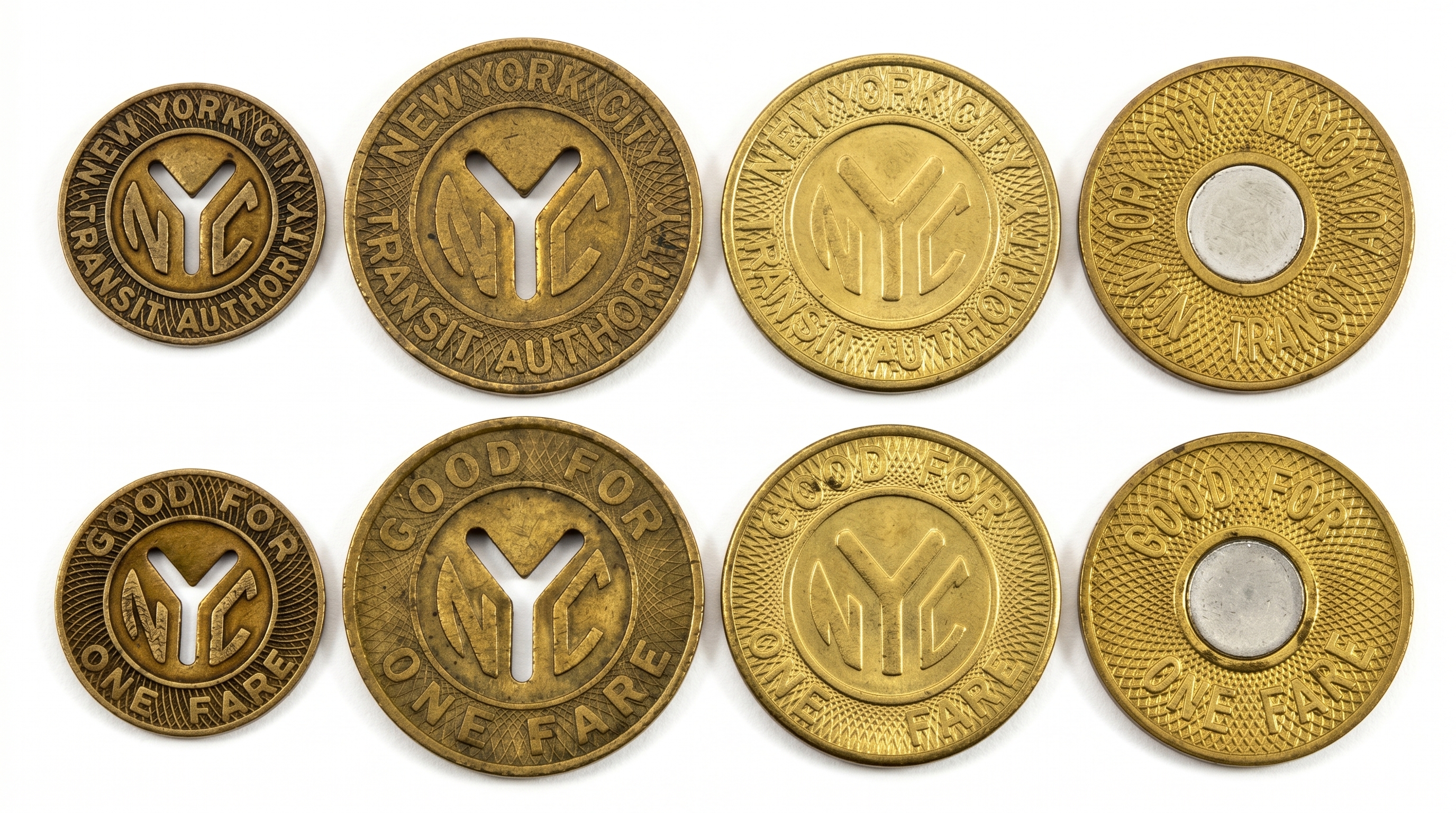
The Bullseye weighed in the neighborhood of two grams. It was slightly smaller than a quarter and slightly thicker, with a faint two-part feel in the hand — the brass ring against the alloy core — that no earlier token had carried. Riders kept them in coat pockets, change purses, the key dish by the door, and — for the heavier users — in token holders, spring-loaded tubes a little longer than a Chapstick, sold at newsstands near major stations. A full tube held a small handful of tokens. You pressed the bottom with your thumb to advance the stack, and the top token emerged ready to drop. Token holders were a private workaround for a public inconvenience: the Transit Authority sold tokens at a flat per-token price; the holders made carrying ten of them less audible. They were manufactured outside the Transit Authority’s awareness and sold by the same newsstands that sold cigarettes and the Daily News.
The token had to be believed in. Its specifications — diameter, weight, magnetic signature — were not secret. They appeared in the Transit Authority’s purchasing documents and in the occasional newspaper piece about fare security. Its safety did not lie in obscurity. It lay in the assumption that the cost of duplicating a piece of stamped metal at scale exceeded the value of the fares the duplicate would steal. For the Small Y, the Large Y, and the Solid Brass NYC, that assumption had been wrong. For the Bullseye, it was right. The city had taken thirty-three years to get a piece of brass that could not be faked.
The Turnstile
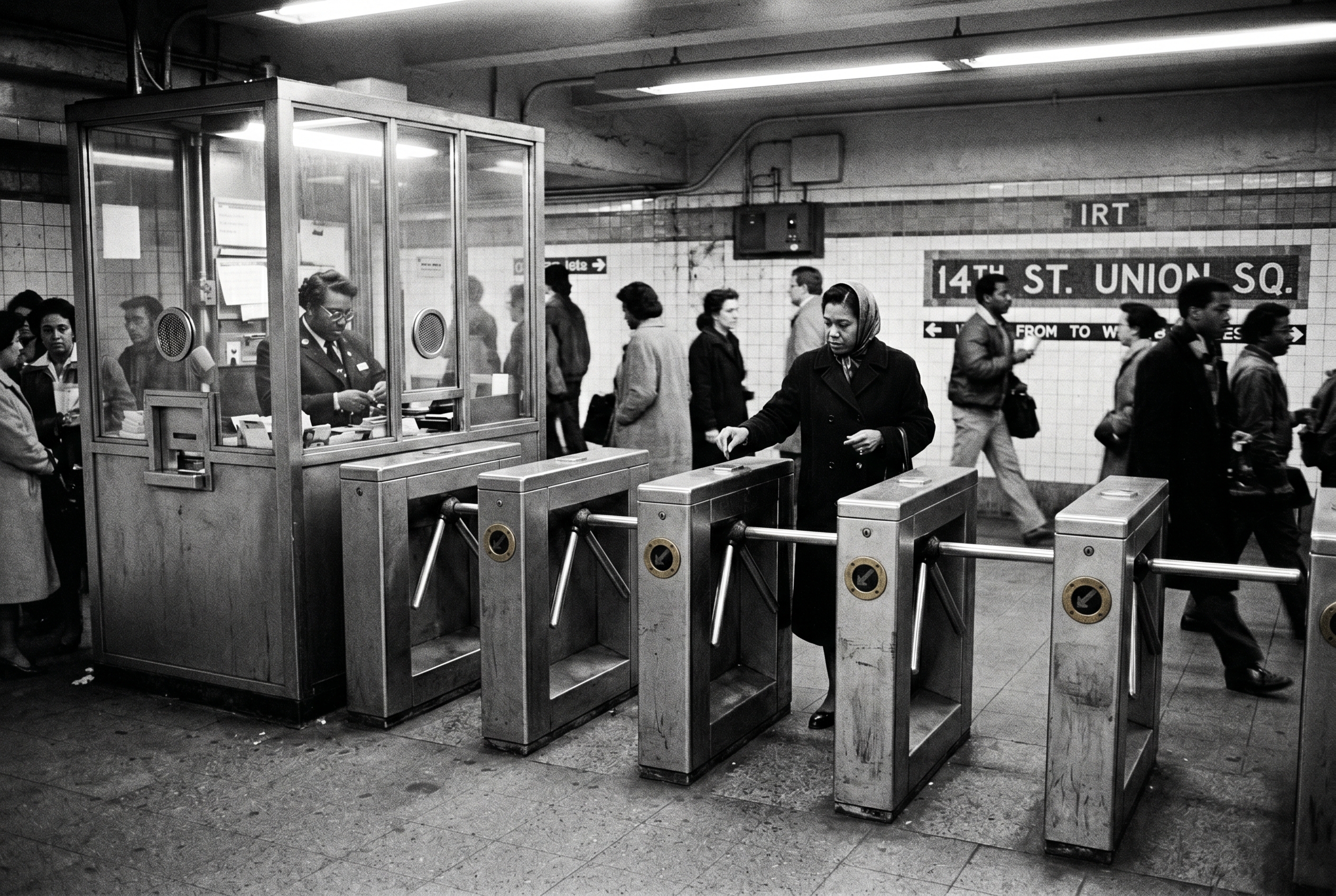
The turnstile was a metal rotor, three arms, mounted at waist height on a steel post, turning on a ratchet that locked against backward motion. The token slot was cut into the post at the rider’s right hand, its brass collar worn smooth by decades of fingertips. A token dropped through the slot, fell into a collection box at the base of the post, and triggered the release of the ratchet. The arm swung; the rider pushed through; the ratchet re-engaged. The sound was two-beat: the clink of the brass falling on the brass below it, and the clack of the rotor’s lock dropping back into place. In a station at 8:30 AM with eight turnstiles working in sequence, the clink-clack was the sound the subway made when it was working. By 1990 any rider had heard it ten thousand times.
To one side of every turnstile bank stood a booth. The booth was a small glass-walled enclosure with a clerk inside it, separated from the platform by a quarter-inch of laminated glass and a slot for money and tokens at counter height. Communication ran through a small speaker grille that amplified and clarified neither sound. The clerk sold tokens, made change, gave directions, and watched the station. The seal was deliberate. Token-booth robberies were a recurring entry in Transit Police monthly reports through the late 1980s, and on more than one occasion in the period a clerk was killed at his post. The glass was meant to make the robbery slower and the killing less likely. It did neither reliably enough.2
The fare a rider paid was not the fare every rider paid. Outer-borough commuters whose subway access required a bus ride first paid the fare twice — once to the bus driver, once at the booth — because the bus transfer slip a driver could issue was valid only for another bus, not for the subway. The two-fare zone, as it was known, applied to commuters from most of Queens, much of Brooklyn outside the older grid, and the eastern Bronx. A daily round-trip from Flushing or East Flatbush cost twice what a daily round-trip from the Upper West Side cost. The disparity was not policy in the sense of a debated and adopted measure; it was the residue of a transit map drawn for an earlier city, and it sat unremarked in the Transit Authority’s budget documents for forty-four years. The free bus-to-subway transfer did not arrive until July 4, 1997, with the MetroCard.1 Until then, the system charged outer-borough working people roughly the equivalent of an extra workweek of fares each month, against earnings from a job whose location they did not choose. The booth clerk dispensed tokens without comment, knowing nothing of any individual commuter’s calculation.
The Workarounds
The token economy generated its own secondary market with an internal logic that was clear to everyone operating inside it and largely invisible to everyone who was not. The basic unit was a discount reseller: a man or a woman working the station approaches, selling individual tokens out of a coat pocket or a paper bag, undercutting the booth’s price by a small margin and earning a living on volume. The discount was small; the wait at the booth at rush hour was meaningful; the trade was real. Transit Police pursued the resellers; the resellers moved.
More elegant was the Connecticut Turnpike trick. The Connecticut Department of Transportation had issued its own highway toll token, priced at seventeen cents, that was close enough to the dimensions and weight of older NYC tokens — the Solid Brass NYC of 1980–1986 in particular — that the older NYCTA turnstile sensors accepted it as a valid fare. When the Bullseye arrived in 1986 with its magnetic core, the trick should have stopped working. It stopped working at the high-traffic stations whose sensors had been upgraded. At the lower-traffic stations it continued to work for years. A box of Connecticut tokens at seventeen cents apiece, bought at a service plaza off the I-95, was a fare arbitrage that paid for the drive several times over. The trick was known among a subset of commuters, the riders’ newsletters that circulated by photocopy through office buildings, and the kind of New Yorker who reads the back pages of the Daily News attentively.
Token sucking was a different operation. The practice exploited a small mechanical flaw: a token pushed only partway into the slot, or one that had jammed without releasing the turnstile, sat lodged in the brass collar, accessible from above. The technique was to lean to the slot, place the mouth against the brass, and apply suction. It required no skill — only the willingness to put one’s mouth against a brass aperture thousands of commuting hands had already touched that day, and the patience to wait until the platform thinned. The Transit Police had a category for it by 1990, used routinely and without irony. The practitioners were not a network. They were individuals working independently, often the same individuals each evening at the same stations. The tokens they extracted, they resold to riders on their way in, sometimes within minutes of recovery, completing the circuit at a small discount to the booth price.
Booth robbery was less frequent but more dangerous. A robber operated against a clerk separated only by glass, often after midnight, often armed. The clerk’s emergency button connected to a Transit Police dispatch system whose response times varied from useful to ornamental. Several clerks were killed at their posts during the period. The remaining clerks worked behind glass that was thicker but never thick enough.
The Transit Authority’s annual operating reports through the early 1990s tracked aggregate fare evasion as a line item — token suckers, resellers, Connecticut tokens, turnstile jumpers, gate-pushers, and the assorted other unauthorized entries — at a figure that was inevitably an estimate, the precision of which the agency did not pretend to have. What was clear was the structural problem. The token was an anonymous, fungible, portable, unmarked, hand-circulated medium of exchange at a fixed face value. It was, in other words, a small-denomination coin issued by a public authority for a narrow use — and like every coin in the history of coins, it could be lost, stolen, found, counterfeited, hoarded, gifted, traded, and arbitraged. The Bullseye had closed the door on counterfeiting. It had left every other door open.
The Decline
The MetroCard arrived in the system in 1993 as a pilot at two lower-Manhattan stations — Whitehall Street and Wall Street — where a few thousand riders a day were given the choice between paying with a token or swiping a magnetic-stripe card encoded with a stored dollar value.3 The Transit Authority’s argument for the card was that a magnetic stripe could carry information a brass disc could not — variable fare rates, time-limited transfers, bulk discounts — and at the same time close every workaround the token economy had developed. A Connecticut Turnpike token was inert against a magnetic-stripe reader. A token sucker presented with a card slot would find nothing to suck. The reseller’s product had no resale value.
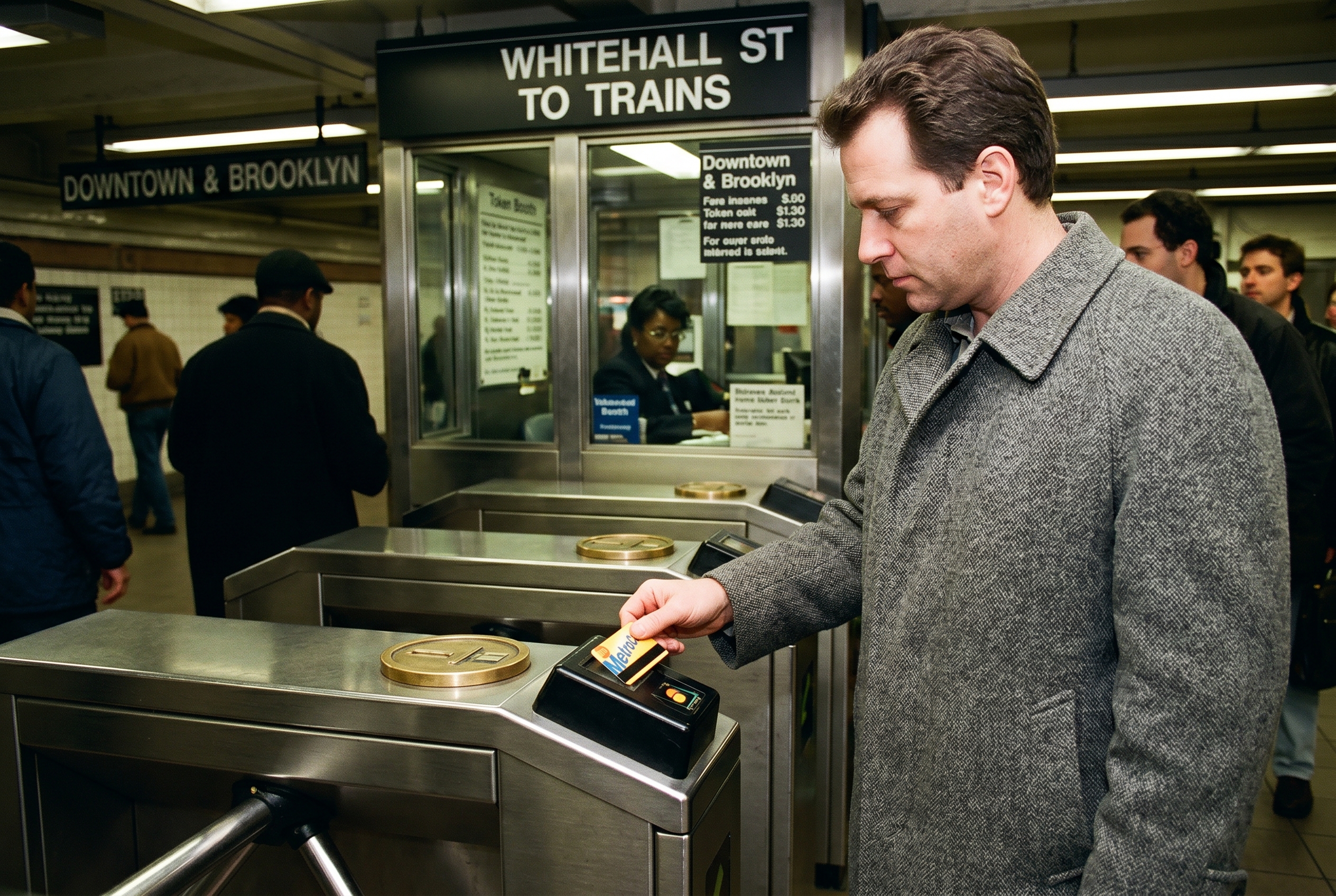
The pilot expanded station by station through 1994 and 1995. The MTA’s free bus-to-subway transfer, the system’s most-promoted innovation and the one that closed the two-fare zone, took effect on July 4, 1997 — the date chosen for the symbolism.1 The token remained valid alongside the MetroCard for several more years; the two systems ran in parallel, booths selling both, turnstiles accepting both, the brass dropping and the card swiping side by side. The double-running was the most expensive operating period in the Transit Authority’s fare history. It was also the period in which booth clerks first spent most of their shift teaching riders to swipe correctly, then most of their shift watching the new vending machines do the clerk’s old work, then most of their shift wondering whether the booth would be staffed at all the following quarter.
In April 2003, the Bullseye token was retired. The Transit Authority held a small ceremony at the Transit Museum and issued a commemorative set for collectors. The token had been in circulation seventeen years. Its predecessor, the Solid Brass NYC, had run six. The Bullseye had outlasted every prior design and had achieved what no prior design had — a perfect counterfeit record over its full service life. It was retired not because it had failed but because the system around it had become more expensive to maintain than to replace. The booths it required, the clerks they required, the cash-handling those clerks required, the security those clerks required, the audit trail the cash needed — all of it cost more than a magnetic-stripe card and a vending machine. The token that could not be faked was withdrawn because the cost of policing it had outgrown the cost of replacing it with something that did not need policing.
The token carried, in two grams of brass, the full weight of the city’s transit economics — fare policy, neighborhood inequality, individual ingenuity, the long-running and quietly losing war between the Transit Authority and its most attentive riders. For forty-four years it administered, without anyone naming it, a tax on living too far from the central stations: the two-fare zone, paid every day by the people who could least afford to pay it twice. It produced its own economy in response — the resellers, the Connecticut tokens, the men at the slot — which the Transit Authority spent four decades pursuing without ever quite catching, because what was being arbitraged was not a flaw in the token but the basic nature of a portable anonymous coin. The Bullseye, when it finally arrived, was a small marvel: a piece of stamped metal that could not be successfully duplicated. It was retired anyway, because what came next was silent and automatic, and what was silent and automatic was cheaper. What the city traded when the physical fare went digital was not efficiency. What it traded was the texture of a transaction a whole platform could hear: the small daily clink-clack of brass and steel, a fare paid in the open, among everyone else paying it too.
A senior editor at Meridian would have commuted on the IRT in the early 1990s and dropped a Bullseye into the slot at 86th Street twice a day, every working day, for a decade. She would have carried the tokens loose in her coat pocket and would never have used a holder. She would have heard the clink-clack and registered it as the sound of getting to work. She would have walked past a reseller at the foot of the stairs at 68th Street–Hunter College most evenings — a man whose face she would have come to recognize and whose name she would never have learned — and once, in a hurry, she would have bought a token from him for a dollar and pushed it into the slot without breaking stride.
The piece Meridian would have run on the MetroCard rollout, in 1994 or 1995, would have been a clean transit-modernization story — the technical promise of the magnetic stripe, the politics of the contract, the implications for the two-fare zone — and would have read well in the City section. The piece it would not have run, debated once at the Monday meeting and not assigned, would have been the one about the man on the stairs at 68th Street: who he was, who he sold to, what the Transit Police did about him on the months they were doing anything about him at all. There would have been no obvious writer for it. No one on the masthead would have lived along the corridor the reseller worked. By the next month’s editorial budget meeting it would have dropped off the list, unmentioned, and no one would have raised it again.
A senior editor on the downtown platform on a Thursday in October would have walked past three men whose work she could not have priced. She would have dropped her Bullseye in the slot and pushed through. The clink. The clack. She would not have thought about it twice.
Also drawn on: Clifton Hood, 722 Miles: The Building of the Subways and How They Transformed New York (Simon & Schuster, 1993; Johns Hopkins University Press paperback, 2004).
Footnotes
-
Andrew J. Sparberg, From a Nickel to a Token: The Journey from Board of Transportation to MTA (Empire State Editions / Fordham University Press, 2014). ↩ ↩2 ↩3 ↩4
-
Brian J. Cudahy, Under the Sidewalks of New York: The Story of the Greatest Subway System in the World (Fordham University Press, second edition, 1995). ↩
-
Sparberg, From a Nickel to a Token, on the 1993 MetroCard pilot at Whitehall Street and Wall Street stations. ↩